
Advertisement


Sections
Monsoon music: From Manipur, mystical songs for the rain
The Meitei people of Manipur have songs for every aspect of the rains. There are songs for when the rain does fall, and songs for when it doesn’t. Songs to appease the rain gods, and songs that embrace all manner of flora and fauna.

Editor’s note: In India, the monsoon nurtures and devastates; it brings life, and sometimes death; it frightens — and bewitches; it is both anticipated and dreaded; longed for and wished away. It is also inextricably linked with the culture of India. The rains have inspired poets, writers, musicians, artists to create some of their most compelling works. The folk music tradition has been particularly inspired by the monsoon — be it in the North, South, East or West, there’s bound to be a folk song (or several) that speaks of the rain and what it represents. In this series, based on conversations with folk musicians and experts, we examine #MonsoonMusic.In part 4 — Manipur. See more from the series here.***Once upon a time, six maidens of the Luwang clan fell in love with six youths. The clan the men belonged to, however, was one considered unsuitable by the maidens’ families. Not wishing to part, the maidens and the youths decided to fly up together into the sky, and live there.On their way, however, one of the maidens gave birth to a child – a cicada. She told her son that he could not accompany her into the sky, as he wasn't permitted there. Instead, once every year, in the month of Inga, she would watch him from the skies, and it would be his – the cicada’s – responsibility to announce to the people on earth that the monsoon had arrived.So goes the fable behind one of Manipur’s most popular folk songs dedicated to the rain, ‘Kumdam Eshei’. “O Cicada! Tell us the monsoon has arrived,” the song’s lyrics proclaim.Guru M Mangangsana Meitei, the Imphal-based musician and founder of Laihui (a centre for research on traditional and indigenous arts), says in the Meitei tradition, there are songs for every aspect of the rains. There are songs for when the rain does fall, and songs for when it doesn’t – and the rain gods must be appeased. The songs envelop all manner of flora and fauna too – from the cicada of ‘Kumdam Eshei,’ to a bird known as ‘nongoubi’ (rain-caller). Nongoubi was cursed by God such that she could never again drink water from the surface of the earth. Ever since, she waits for the monsoons to quench her thirst, by drinking the rainwater that falls from the skies.Here, Guru M Mangangsana Meitei renders ‘Kumdam Eshei’ accompanied by a pena:The monsoon season in Manipur begins towards the end of March, and lasts until September-October. When the monsoons arrive, the farmers start work in the fields. “We have many folk songs that talk about the harvest, rice cultivation, and of the farmers in their fields,” say the members of SAM PAA, a Manipur-based experimental band that promotes folk and traditional music.Manipur is inhabited by over 30 indigenous tribes with their own tradition and culture. The summer monsoon months – April to July, or Kalen to Ingen as per the Manipuri calendar – are considered important by most tribes, with significant rituals being carried out during this period. “Nature is worshipped in the Manipuri tradition, and even though the music and dance traditions were lost under the strong Christian influence, they are being revived by the Manipuri people,” says Guru M Mangangsana Meitei.The Lai Haraoba and annual rice plantation are the important cultural events the monsoon in Manipur is marked by. Guru Mangangsana explains that the Lai Haraoba – which means ‘merrymaking of the Gods’ – is an annual festival celebrated in all the villages of Manipur’s valley. Observed for anywhere from three days to months, it involves a ritual whereby the creation of earth, life and human civilisation is re-enacted. Meitei people (mainly plain-dwellers) observe Lai Haraoba to please the Sanamahi deities (Sanamahism being the pre-Hindu religion of the Meitei people). The festival is in essence, a recollection of the creation stories – especially the origin of the universe and the evolution of plants and animals through the will of Atiya Shidaba (the supreme god of the Meitei).[imgcenter]![]() [/imgcenter]Rituals related with rain and water are an integral part of the festivities, Guru Mangangsana says. The first among them is Ikouba (calling up the spirits of the deities from the water), Leitai Nongdai Jagoi (making of earth on water), Higarol (rowing the boat with the deities’ spirits up to the shrine), Hoirou Haya (union of the sky and earth), Long Khonba (catching of fishes or reptiles), Hijan Hirao (making of the boat), Pamyanlon and Loutarol (plantation of rice and vegetables) etc.All these episodes are performed in the form of dance and music, led by Manipuri shaman priestesses, priests, pena (a mono-stringed instrument of the lute category) musicians and singers, along with the villagers.The annual rice plantation too is marked by songs known as ‘Khullang Eshei’ (songs sung by paddy field workers). SAM PAA point to another popular folk song that is associated with the monsoon – ‘Nonglao Eshei’. “From time immemorial, this song has been sung by the Meiteis to call the first rain of the season. Since it is a folk song, no one knows who wrote it. It has been handed down from one generation to another and is preserved by oral tradition. There is no written script for the verses,” they explain.“‘Nong’ means rain, ‘lao’ means calling for it to arrive while ‘eshei’ means song. The rain in Manipur usually arrives on time, but when it doesn’t, it is believed that singing ‘Nonglao Esei’ will bring it for sure. The names of Gods, mountains such as Koubru and Kounu, are mentioned in the song. It also describes the aftermath of a heavy rainfall.”Here is a rendition of ‘Nonglao Eshei’ by SAM PAA. The lyrics say:“Pour, pour o rain! Let all the old things be afloat, rise up to the top of the hill, let all the dried plants regrow.”
[/imgcenter]Rituals related with rain and water are an integral part of the festivities, Guru Mangangsana says. The first among them is Ikouba (calling up the spirits of the deities from the water), Leitai Nongdai Jagoi (making of earth on water), Higarol (rowing the boat with the deities’ spirits up to the shrine), Hoirou Haya (union of the sky and earth), Long Khonba (catching of fishes or reptiles), Hijan Hirao (making of the boat), Pamyanlon and Loutarol (plantation of rice and vegetables) etc.All these episodes are performed in the form of dance and music, led by Manipuri shaman priestesses, priests, pena (a mono-stringed instrument of the lute category) musicians and singers, along with the villagers.The annual rice plantation too is marked by songs known as ‘Khullang Eshei’ (songs sung by paddy field workers). SAM PAA point to another popular folk song that is associated with the monsoon – ‘Nonglao Eshei’. “From time immemorial, this song has been sung by the Meiteis to call the first rain of the season. Since it is a folk song, no one knows who wrote it. It has been handed down from one generation to another and is preserved by oral tradition. There is no written script for the verses,” they explain.“‘Nong’ means rain, ‘lao’ means calling for it to arrive while ‘eshei’ means song. The rain in Manipur usually arrives on time, but when it doesn’t, it is believed that singing ‘Nonglao Esei’ will bring it for sure. The names of Gods, mountains such as Koubru and Kounu, are mentioned in the song. It also describes the aftermath of a heavy rainfall.”Here is a rendition of ‘Nonglao Eshei’ by SAM PAA. The lyrics say:“Pour, pour o rain! Let all the old things be afloat, rise up to the top of the hill, let all the dried plants regrow.”
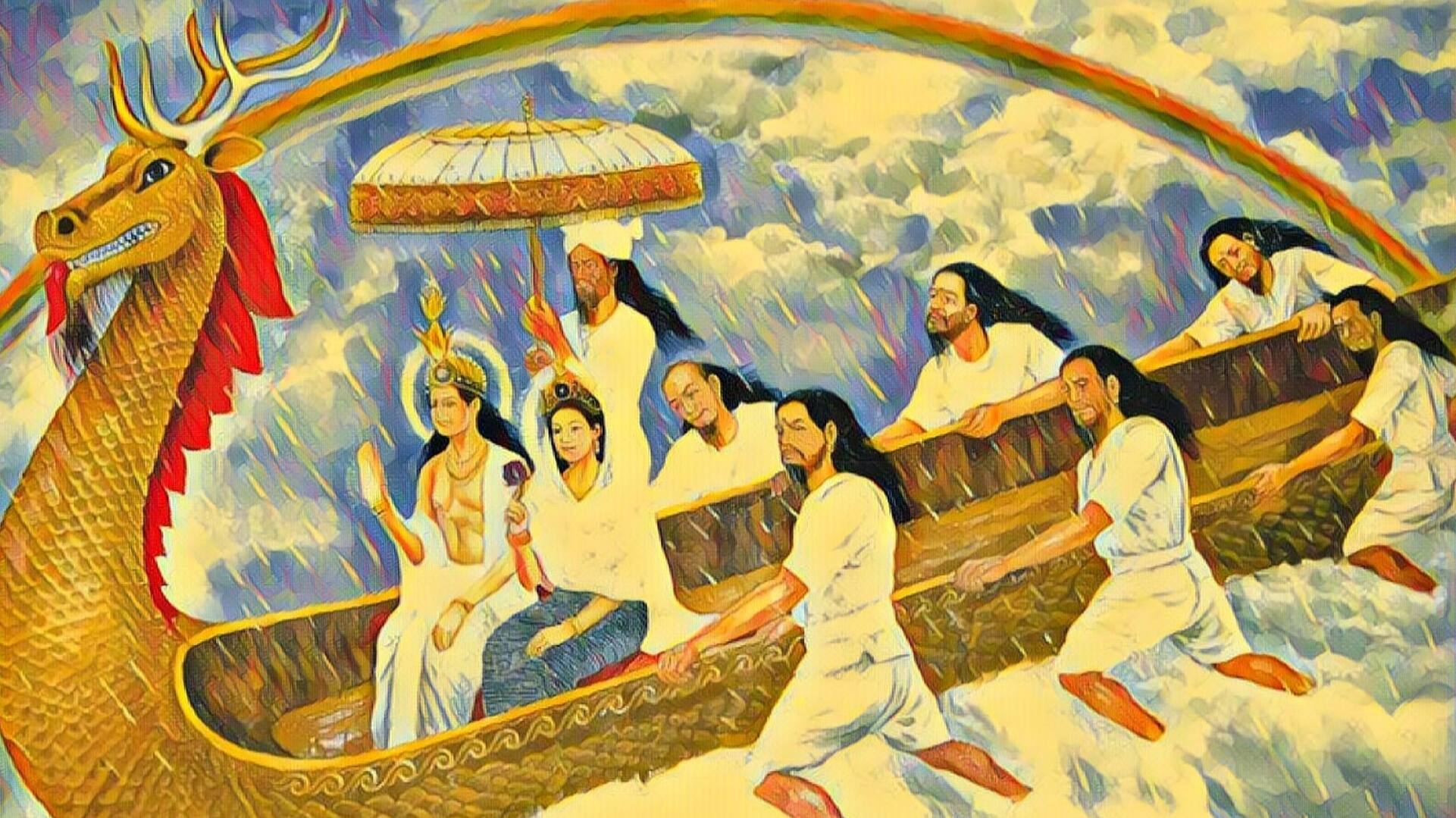 [/imgcenter]Rituals related with rain and water are an integral part of the festivities, Guru Mangangsana says. The first among them is Ikouba (calling up the spirits of the deities from the water), Leitai Nongdai Jagoi (making of earth on water), Higarol (rowing the boat with the deities’ spirits up to the shrine), Hoirou Haya (union of the sky and earth), Long Khonba (catching of fishes or reptiles), Hijan Hirao (making of the boat), Pamyanlon and Loutarol (plantation of rice and vegetables) etc.All these episodes are performed in the form of dance and music, led by Manipuri shaman priestesses, priests, pena (a mono-stringed instrument of the lute category) musicians and singers, along with the villagers.The annual rice plantation too is marked by songs known as ‘Khullang Eshei’ (songs sung by paddy field workers). SAM PAA point to another popular folk song that is associated with the monsoon – ‘Nonglao Eshei’. “From time immemorial, this song has been sung by the Meiteis to call the first rain of the season. Since it is a folk song, no one knows who wrote it. It has been handed down from one generation to another and is preserved by oral tradition. There is no written script for the verses,” they explain.“‘Nong’ means rain, ‘lao’ means calling for it to arrive while ‘eshei’ means song. The rain in Manipur usually arrives on time, but when it doesn’t, it is believed that singing ‘Nonglao Esei’ will bring it for sure. The names of Gods, mountains such as Koubru and Kounu, are mentioned in the song. It also describes the aftermath of a heavy rainfall.”Here is a rendition of ‘Nonglao Eshei’ by SAM PAA. The lyrics say:“Pour, pour o rain! Let all the old things be afloat, rise up to the top of the hill, let all the dried plants regrow.”
— Image courtesy Facebook/@Sanamahism laining
First Published:Sep 01, 2018, 16:40:05 IST
Advertisement
Advertisement

Off-centre | Vande Mataram: The mother that we adore
A meditation on the meaning of India as the country celebrates 77th independence Day
Of nature, culture and alcohol: A glimpse into Sikkim’s age-old brewing traditions
Most rural households across Sikkim have their own breweries, which are an integral part of the local culture.
Revisiting the Bollywood dream sequence: A tour of the world, and within
The Bollywood dream sequence helped stretch my imagination in a way that I believed the whole world was within me. This self-sufficiency helped me get through the physical setting I was in, from awkward social gatherings to the confines of my home during the pandemic.
Trams, part of Kolkata heritage, are little more than a nostalgia ride today
In recent years, hit by natural disasters and official neglect, the city’s tram system has become little more than a nostalgia ride, its passengers more often looking for a lark than an efficient trip home.
Online exhibition archives oral histories of the Kolis, degradation of Mumbai's coastal ecology
The online exhibition Through the Eyes of the Kolis uses their photos to highlights how Mumbai's ecology has been disturbed and how the fishermen community are adapting.
Advertisement
Advertisement