
Advertisement


Sections
A few poems should be unwritten
His body of work is defined by defiance and empathy. Ambedkar, Buddha, his family, martyrs, and leaders make appearances in his poetry carrying the weight of history and the strength of his words.

 I started writing poetry as a response to what I was reading. When I moved from my hometown, Nagpur, to Mumbai, I found myself in the midst of literature and poetry in English. That also led me to find out that the experiences of the people around me, as well as what I was reading, were different compared to my own life experiences.I found a connection, finally, when I read regional Dalit literature and translated works. This is what I am now trying to bring to the English language with my poetry. My ‘local’ experiences as they happen, spontaneously. My collection published earlier in the year titled, The Bridge of Migration from Panther’s Paw, has been five years in the making. My work covers a variety of subjects dealing with provincial life, you could call it Dalit epistemology.I grew up in Nagpur in what was an untouchable ghetto that later became a Buddhist colony. Having studied at Dr Ambedkar College in Nagpur, I moved to Mumbai to pursue my Masters' degree. When I moved away from home, the contradictions I was seeing around me led me to write. We are all social beings after all. You can affect the society much the same way it affects you. In my work, I write about my life, my family, the society, the oppression, drama and the victories.[imgcenter]
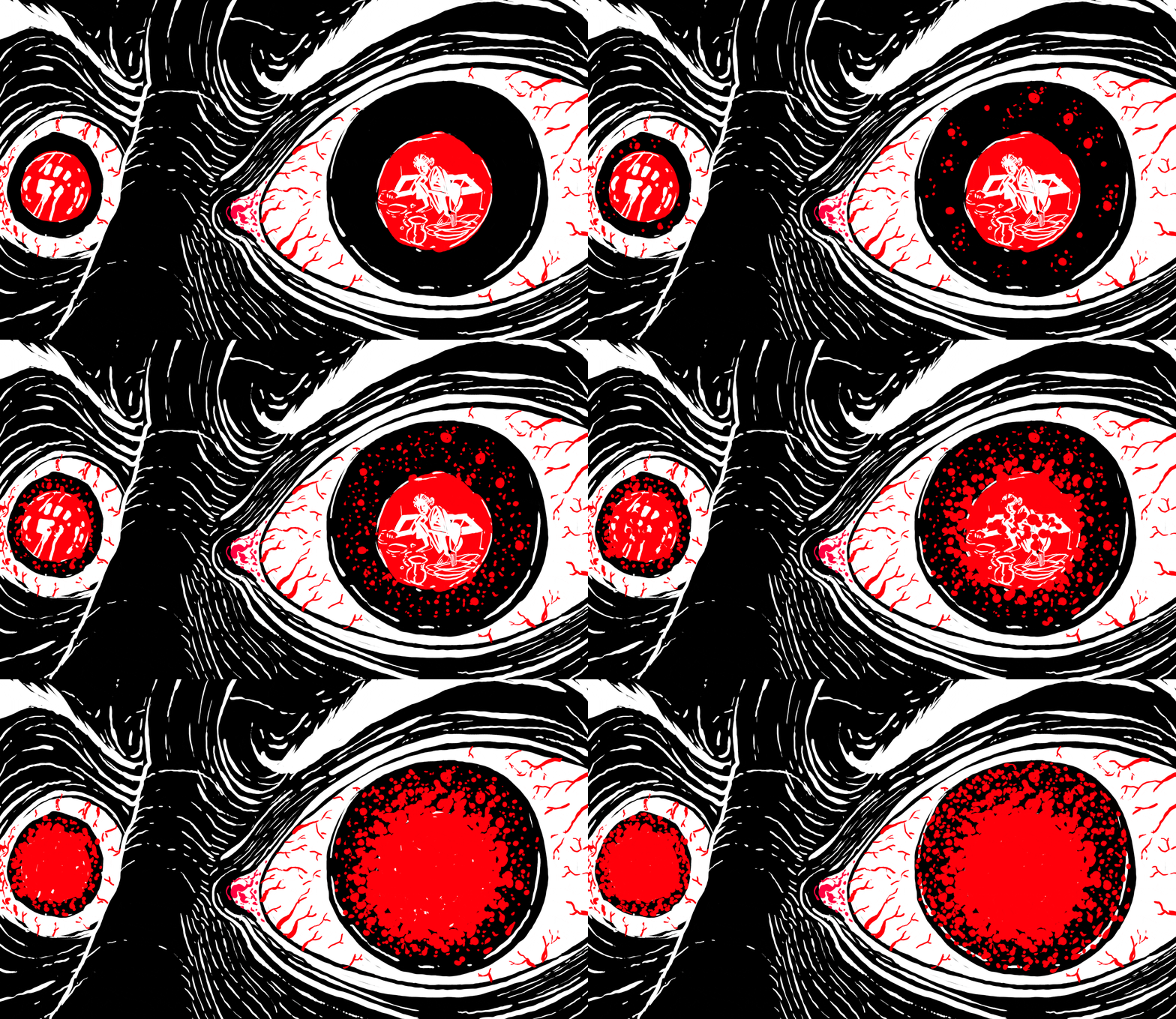 [/imgcenter]Unwritten poemMy father's bloodshot eyeshands drenched in sweatwhile working,my mother who works as housemaidwashes utensils at other homesin both of their eyesthere is an anxiety to gather enough moneyfor the education and marriage of my sisters,and my dishonest dreamsthat don't understand all this.And my one honest attemptto pierce all these togetherthrough the needle of woundsand make a poem out of it.Shewho since her childhoodhas grown up in Reshimbaugasks me, “your poems are pessimistic.You should write beautiful love poems.”How should I tell her,in our basti the meaning of lovehas been recently transformedby the slogan of ‘Jai Bhim’?How should I tell her,our father and wewho drank the poison of this countryplanted a beautiful flower called the Buddhain 1956?How should I tell her,few poems should be readwithout being written?
Read the other segments of the series here.
First Published:Jun 11, 2017, 12:37:30 IST
Advertisement
Advertisement

Off-centre | Vande Mataram: The mother that we adore
A meditation on the meaning of India as the country celebrates 77th independence Day
Of nature, culture and alcohol: A glimpse into Sikkim’s age-old brewing traditions
Most rural households across Sikkim have their own breweries, which are an integral part of the local culture.
Revisiting the Bollywood dream sequence: A tour of the world, and within
The Bollywood dream sequence helped stretch my imagination in a way that I believed the whole world was within me. This self-sufficiency helped me get through the physical setting I was in, from awkward social gatherings to the confines of my home during the pandemic.
Trams, part of Kolkata heritage, are little more than a nostalgia ride today
In recent years, hit by natural disasters and official neglect, the city’s tram system has become little more than a nostalgia ride, its passengers more often looking for a lark than an efficient trip home.
Online exhibition archives oral histories of the Kolis, degradation of Mumbai's coastal ecology
The online exhibition Through the Eyes of the Kolis uses their photos to highlights how Mumbai's ecology has been disturbed and how the fishermen community are adapting.
Advertisement
Advertisement