
Advertisement


Sections
World Theatre Day 2019: Three Indian playwrights tell us about the scripts they never staged
On World Theatre Day 2019, a throwback to Firstpost's series of interviews with Indian playwrights such as Rahul DaCunha, Purva Naresh, Ramu Ramanathan, about the play/s they never managed to bring to stage.

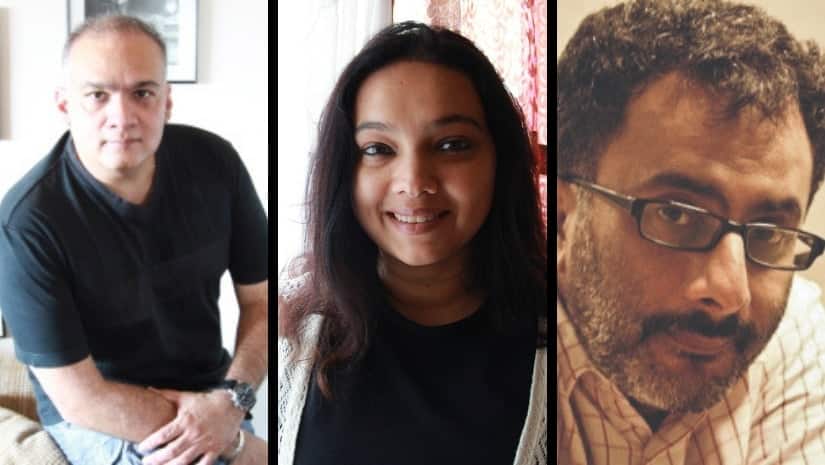 L-R: Rahul DaCunha, Purva Naresh, Ramu Ramanathan. File Photos[/caption]On World Theatre Day 2019, here's a look at some of them:Rahul DaCunha on I Do and Page 3 — two unfinished scripts he hasn't yet given up onBack in 2003-04, Rahul started writing a play titled Page 3. He says, “Reeling from political ineptitude, Mumbai needed a CEO, who would not be aligned to any party, and who would be held accountable like any CEO in a company would. Stemming from this belief, I started writing a play about the marriage of two people inhabiting different worlds: a socialist and a socialite. A friend starts to disrupt the life of the socialist. It was a humour-laced social commentary on the convenience of friendships, relationships and politics.”One year into writing Page 3, Rahul found himself at the beginning of his divorce proceedings. Where Page 3 came out of his frustrations of being a citizen in a corrupt city, Rahul found that writing about his emotional situation was cathartic. I Do stemmed from his personal anger at himself, at the system, at where his life was; the writing of which began while he was sitting in the divorce court.
Meant to be a one-and-a-half-hour play with no intervals, I Do was about two people sitting in divorce court along with their lawyers as they wait for the judge to arrive. The conversation between the two oscillates from making pointed observations about relationships to acerbic humour about the state of affairs.While Page 3 took the backseat in the process of Rahul’s divorce, I Do too reached a stage where the playwright couldn’t go further. In drama school, playwrights are often asked what their anger is. The anger, in this case, is the rage or the passion that drives a writer to wake up and write about the issues that matter to him. While Rahul was writing I Do, he got divorced, became friends again with his ex-wife and somehow the anger fizzled out. “When the anger fizzled out, so did the play. I realised at one point that the play needed another angle. At that stage in my life, I couldn’t find it.”Read the full interview with Rahul DaCunha here.***Purva Naresh on her unfinished Irom Sharmila play: We've already failed her; I can't do it againFor five years, Purva had been gravitating towards writing about Manipuri civil rights and political activist Irom Sharmila. “I was so interested by her life and what she stood for. There was abundant information about her activities in the newspapers. I read up a lot beyond that, had even planned to go and meet her as part of my research. Yet I felt I couldn’t crack the idea of the play. If it’s based on someone, I don’t want it to sound like another adulatory work, or a biography. I wasn’t looking to document Irom Sharmila. I was looking to write about what makes her who she is…her Irom Sharmila-‘ness’,” Purva said.
Her perspective was well in place but Purva has been keen to not make the play about just Irom Sharmila’s struggles or make it a plot-oriented piece of work that strings together incident after incident that shaped the activist’s life. How to proceed with the idea of her is fundamental to the writing of the play. Setting the play in the context of contemporary India and giving it a global perspective, Purva is still looking to answer why she would write about Irom Sharmila today.“One of the reasons I’m stuck with this script is because we as a people have already failed Irom Sharmila once. I can’t do that again. I need to have the script right.”Read the full interview with Purva Naresh here.***Ramu Ramanathan, raconteur extraordinaire, on the stories he'd love to bring to the stageA story that Ramu Ramanathan wants to write finds its roots in the Mathura rape case of 1972. The story of the custodial rape of a young Adivasi girl by two policemen saw much public anguish. The High Court set aside a sessions court judgment that stated her being habituated to intercourse, therefore making her consent implicit. The High Court held that passively submitting out of fear cannot be construed as consent. While this judgment was historic, the Supreme Court of India’s ghastly reversal of the High Court judgment on grounds of no visible signs of struggle, saw the acquittal of the accused. This led to public outcry and gave birth to many women’s rights groups whose activists went on to become leading voices in matters of gender equality over the years.“Every single time I sat down to write about this, something else was playing on outside that would make me stop. Whether it was the cases of the '90s, the bar dancers in the subsequent decade, or even Nirbhaya, there was something even more horrific happening simultaneously. The idea to write this play was to contextualise the independent women’s autonomous movement. Over time the sexual violence of that play got diminished because of what’s been happening. One wouldn’t want to be seeing as tapping on the hysteria that surrounds such major movements,” he says.
Ramanathan has worked out all the characters and situations, with the tone of the play needing some more time and thought. Over three decades, Ramanathan has accumulated copious notes, while meeting extraordinary women who have participated in various movements that sought better rights and justice for women. “It is undoubtedly a play about what happened to Mathura and the aftermath, but it is the kind of atrocity and travesty of justice that has manifested again and again through various instances, each time questioning the middle-class morality of a woman’s identity. I’ve imagined this play to open with a rock song, because what better than rock to be a voice of protest!”Read the complete interview with Ramu Ramanathan here.***Read more theatre stories on Firstpost here and here.
First Published:Mar 27, 2019, 10:31:52 IST
Advertisement
Advertisement

Here's why you crave sweets after every meal: This one thing can fix it
It's common to crave something sweet after meals. However, what's often dismissed as "having a sweet tooth," is mostly nutritional deficiency
1 min read
India's most beloved national parks for wildlife lovers
India holds some of the world’s most wonderful wilderness spaces. Forests and jungles where myth, beauty and survival exist side by side. From mangroves that swallow rivers to grasslands shaped by centuries of migration, the country’s national parks offer more than sightings. They offer moments of stillness, surprise, and reverence.
1 min read
Even the Beckhams break: The rise of family estrangement
People are choosing to cut off contact with their families, prioritising mental health.
4 min read
European Council Chief has an OCI card: What is it?
The OCI Scheme, introduced in 2005, grants foreign nationals of Indian origin a life-long visa for India, but no political rights.
1 min read
The 90s show Friends, and why we misread modern friendships
We’ve all heard about the loneliness epidemic at this point. It isn’t even particularly shocking — it seems like the result on the obvious — people consistently glued to their phones, seeking intimacy and even sex through phone screens, consistent comparison to other peoples’ partners, and what their relationships look like, to how far everyone has come in their jobs — there is much to feel diminished about.
5 min read
Advertisement
Advertisement