
Advertisement


Sections
Who's afraid of the courier guy? Should you be?
The courier has become our window to the world. He's how we get bills, gadgets we buy online, wedding invites. But he's also our easiest security breach. The spy eye on the door has become our blind eye.

Enter an unlikely harbinger of doom – the courier guy.He is a familiar sight. He rings the door bell. You peep through the spy-eye and see a youngish man, sorting through a sheaf of papers, a parcel in one hand, a sidebag on his shoulder. You open the door to sign for your package.And then BAM!Kalpana Pan, a housewife in Kolkata had a handkerchief soaked in chloroform pressed to her face. When her husband came back home he found her on the floor, the almirahs ransacked and Rs 4.5 lakh worth of gold jewellery missing.The consequences were even deadlier for Chaitali Santra. The freelance journalist and women’s rights activist had been getting some threatening calls for a few days. She told her daughter to be careful but it didn’t occur to her to beware of the courier guy. She opened a parcel the “courier” delivered on her bed. It had a bomb. She was killed instantly.The courier has become a double-edged sword. We are dependent on them and thus at their mercy. They have become the strangers whose kindness we implicitly trust.[caption id="attachment_484631" align="alignleft" width="380"] Representational image. AFP.[/caption]Kalpana Pan did all the right things. She looked through the spy-eye. She called her husband to ask if he was expecting a letter. But at a time when everything, from telephone bills, to sari exhibition opening announcements, to your latest online gadget purchase comes via courier, you don’t have very much choice when it comes to opening the door for the courier.Our grilled balconies and collapsible gates might thwart the cat-burglar but as a society “Courier here” has become our open sesame. As The Telegraph writes in an editorial this week.
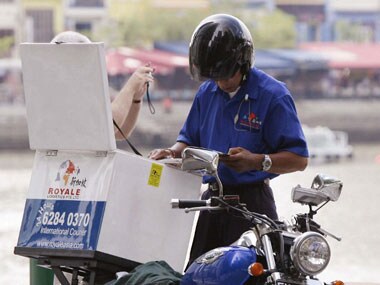 Representational image. AFP.[/caption]Kalpana Pan did all the right things. She looked through the spy-eye. She called her husband to ask if he was expecting a letter. But at a time when everything, from telephone bills, to sari exhibition opening announcements, to your latest online gadget purchase comes via courier, you don’t have very much choice when it comes to opening the door for the courier.Our grilled balconies and collapsible gates might thwart the cat-burglar but as a society “Courier here” has become our open sesame. As The Telegraph writes in an editorial this week.
No amount of caution on the part of the police or citizens can prevent such cunningly aggressive forms of access to what used to be regarded as inviolable domestic spaces. And this is happening while online shopping, and therefore the importance and ubiquity of courier companies, is catching on as an inevitable part of modern life and its new conveniences.Part of the problem is while the neighgbourhood had one familiar postman on a regular beat, we now have a slew of unfamiliar couriers. You don’t remember their faces because they are the courier guys – a vast army of 20 something men on bicycles roaming through our cities in the dead of afternoon. The old police advice of not opening the door to strangers is meaningless in a world where six different couriers can ring your doorbell in one afternoon.The courier business is huge. A survey by ICRIER found over 2500 companies, many of them small family businesses. That gives the customer a great buffet of choices. If you don’t like one company, you can always find another. But it also means they are harder to regulate according to the ICRIER survey.
Moreover, since the courier industry/sector constitute of a large number of small, family-based unorganised companies spread across India, it is difficult to monitor them unlike companies in sectors like telecommunications where there are only a few large corporates.As Kalpana Pan and Chaitali Santra found out almost anyone can pass themselves off as a courier guy.Of course, we would not need as many courier guys as we do now if the postal service was more reliable. The government’s proposed solutions have all been about protecting the lacklustre postal service instead of improving it. A. Raja in his ministerial days wanted to amend the 1898 Indian Post Office Act to ban private courier companies from carrying anything below 500 grams. That would be the exclusive dominion of the post office. Mind you, the post office is not promising this letter will reach its intended recipient any time soon. A friend sent an invitation to her mother’s funeral by ordinary Indian mail. It reached me a full week after the last rites were over.Anyway most of us will shudder at the prospect of going to the post office anymore and standing in a snaking queue to pick up a parcel. The memories of the postmaster sitting behind a mounds of yellow files, the didi doling out stamps at a reluctant snail’s pace, the little pot of gooey green paste on a rickety table are all part of a country we hope have long left behind.The courier is the symbol of a newer more efficient 21st century go-getter country. He epitomizes what we want from life – things delivered at our doorstep, efficiently, quickly and securely. It turns out that he is also our most obvious security breach. We spend inordinate amounts of time and money insulating ourselves from the big bad world outside with its terrible traffic, its choking pollution, its purse-snatching thugs. Ironically, the more we insulate ourselves at home, the more we depend on the courier guys to bring the world to us.So ask not for whom that doorbell tolls.It is, indeed, tolling for thee. Can you afford not to open that door?
First Published:Oct 09, 2012, 15:17:51 IST
Advertisement
Advertisement

Here's why you crave sweets after every meal: This one thing can fix it
It's common to crave something sweet after meals. However, what's often dismissed as "having a sweet tooth," is mostly nutritional deficiency
1 min read
India's most beloved national parks for wildlife lovers
India holds some of the world’s most wonderful wilderness spaces. Forests and jungles where myth, beauty and survival exist side by side. From mangroves that swallow rivers to grasslands shaped by centuries of migration, the country’s national parks offer more than sightings. They offer moments of stillness, surprise, and reverence.
1 min read
Even the Beckhams break: The rise of family estrangement
People are choosing to cut off contact with their families, prioritising mental health.
4 min read
European Council Chief has an OCI card: What is it?
The OCI Scheme, introduced in 2005, grants foreign nationals of Indian origin a life-long visa for India, but no political rights.
1 min read
The 90s show Friends, and why we misread modern friendships
We’ve all heard about the loneliness epidemic at this point. It isn’t even particularly shocking — it seems like the result on the obvious — people consistently glued to their phones, seeking intimacy and even sex through phone screens, consistent comparison to other peoples’ partners, and what their relationships look like, to how far everyone has come in their jobs — there is much to feel diminished about.
5 min read
Advertisement
Advertisement