


New sample by Curiosity shows that water on Mars much more acidic
A new Martian sample taken by NASA's Curiosity rover hints at water that was more acidic than evidenced in its first drill at Mount Sharp - a layered rock record of ancient Martian environment.

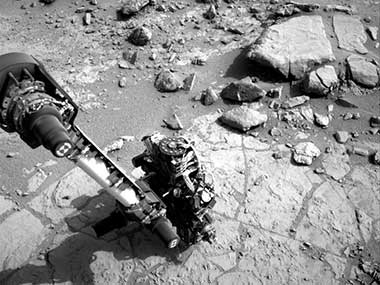
Curiosity Mars Rover. AFP[/caption]Both target sites lie in a outcrop called "Pahrump Hills," an exposure of the Murray formation that is the basal geological unit of Mount Sharp.The Curiosity mission team has already proposed a hypothesis that this mountain, the size of Mount Rainier in Washington, began as sediments deposited in a series of lakes filling and drying.The team chose a target called "Mojave" largely due to an abundance of slender features, slightly smaller than rice grains, visible on the rock surface.Researchers sought to determine whether these are salt-mineral crystals, such as those that could result from evaporation of a drying lake, or if they have some other composition.Mojave 2, an alternative drilling target selected at the Mojave site, has the same type of crystal-shaped features."This was our first use of low-percussion drilling on Mars, designed to reduce the energy we impart to the rock," said John Michael Morookian, the team's surface science and sampling activity lead for the Pahrump Hills campaign.IANS

Here's why you crave sweets after every meal: This one thing can fix it
India's most beloved national parks for wildlife lovers
Even the Beckhams break: The rise of family estrangement
European Council Chief has an OCI card: What is it?
The 90s show Friends, and why we misread modern friendships