


His bed is the footpath near Gate Number 3, Jamia Masjid
New Delhi is still in the grip of winter. But some residents of the capital are especially hard-hit. One and a half lakh people in the capital are homeless. What happens to them on a winter's night?

By Fahad ShahUnlike many people in Delhi who sleep in their concrete houses, Sonu Kumar sleeps on a footpath near gate number 3 of Jamia Masjid, in Old Delhi. Sonu Kumar is from Barabanki, Uttar Pradesh where his four brothers live with their families. Kumar says he takes liquor and sedatives to keep himself warm during chilly nights.He came to Delhi seven years ago and visited his home only when his mother passed away. A rickshaw puller, Kumar has nothing, neither a utensil nor another pair of shoes. He earns around 300 rupees a day and he has to pay rent for pretty much everything he uses to live. For his rickshaw, which he plies from noon to five everyday, he pays 55 rupees a day."I eat at a street vendor. I can't marry ever, for I don't have money to save," he says, sitting on his rickshaw outside Meena Bazar. "Last winter I used to sleep near Meena Bazar where a man rents out a cot, quilt, and a mattress for 30 rupees a night. But this year I bought my own quilt, a used one, for 300 rupees."The government has erected Rehan Basera or shelters for homeless people at many places but they accommodate a small number of people. "They are just a few," Kumar says. He says the government is only there in name. For the poor there is no government.[caption id="attachment_194681" align="alignleft" width="380" caption="A night shelter in New Delhi. Fahad Shah"]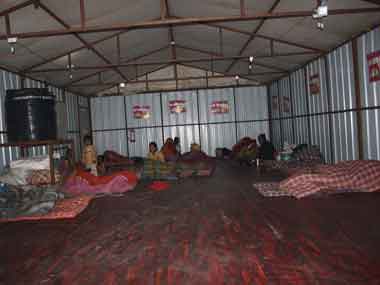 [/caption]During the construction of stadiums and parking compounds in the city for the Commonwealth Games many homeless people struggled to find a place to sleep because they were not allowed to sleep on the pavement. Now while walking through the lanes and bylanes of the city, a number of people can be found sleeping near shopfronts. They burn some empty cartons and wood to get warm and wander around in search of a place to sleep.Mukhtar Ahmed provides sleeping facilities to homeless people in Meena Bazar. He says when Rehan Basera is occupied people come to him. Ahmed is from Bihar and lives in Wazirabad in the capital. He runs a tea stall on a cart near Cotton Market and has 35 cot-mattress-quilt sets which are put in a parking area for homeless people to sleep."I give them all this for a rent of 30 rupees per night. There are many like me who provide stuff to homeless. Every night there is a good number of people who come to sleep. Some sleep at other similar places. Many homeless sleep by covering themselves with a blanket, polythene sheet, jute bags or even dry grass, at any vacant place which they can find," Ahmed says while negotiating on rent with a teenaged boy.In December 2011, a survey report conducted by United Nations Development Programme (UNDP) in association with Mother, an NGO, estimated that a total of 55,955 people were living without any shade or shelter in the capital. It was accepted by Unique Identification Authority of India which agreed to give Aadhar numbers to the homeless.Recently the Indian Express newspaper quoted Amod Tyagi of St Stephen’s Hospital as saying that there is a need for at least 1,000 shelters in Delhi. However the newspaper said Delhi has only 64 permanent shelters and 51 temporary ones which accommodate around 12,000 people, while Delhi's homeless population is more than one and half lakh. Some of the shelters in old Delhi are in Jamna Bazar, Hanuman Mandir, Urdu Park, Dilli Gate and Ajmeri gate.Nanak Chand Mittal, a caretaker of one such shelter at Kabootar Market in Meena Bazar says the shelter was opened for the public on 26 December 2011 by an NGO, Sur Nirman in collaboration with the state government. "There are two shelters divided between 'males only' and 'families'. The average number remains 60-80 persons a night. When there is bad weather more people come to sleep. It is a free service but every person has to register their details with us. Usually, all these people sleep on pavements."In the family shelter on the night this reporter visited there were 30 people, in the men-only shelter there were 80. For the two shelters there are 200 blankets, 80 mattresses which are provided by the government. There is a drinking water tank and toilets outside the shelters. A solar lighting system is used to provide light.On 16 January 2012, the Supreme Court asked the Joint Apex Advisory Committee, including members of NGOs and government officials, to look into the issues relating to homeless people. It asked it to carry out its order in "letter and spirit" to "preserve and protect" the lives of homeless people by providing them roofs with all necessary facilities, especially in north India. The bench of Justices Dalveer Bhandari and Dipak Misra asked governments of the northern states to implement its order "without loss of time".Despite erecting some temporary shelters in the city there are many people who sleep under open sky. While Delhi is spending huge money on modernising the city, the homeless are abandoned to die during the chilly winter.In the past eleven years, except for 2010, the month of January has recorded the lowest minimum temperature dipping below five degrees Celsius. The lowest in the past decade was on 8 January 2006 when the mercury had dipped to 0.2 degrees Celsius. The death toll in the whole country due to the relentless cold wave has reached to 165 this winter till 12 January.

Here's why you crave sweets after every meal: This one thing can fix it
India's most beloved national parks for wildlife lovers
Even the Beckhams break: The rise of family estrangement
European Council Chief has an OCI card: What is it?
The 90s show Friends, and why we misread modern friendships