
Advertisement


Sections
German professor apologizes after denying internship to Indian student citing India's ‘rape problem'
An Indian male student was recently denied an internship at the Leipzig University in Germany because he comes from a country with a "rape problem."

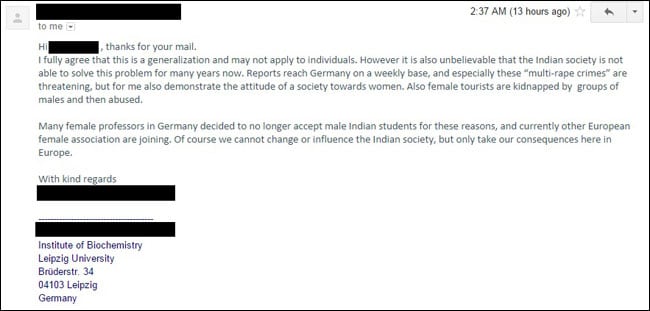
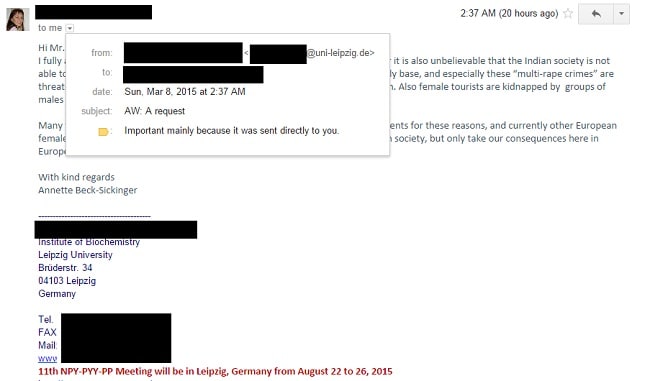
Get this: An Indian male student was recently denied an internship at the Leipzig University in Germany because he comes from a country with a "rape problem." The professor even engaged in an email exchange with a friend of the applicant, where she justified her decision as a "consequence" of India's "attitude" towards women, and suggested that other female European professors were also practising her policy.The move led to widespread criticism following which the German Ambassador to India, Michael Steiner, objected strongly to the exchange, which ultimately led to an apology by the professor.![Screenshot]() Screenshot[/caption]When the student tries to convince her otherwise, the professor replied, “I fully agree that this is a generalisation and may not apply to individuals. However, it is also unbelievable that the Indian society is not able to solve this problem for many years.” The student's emails, however, were not made public.[caption id="attachment_2143743" align="aligncenter" width="650"]
Screenshot[/caption]When the student tries to convince her otherwise, the professor replied, “I fully agree that this is a generalisation and may not apply to individuals. However, it is also unbelievable that the Indian society is not able to solve this problem for many years.” The student's emails, however, were not made public.[caption id="attachment_2143743" align="aligncenter" width="650"]![Screenshot 2]() Screenshot 2[/caption][caption id="attachment_2143745" align="aligncenter" width="650"]
Screenshot 2[/caption][caption id="attachment_2143745" align="aligncenter" width="650"]![Screen shot three]() Screen shot three[/caption]Taking note of the incident, German Ambassador Michael Steiner wrote "Let's be clear: India is not a country of rapists.""In India, the Nirbhaya case has triggered a lively honest, sustained and very healthy public debate - a public debate of a quality that wouldn't be possible in many other countries."The Indian Government and Indian civil society organisations are very committed to tackling the issue. Yesterday we celebrated International Women's Day at the German Embassy here in Delhi with many local activists including many men," he said in the letter.He said the Nirbhaya rape case has refocused attention on the issue of violence against women. "Rape is indeed a serious issue in India as in most countries, including Germany.""Your oversimplifying and discriminating generalization is an offense to these women and men ardently committed to furthering women empowerment in India; and it is an offense to millions of law-abiding, tolerant, open-minded and hard-working Indians," he said.The denial of the itnernship comes just days after the BBC Documentary, India's Daughter, which highlights purportedly highlights the misogynist mindset of India's men, was banned in India.
Screen shot three[/caption]Taking note of the incident, German Ambassador Michael Steiner wrote "Let's be clear: India is not a country of rapists.""In India, the Nirbhaya case has triggered a lively honest, sustained and very healthy public debate - a public debate of a quality that wouldn't be possible in many other countries."The Indian Government and Indian civil society organisations are very committed to tackling the issue. Yesterday we celebrated International Women's Day at the German Embassy here in Delhi with many local activists including many men," he said in the letter.He said the Nirbhaya rape case has refocused attention on the issue of violence against women. "Rape is indeed a serious issue in India as in most countries, including Germany.""Your oversimplifying and discriminating generalization is an offense to these women and men ardently committed to furthering women empowerment in India; and it is an offense to millions of law-abiding, tolerant, open-minded and hard-working Indians," he said.The denial of the itnernship comes just days after the BBC Documentary, India's Daughter, which highlights purportedly highlights the misogynist mindset of India's men, was banned in India.
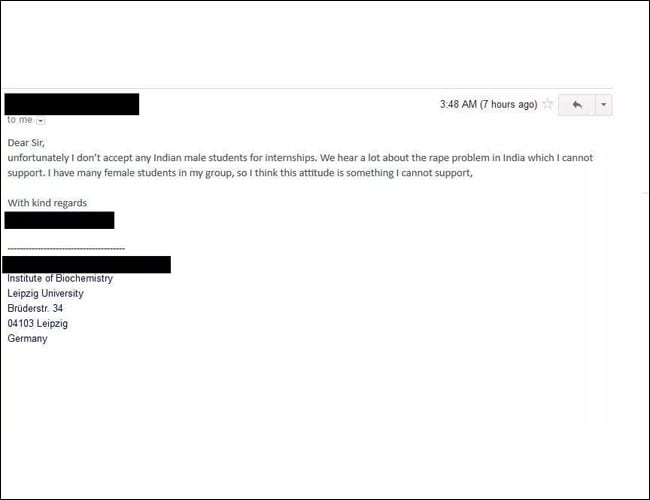
"I made a mistake. I never had the intention of discriminating against Indian society. I have nothing at all against students from India - quite to the contrary. If I hurt anybody's feelings, I duly and heartily apologize and feel sorry for any misunderstandings," Professor Sickinger said in a statement uploaded on the German embassy website.A thread of emails reproduced on Quora reveals that the University's professor Annette Beck Sickinger denied the Indian male student an internship at Institute of Biochemistry, saying that they don’t take Indian male students because they might commit crimes like rape.The email reads, " Unfortunately I don’t accept any Indian male students for internships. We hear a lot about the rape problem in India which I cannot support. I have many female students in my group, so I think this attitude is something I cannot support.”[caption id="attachment_2143715" align="aligncenter" width="650"]
 Screenshot[/caption]When the student tries to convince her otherwise, the professor replied, “I fully agree that this is a generalisation and may not apply to individuals. However, it is also unbelievable that the Indian society is not able to solve this problem for many years.” The student's emails, however, were not made public.[caption id="attachment_2143743" align="aligncenter" width="650"]
 Screenshot 2[/caption][caption id="attachment_2143745" align="aligncenter" width="650"]
 Screen shot three[/caption]Taking note of the incident, German Ambassador Michael Steiner wrote "Let's be clear: India is not a country of rapists.""In India, the Nirbhaya case has triggered a lively honest, sustained and very healthy public debate - a public debate of a quality that wouldn't be possible in many other countries."The Indian Government and Indian civil society organisations are very committed to tackling the issue. Yesterday we celebrated International Women's Day at the German Embassy here in Delhi with many local activists including many men," he said in the letter.He said the Nirbhaya rape case has refocused attention on the issue of violence against women. "Rape is indeed a serious issue in India as in most countries, including Germany.""Your oversimplifying and discriminating generalization is an offense to these women and men ardently committed to furthering women empowerment in India; and it is an offense to millions of law-abiding, tolerant, open-minded and hard-working Indians," he said.The denial of the itnernship comes just days after the BBC Documentary, India's Daughter, which highlights purportedly highlights the misogynist mindset of India's men, was banned in India.
First Published:Mar 10, 2015, 07:47:51 IST
Advertisement
Advertisement

Here's why you crave sweets after every meal: This one thing can fix it
It's common to crave something sweet after meals. However, what's often dismissed as "having a sweet tooth," is mostly nutritional deficiency
1 min read
India's most beloved national parks for wildlife lovers
India holds some of the world’s most wonderful wilderness spaces. Forests and jungles where myth, beauty and survival exist side by side. From mangroves that swallow rivers to grasslands shaped by centuries of migration, the country’s national parks offer more than sightings. They offer moments of stillness, surprise, and reverence.
1 min read
Even the Beckhams break: The rise of family estrangement
People are choosing to cut off contact with their families, prioritising mental health.
4 min read
European Council Chief has an OCI card: What is it?
The OCI Scheme, introduced in 2005, grants foreign nationals of Indian origin a life-long visa for India, but no political rights.
1 min read
The 90s show Friends, and why we misread modern friendships
We’ve all heard about the loneliness epidemic at this point. It isn’t even particularly shocking — it seems like the result on the obvious — people consistently glued to their phones, seeking intimacy and even sex through phone screens, consistent comparison to other peoples’ partners, and what their relationships look like, to how far everyone has come in their jobs — there is much to feel diminished about.
5 min read
Advertisement
Advertisement