
Advertisement


Sections
Critical to have dialogues with those who share different ideologies: Dan Brown
Survival in an increasingly shrinking world depends on ability to ask difficult questions and engage in dialogue with people having ideas different to one's own, according to celebrated US author Dan Brown.

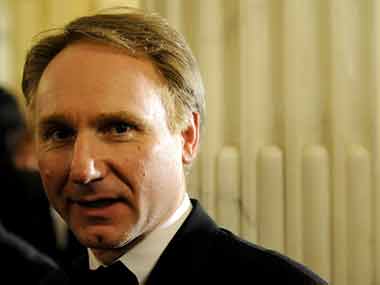
New Delhi: Survival in an increasingly shrinking world depends on ability to ask difficult questions and engage in dialogue with people having ideas different to one's own, according to celebrated US author Dan Brown."The world is getting smaller everyday and now more than ever there is enormous danger in believing that we are infallible. That our version of truth is absolute and that everyone who does not think like we do is wrong and therefore our enemy," said the "The Da Vinci Code" author.[caption id="attachment_1797041" align="alignleft" width="380"]![Author Dan Brown presented the 8th Penguin lecture. AFP]() Author Dan Brown presented the 8th Penguin Annual Lecture in New Delhi. AFP[/caption]Brown, whose widely read novels interrogate the relation between science and religion, was here to deliver the eighth Penguin Annual Lecture on Monday on codes, science and religion.Brown, who had visited India 30 years ago as a 19-year-old, said he received a "welcome that was warm" and he was waiting for "the right excuse to come back"."For one's own survival, it is critical that we live without malice that we educate ourselves and that we ask difficult questions and above all we engage in dialogue especially with those whose ideas are not own own," he said.Calling the present times as "a very exciting era," Brown said, "Right now in the first time in history the line between science and religion has started to blur."Science and religion, for him are simply partners, two different languages attempting to tell the same story."Both are manifestations of man's quest to understand the divine. While science dwells on answers, religion savors the questions," said the author of "Angels & Demons", "The Lost Symbol", "Inferno", "Digital Fortress" and "Deception Point".Science and religion have for time immemorial battling to be provide answers to man's questions, he said.While tackling complex questions, scientists use phrases like "uncertainty principle" and "theory of relativity," and physics becomes metaphysics and numbers become imaginary.At the same time there are a part of scientists who have religious experiences."Hindu sanyasis are reading physics books and learning about the experiments which they believe in their hearts for centuries but unable to quantify."Brown also talked about the evolution of religion and the "God of Gaps".From infertility to earthquakes, diseases even love there was a god to explain everything which later was filled by explanations by science."Ironically we turn to God now for only for a handful of existential questions which science has never been able to answer like 'Where did we come from? Why are we here? And what happens when we die?" Brown said.He began the lecture by giving a snapshot of the world he grew up in surrounded by both science and religion.In his family's garage, his mother, a professional musician, owned a vehicle with the licence plate "Kyrie", which meant the Lord in Greek and his mathematician father's car sported the licence plate "Metric".Brown recounted his experience of having his book "The Da Vinci Code" adapted into a film after resisting the idea for much time.Much to the mirth of the audience, Brown recounted the moment when he tried on a Scottish kilt alongside actor Tom Hanks, who plays the role of Harvard symbologist Robert Langdon.Brown is currently working on a new book as well as a film version of his most recent novel "The Inferno." He wrote his first book at the age of five titled "The Giraffe, the Pig, and the Pants on Fire".PTI
Author Dan Brown presented the 8th Penguin Annual Lecture in New Delhi. AFP[/caption]Brown, whose widely read novels interrogate the relation between science and religion, was here to deliver the eighth Penguin Annual Lecture on Monday on codes, science and religion.Brown, who had visited India 30 years ago as a 19-year-old, said he received a "welcome that was warm" and he was waiting for "the right excuse to come back"."For one's own survival, it is critical that we live without malice that we educate ourselves and that we ask difficult questions and above all we engage in dialogue especially with those whose ideas are not own own," he said.Calling the present times as "a very exciting era," Brown said, "Right now in the first time in history the line between science and religion has started to blur."Science and religion, for him are simply partners, two different languages attempting to tell the same story."Both are manifestations of man's quest to understand the divine. While science dwells on answers, religion savors the questions," said the author of "Angels & Demons", "The Lost Symbol", "Inferno", "Digital Fortress" and "Deception Point".Science and religion have for time immemorial battling to be provide answers to man's questions, he said.While tackling complex questions, scientists use phrases like "uncertainty principle" and "theory of relativity," and physics becomes metaphysics and numbers become imaginary.At the same time there are a part of scientists who have religious experiences."Hindu sanyasis are reading physics books and learning about the experiments which they believe in their hearts for centuries but unable to quantify."Brown also talked about the evolution of religion and the "God of Gaps".From infertility to earthquakes, diseases even love there was a god to explain everything which later was filled by explanations by science."Ironically we turn to God now for only for a handful of existential questions which science has never been able to answer like 'Where did we come from? Why are we here? And what happens when we die?" Brown said.He began the lecture by giving a snapshot of the world he grew up in surrounded by both science and religion.In his family's garage, his mother, a professional musician, owned a vehicle with the licence plate "Kyrie", which meant the Lord in Greek and his mathematician father's car sported the licence plate "Metric".Brown recounted his experience of having his book "The Da Vinci Code" adapted into a film after resisting the idea for much time.Much to the mirth of the audience, Brown recounted the moment when he tried on a Scottish kilt alongside actor Tom Hanks, who plays the role of Harvard symbologist Robert Langdon.Brown is currently working on a new book as well as a film version of his most recent novel "The Inferno." He wrote his first book at the age of five titled "The Giraffe, the Pig, and the Pants on Fire".PTI
 Author Dan Brown presented the 8th Penguin Annual Lecture in New Delhi. AFP[/caption]Brown, whose widely read novels interrogate the relation between science and religion, was here to deliver the eighth Penguin Annual Lecture on Monday on codes, science and religion.Brown, who had visited India 30 years ago as a 19-year-old, said he received a "welcome that was warm" and he was waiting for "the right excuse to come back"."For one's own survival, it is critical that we live without malice that we educate ourselves and that we ask difficult questions and above all we engage in dialogue especially with those whose ideas are not own own," he said.Calling the present times as "a very exciting era," Brown said, "Right now in the first time in history the line between science and religion has started to blur."Science and religion, for him are simply partners, two different languages attempting to tell the same story."Both are manifestations of man's quest to understand the divine. While science dwells on answers, religion savors the questions," said the author of "Angels & Demons", "The Lost Symbol", "Inferno", "Digital Fortress" and "Deception Point".Science and religion have for time immemorial battling to be provide answers to man's questions, he said.While tackling complex questions, scientists use phrases like "uncertainty principle" and "theory of relativity," and physics becomes metaphysics and numbers become imaginary.At the same time there are a part of scientists who have religious experiences."Hindu sanyasis are reading physics books and learning about the experiments which they believe in their hearts for centuries but unable to quantify."Brown also talked about the evolution of religion and the "God of Gaps".From infertility to earthquakes, diseases even love there was a god to explain everything which later was filled by explanations by science."Ironically we turn to God now for only for a handful of existential questions which science has never been able to answer like 'Where did we come from? Why are we here? And what happens when we die?" Brown said.He began the lecture by giving a snapshot of the world he grew up in surrounded by both science and religion.In his family's garage, his mother, a professional musician, owned a vehicle with the licence plate "Kyrie", which meant the Lord in Greek and his mathematician father's car sported the licence plate "Metric".Brown recounted his experience of having his book "The Da Vinci Code" adapted into a film after resisting the idea for much time.Much to the mirth of the audience, Brown recounted the moment when he tried on a Scottish kilt alongside actor Tom Hanks, who plays the role of Harvard symbologist Robert Langdon.Brown is currently working on a new book as well as a film version of his most recent novel "The Inferno." He wrote his first book at the age of five titled "The Giraffe, the Pig, and the Pants on Fire".PTI
 First Published:Nov 11, 2014, 13:06:27 IST
Advertisement
Advertisement

Here's why you crave sweets after every meal: This one thing can fix it
It's common to crave something sweet after meals. However, what's often dismissed as "having a sweet tooth," is mostly nutritional deficiency
1 min read
India's most beloved national parks for wildlife lovers
India holds some of the world’s most wonderful wilderness spaces. Forests and jungles where myth, beauty and survival exist side by side. From mangroves that swallow rivers to grasslands shaped by centuries of migration, the country’s national parks offer more than sightings. They offer moments of stillness, surprise, and reverence.
1 min read
Even the Beckhams break: The rise of family estrangement
People are choosing to cut off contact with their families, prioritising mental health.
4 min read
European Council Chief has an OCI card: What is it?
The OCI Scheme, introduced in 2005, grants foreign nationals of Indian origin a life-long visa for India, but no political rights.
1 min read
The 90s show Friends, and why we misread modern friendships
We’ve all heard about the loneliness epidemic at this point. It isn’t even particularly shocking — it seems like the result on the obvious — people consistently glued to their phones, seeking intimacy and even sex through phone screens, consistent comparison to other peoples’ partners, and what their relationships look like, to how far everyone has come in their jobs — there is much to feel diminished about.
5 min read
Advertisement
Advertisement