
Advertisement


Sections
Why Meghalaya struggles to prevent Illegal coal mining despite repeated tragedies
There are many instances where coal miners lose lives in illegal coal mines and such deaths are neither reported nor acknowledged in Meghalaya

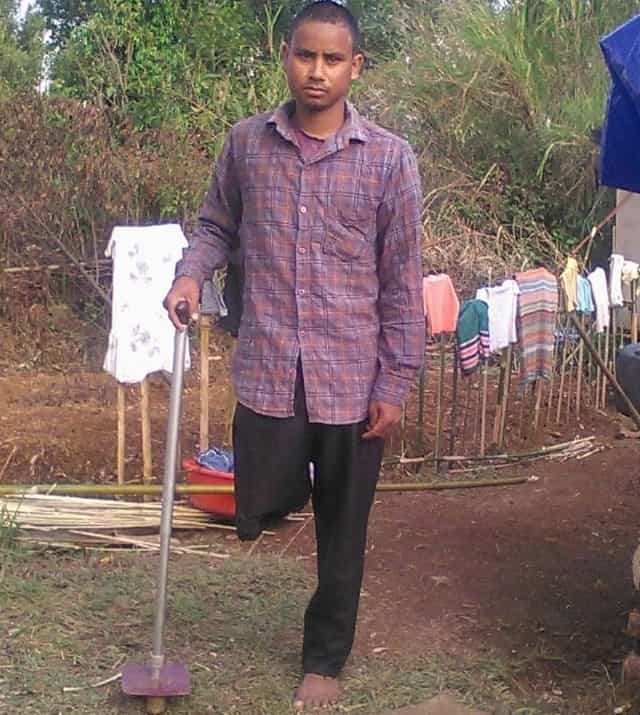 Siswifor Dkhar lost hid foot during a coal mining accident in Meghalaya. Image procured by Syeda Ambia Zahan[/caption]“In my village, 30 to 40 youths are engaged in mining and that’s the only thing they know which would get them some money. Coal is much more profitable. The youths get Rs 500-800 for a shift,” Dkhar said.He is yet to purchase an artificial limb as he is waiting to receive a major part of the government compensation. The Meghalaya government announced Rs 5 lakh for Dkhar after the accident.“Till now I have got Rs 2 lakh as compensation in four installments. If I got the full compensation I could have been able to walk again and start a business. But now all the compensation money is gone into providing for the family,” he said.The miner said he hasn’t seen any government training programme organised in his area on alternative livelihood opportunities.Dkhar, who is waiting for the help of the government to get an artificial limb, has now opened a poultry firm to support his family as he can no longer work the coal mines.Manik Ali, a former coal miner from Assam’s Chirang district, lost his brother Monirul Islam in the 2018 accident. Till the tragedy, coal mining was the main occupation of Ali’s family.
It is no longer so.“My father has bought agricultural land from the compensation provided by the government. Now we cultivate ridge gourd and groundnut there,” said Ali.Ali, however, said, though many families in his district left coal mining, still lots and lots of people have joined the dangerous job of coal digging. Coal digging and mining are the same as rat-hole mining involved digging mostly by hand.“In my village, the boys will still go to Meghalaya for mining at least twice a year,” said Ali.So why the miners are digging out the black gold risking life despite the fear of legal consequences is the question that needs to be addressed.Is obtaining a mining license or getting a lease on coal fields too difficult?Miners feel so!As per the order of the Supreme Court, the Meghalaya government on 25 March issued a standard operating procedure for grant of Prospecting License and/or Mining Lease for coal in the state for processing applications submitted under the Mineral Concession Rules 1960.
CARDS by FirstpostThe 15-page notification listed land documents, mining dues clearance certificate, map of the proposed mining site, certificate of Sixth Schedule status, KML files and statutory approvals, non-forest area declaration, an agreement between applicant and landowner among others.Most importantly, the application for a prospecting license shall be for an area not less than 100 hectares. However, coal in the state is found scattered all across the hills and satellite images show thousands of rat-hole mines in different locations.Justine Dkhar, the joint secretary of the Jaintia Coal Mine Owners and Dealers Association and a former MLA of Khliehriat in East Jaintia Hills — a site notorious for illegal coal mining — said that the complexity of the bureaucratic process of obtaining a mining license was the reason people were not at all encouraged to go for it.“The landholding in Meghalaya is such that mining in the state is very difficult as per the MMDR (Mines and Minerals Development and Regulation Act, 1957). Nobody except a few people in Khasi and Garo hills owns that kind of land. In Meghalaya, coalfields are scattered in small segments. Coal is scattered. This makes applying for a license or lease as per the act impossible. In East Jaintia Hills I don’t know how many have applied for it, but I know no one has got a license yet,” Justine said.He also said that the usage of modern heavy machinery to extract coal unlike other mineral-rich states of India is not possible in Meghalaya because the coal seams are thin.“The coal seams here are only 1.5 to 3 feet. The high wall mining method is not going to work here and it would lead to more environmental damage,” the former MLA said.According to Justine, a handful of mine owners who are rich and educated can only understand the process. The smallholders cannot do mining as per MMDR law.There is no government estimate on the number of rat-hole mines operating in the state. However, an unofficial report says there are about 60,000 such rat-hole mines operating out of East Jaintia Hills district, one of the major coal-producing sites of Meghalaya.Activists accuse government of hiding information on illegal coal mining"There is no coal that is lying extracted in Meghalaya," said Agnes Kharshiing, an environmental and human rights activist from the state.“The coal that was extracted before the ban of NGT has already been illegally transported from the state. You see hundreds of trucks loading coal and moving out of the state every day. And now that it needs to be given out for auction, the government is illegally digging out coal to maintain the estimate,” she said.In December 2018, coal miners of the state had submitted before the Supreme Court that 1.77 lakh metric tonnes of coal were lying extracted in Meghalaya.But four months later, the Meghalaya Mining and Geology Department in an affidavit to the apex court claimed that there were 32.57 lakh metric tonnes of coal yet to be exported.“Show us the extracted coal that the government claims to have been lying in the state. Now that we have advanced technology, use GPS, take out the drones and show the coal. But can you? No! Because you know there is no coal. Everything has been transported out of the state secretly. So you are digging out fresh coal for auction,” said Kharshiing, the activist who was attacked while she and one of her associates were going to a coal mine to collect info about illegal mining in the year 2019.The Supreme Court, in July 2019 ordered the disposal of the entire extracted coal stocks lying in various sites of Meghalaya through Coal India Limited.Moving to alternative livelihood opportunities a tough choiceDiscovered by the British in Khasi Hills in the early 19th Century, coal mining in Meghalaya took off commercially soon after it attained statehood in the year 1972. The community-based mining before that – in which villagers extracted coal for household usages slowly got replaced by commercial coal mining through rat holes.Soon, wealthy traders from the state as well from neighbouring states of Assam, Tripura and West Bengal started acquiring community land from the villagers.The 2014 ban on rat-hole mining, which is the most common practice of digging out coal in Meghalaya, didn't prove effective in stopping the practice because livelihood options in the coal mining areas are limited.Aiban BS Swer, director of Meghalaya Basin Development Authority (MBDA), a government body set up in 2012 to provide multi-livelihood opportunities in rural areas, said that the department has taken up several projects with the support of World Bank, International Fund For Agricultural Development (IFAD) and Japan International Corporation Agency (JICA), in terms of providing livelihood to youths engaged in illegal coal mining.“Through the Meghalaya Livelihood and Access to Market Projects (MEGHA-LAMP) launched in 2015, the government of Meghalaya is trying to create livelihood opportunities adapted to the hill environment and to the effects of climate change,” Swer said.In another project called Meghalaya Community-Led Landscape Management Project (MCLLMP) the authority is aiming at strengthening rural communities and traditional institutions so they can take charge of their natural resources by implementing community-led sustainable community natural resource management plans in a systematic manner.“Through these projects, the youths of rural areas who are engaged in mining are being given opportunities to opt for plantation of oil-producing plants like lemongrass and aromatic plants among others,” he said.Swer also said that the locations where coal was being mined discreetly were in different areas and in high altitudes and very remotely placed and MBDA was trying to reach out to the miners with training programmes on skill development to provide them alternative opportunities.On the other hand, many believe that it is very hard for the government to convince someone to leave mining and take up agricultural and related activities because the former is way more profitable.“Once a site is used for coal mining, it cannot be revived again for agriculture or other allied activities. Coal mining is much more profitable than agriculture. We tried to impart some kind of skill development training in the past but it was not very fruitful. Youths are not interested and it is difficult to convince them," said a former officer, who until recently served in the Meghalaya Skill Development Society.He also said that as the majority of the coal miners are from outside the state, imparting training to them by the Meghalaya government is difficult.However, Meghalaya environment activist Angela Rangad said that the notion of coal providing livelihood to youths in Meghalaya was a myth and only a handful of coal mine owners are accumulating wealth through illegal mining.There is poverty among the indigenous people from mining sites and they are migrating to Shillong, Jowai and other district towns of Meghalaya.
First Published:Jun 15, 2021, 10:18:00 IST
Advertisement
Advertisement

PM Modi announces fast-track courts for paper leak cases; CJP responds ‘Dharmendra Pradhan must go’
Amid protests demanding accountability for the leak of medical entrance test Neet and other irregularities in the education system, Prime Minister Narendra Modi has announced that the government has decided to set up fast-track courts to ensure swift and stringent punishment for those involved in paper leaks.
3 min read
Sikkim tunnel collapse rescue resumes, death toll rises to 22
The death toll at the collapsed tunnel at Sikkim's Namchi district rose to 22 after nine more bodies were recovered overnight. At least 27 workers were trapped in a tunnel at an NHPC project after a sudden burst of suspected methane gas trapped within rock formations triggered an explosion.
2 min read
Delhi Police asks personnel to wear uniform: What the law says on cops in plainclothes during protests
The Delhi Police has instructed all its personnel to wear uniforms when they report for duty at Jantar Mantar for crowd control. This comes after outrage grew over videos of men in civilian clothes or without name tags hitting protesters in the Capital. Is it legal for the police to ditch uniforms during protests?
4 min read
No premium queues, 30-minute target: What changes for Indian passport applicants in UAE
Indian passport applicants in the UAE can now access passport, visa and attestation services through Alhind’s 16 centres, with no premium queues, a Dh19 service fee and a target of completing applications within 30 minutes
4 min read
CJP Protest in Delhi Live Updates: PM Modi announces fast-track courts for NEET paper leak cases
CJP Protest in Delhi Live Updates: Heavy security has been deployed at the Jantar Mantar in Delhi, where the Cockroach Janta Party (CJP) is continuing its protest demanding the resignation of Union Education Minister Dharmendra Pradhan over the recent paper leaks controversy
1 min read
Advertisement
Advertisement