


Whose religion is it, anyway? Supreme Court reserves verdict on poll law provision on corrupt practice
SC reserved its verdict on the "width and scope" of an electoral law provision dealing with issue whether seeking votes on the ground of "religion, race, caste, community or language", amounted to "corrupt practice".

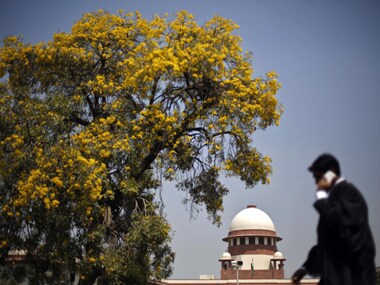
Supreme Court of India. Reuters[/caption]He also dealt with the issue of religion and the State prevalent in various countries and said, "In some countries, there is a strong divide between the Church and the state. But no country is like ours. Secularism in India means equal treatment to all religions." The bench said there is freedom to "practice and propagate" the religion, but "can it (religion) be used for electoral purposes".The court further said the term "his religion" needed interpretation as it had been held that it meant the faith of candidates only and, as a result, the appeals for votes made by an agent and a third party, on the ground of others' faith, get excluded from the ambit of section 123(3) of the RP Act. Khurshid said the issue of seeking votes in the name of religion needed to be taken to its "logical conclusion" by the apex court.Senior advocate Indira Jaising, appearing for Setalvad and other two activists, said the term "his religion" needed to be given "broad and wide" interpretation and sought re-visiting of the Hindutva judgement. The issue as to when it can be said that a person has appealed for votes in the name of religion should be interpreted afresh and section 123(3) of the Act be read together with other sub-sections of the provision, she said."This case is all about the political speech on the ground of religion. We vote as citizens and not as Hindus or Muslims," Jaising said adding that the interpretation that 'his religion' meant faith of candidates only is flawed. She referred to an earlier apex court verdict where the appeal by a Hindu seer asking Hindus in a temple to vote for Hindus was held to be bad in law and said this was the "ratio" (the point in a case that determines the judgment) and not the observation that Hindutva is a "way of life".Additional Solicitor General Tushar Mehta, appearing for Madhya Pradesh, Gujarat and Rajasthan, referred to various provisions of the RP Act dealing with filing of election petitions and powers of the court to pass an order if there are allegations of corrupt practices in the poll."It is clear that for the purpose of declaring an election of returned candidate to be void due to any corrupt practice committed in the interest of returned candidates by an agent other than his election agent, it is necessary to establish that results of election have been materially affected due to the corrupt practice," he said.He also expressed apprehension on possible judicial scrutiny of promises made by political parties in their election manifestos.There are bodies like Election Commission to deal with the wrongs committed in the manifestos, he said.During the hearing, the bench asked as to why state governments were seeking to intervene in the proceedings."I can understand if a political party raises this question. But why are state governments seeking intervention," the CJI asked."I was hoping that this question would be asked to intervening NGOs and activists as they have no stakes," the ASG said.Meanwhile, CPI(M) sought to intervene in the ongoing hearing on whether seeking votes in the name of religion or caste amounted to "corrupt practices" under the RP Act.Senior advocate Sanjay Hegde, appearing for the party, also sought re-visting of the Hindutva judgement.The CPI(M), in its plea, submitted that it believed in secularism and quoted its Programme saying it was committed to wage an "uncompromising struggle" for the consistent implementation of the principles of secularism.The counsel for Maharashtra chose not to advance arguments as the bench made clear that it was not re-visiting the Hindutva verdict.Advancing rejoinder arguments at the fag end of the day's hearing, senior advocate Shyam Divan referred to materials available on the website of the Election Commission with regard to parties like Shiromani Akali Dal (SAD) and said the court should keep in mind that there are political outfits having accepted religion-based agenda.He also referred to the contents including objectives of parties like SAD, Indian Union of Muslim League and DMK and said they clearly say that they would work for the cause of a particular religion or language and hence, there cannot be a straight-jacket formula to deal with the issue at hand.These things show the parties are bound by objectives, accepted by the poll panel and hence can appeal to electors on the name of religion, language etc, he said.Yesterday, the court observed discrimination on the basis of religion or caste is a key part of political discourse.The apex court asked whether a candidate or a party, seeking votes in the name of religion, caste or tribe by promising that this would help protect and improve the voters' lot as a community, would be a "corrupt practice".The bench is hearing a batch of petitions including the one filed by Abhiram Singh whose election as an MLA in 1990 on BJP ticket from Santacruz assembly seat in Mumbai was set aside by the Bombay High Court.The apex court in February 2014 had tagged Abhiram Singh's petition with others in which the five judge bench had decided in 2002 to re-visit its 20-year old 'Hindutva' judgement for an authoritative pronouncement on electoral laws by a seven-judge bench.The issue of interpretation of section 123(3) arose on January 30, 2014 before a five-judge which referred it for examination before a larger bench of seven judges.A three-judge bench on April 16, 1992 had referred to a five-judge Constitution bench Singh's appeal in which the same question and interpretation of Section 123(3) was raised.While the five-judge bench was hearing this matter on January 30, 2014, it was informed that an identical issue was raised in an election petition filed by Narayan Singh against BJP leader Sunderlal Patwa and the another Constitution Bench of five judges of the apex court had referred it to a larger bench of seven judges.Thereafter, the five-judge bench had referred Singh's matter also to the Chief Justice for placing it before a seven-judge bench.

China has dominated Myanmar’s rare earth mines — now India eyes deal to harness country’s critical minerals
CJP protest in Delhi: New videos of stone pelting, violence emerge as police, agitators trade charges
'From make in India to launch from India': Skyroot COO on why Vikram-1 could change India’s space sector
Choke terror funding, keep international shipping lanes safe: Jaishankar at Asean Regional Forum
PM Modi announces fast-track courts for paper leak cases; CJP responds ‘Dharmendra Pradhan must go’