
Advertisement


Sections
Where do we go from here? India should consider self registration, inter-state welfare schemes for migrant workers' social security
The ongoing migrant workers crisis has amplified the need for a universal and comprehensive social security regime for all workers in the informal sector

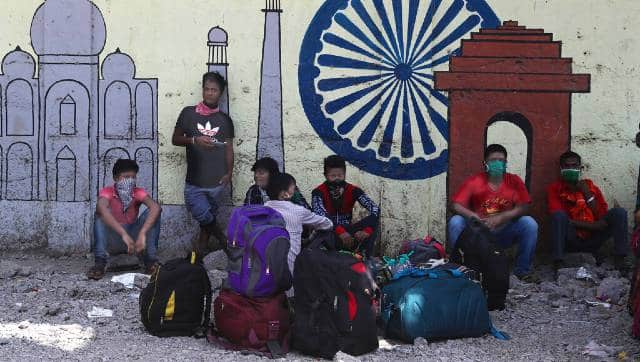
While the Atma Nirbhar Bharat welfare measures for migrant workers are steps in the right direction, issues relating to the delivery of benefits remain unaddressed. Creation of a robust registration system, overcoming state level domicile restrictions and a larger policy framework that can address the social security needs of all informal workers are some of the major steps needed.India’s development story is deeply connected with migration. More than 455 million internal migrants work in sectors such as construction, hospitality and manufacturing around the country. Internal migration for work, especially from rural to urban areas, positively impacts low-income households, and benefits both the regions people migrate from and towards. However, as the COVID-19 crisis has shown in stark detail, internal migrants have been left out of India’s social security net.[caption id="attachment_8421491" align="alignnone" width="640"]![File image of migrant workers and their families gathered at Dharavi slum in Mumbai. AP]() File image of migrant workers and their families gathered at Dharavi slum in Mumbai. AP[/caption]While there have been positive steps by the government to provide relief to migrant workers, including the decision to provide rations at site and to release funds under the Building and Other Construction Workers (BOCW) Act, the authors would like to emphasise that this is not enough. There are larger issues regarding the delivery architecture for welfare that are still unaddressed.These concerns have been amplified during the ongoing national lockdown. One rapid assessment survey conducted by Jan Sahas found that most migrant workers had limited or no access to ration and a high incidence of debt distress while lack of access to required documentation limited their access to welfare measures.India Migration Now and Dvara Research conducted a survey of migrant construction workers in Thane in April this year, and found that more than two-thirds were not able to access benefits under Building and Other Construction Workers Act 1996 (BOCW). The recent notification released by the Delhi Government has noted difficulty in identifying and delivering rations to non-PDS beneficiaries further highlights the need to reconsider the approach for delivering welfare.Two specific issues arise with respect to seasonal migrant workers in India. First, welfare schemes in India are based on the domicile of a household. Seasonal migrant workers are rarely able to access welfare measures in the destination states.The benefits of Central Government schemes are often relayed to citizens through state or local governments, which can make them available only to their permanent residents or “domiciles”. In such a situation, interstate migrant workers lose their entitlements when they cross the borders of their native states. Migrant workers are typically engaged as short-term wage workers in the informal sector.Second, the larger concern is that the informal sector accounts for three-quarters of the Indian workforce, but lacks any formal social protection from the state.
File image of migrant workers and their families gathered at Dharavi slum in Mumbai. AP[/caption]While there have been positive steps by the government to provide relief to migrant workers, including the decision to provide rations at site and to release funds under the Building and Other Construction Workers (BOCW) Act, the authors would like to emphasise that this is not enough. There are larger issues regarding the delivery architecture for welfare that are still unaddressed.These concerns have been amplified during the ongoing national lockdown. One rapid assessment survey conducted by Jan Sahas found that most migrant workers had limited or no access to ration and a high incidence of debt distress while lack of access to required documentation limited their access to welfare measures.India Migration Now and Dvara Research conducted a survey of migrant construction workers in Thane in April this year, and found that more than two-thirds were not able to access benefits under Building and Other Construction Workers Act 1996 (BOCW). The recent notification released by the Delhi Government has noted difficulty in identifying and delivering rations to non-PDS beneficiaries further highlights the need to reconsider the approach for delivering welfare.Two specific issues arise with respect to seasonal migrant workers in India. First, welfare schemes in India are based on the domicile of a household. Seasonal migrant workers are rarely able to access welfare measures in the destination states.The benefits of Central Government schemes are often relayed to citizens through state or local governments, which can make them available only to their permanent residents or “domiciles”. In such a situation, interstate migrant workers lose their entitlements when they cross the borders of their native states. Migrant workers are typically engaged as short-term wage workers in the informal sector.Second, the larger concern is that the informal sector accounts for three-quarters of the Indian workforce, but lacks any formal social protection from the state.![Representational image. AP]() Representational image. AP[/caption]Secondly, there is a need for greater coordination between source and destination states to ensure portability of benefits on the lines of the 2012 Memorandum of Understanding (MoU) between Odisha and Andhra Pradesh. These should be facilitated by the central government across all the migrant corridors. Another important step in this direction would be to make all welfare schemes interoperable. The One Nation, One Ration Card scheme is one such example of this.Finally, these are all short-term fixes. The idea of social security is to ensure access to a minimum floor of protection against the most critical risks that endanger the well-being of every household. The ongoing crisis has amplified the need for a universal and comprehensive social security regime for all workers, especially those employed in the informal sector and especially for migrant workers.While short-term measures to provide welfare for our informal workforce are important, it is also important to look ahead to devising a solution to ensure universal and comprehensive social security.The article first appeared on Dvara.com and has been reproduced with permission. Varun is the founder and lead at India Migration Now while Nishanth is the head of Dvara Research’s social protection initiative
Representational image. AP[/caption]Secondly, there is a need for greater coordination between source and destination states to ensure portability of benefits on the lines of the 2012 Memorandum of Understanding (MoU) between Odisha and Andhra Pradesh. These should be facilitated by the central government across all the migrant corridors. Another important step in this direction would be to make all welfare schemes interoperable. The One Nation, One Ration Card scheme is one such example of this.Finally, these are all short-term fixes. The idea of social security is to ensure access to a minimum floor of protection against the most critical risks that endanger the well-being of every household. The ongoing crisis has amplified the need for a universal and comprehensive social security regime for all workers, especially those employed in the informal sector and especially for migrant workers.While short-term measures to provide welfare for our informal workforce are important, it is also important to look ahead to devising a solution to ensure universal and comprehensive social security.The article first appeared on Dvara.com and has been reproduced with permission. Varun is the founder and lead at India Migration Now while Nishanth is the head of Dvara Research’s social protection initiative
 File image of migrant workers and their families gathered at Dharavi slum in Mumbai. AP[/caption]While there have been positive steps by the government to provide relief to migrant workers, including the decision to provide rations at site and to release funds under the Building and Other Construction Workers (BOCW) Act, the authors would like to emphasise that this is not enough. There are larger issues regarding the delivery architecture for welfare that are still unaddressed.These concerns have been amplified during the ongoing national lockdown. One rapid assessment survey conducted by Jan Sahas found that most migrant workers had limited or no access to ration and a high incidence of debt distress while lack of access to required documentation limited their access to welfare measures.India Migration Now and Dvara Research conducted a survey of migrant construction workers in Thane in April this year, and found that more than two-thirds were not able to access benefits under Building and Other Construction Workers Act 1996 (BOCW). The recent notification released by the Delhi Government has noted difficulty in identifying and delivering rations to non-PDS beneficiaries further highlights the need to reconsider the approach for delivering welfare.Two specific issues arise with respect to seasonal migrant workers in India. First, welfare schemes in India are based on the domicile of a household. Seasonal migrant workers are rarely able to access welfare measures in the destination states.The benefits of Central Government schemes are often relayed to citizens through state or local governments, which can make them available only to their permanent residents or “domiciles”. In such a situation, interstate migrant workers lose their entitlements when they cross the borders of their native states. Migrant workers are typically engaged as short-term wage workers in the informal sector.Second, the larger concern is that the informal sector accounts for three-quarters of the Indian workforce, but lacks any formal social protection from the state.
Neither the Inter-State Migrant Workers (ISMW) Act, 1979, nor the Unorganised Workers Social Security Act, 2008, have any specific provisions on social security for migrant workers.Instead, social security is the subject matter of ad hoc schemes at the discretion of the government. This has been retained in the proposed Code on Social Security Bill, 2019.The current crisis has highlighted the need for setting in place a social security system for migrant workers. There are three ways to overcome this issue: firstly, destination states must implement enrolment protocols to include short term migrant workers into existing welfare mechanisms. One successful example of this is in Kerala, which has implemented migrant-specific labour welfare schemes, health provisions and child policies.Kerala has even issued alternative identity cards for education and welfare services to its “guest workers". In fact, the Parliamentary Standing Committee on Labour has recommended that the Labour Codes make special provisions for migrant labour, “as has been done by the State Government of Kerala”.The idea of registration of workers for targeted welfare delivery is not a new one. Indeed, this was one of the primary objectives of the ISMW Act. Inspired by Odisha’s Dadan Labour (Control and Regulation) Act , 1975, an act to protect and safeguard the interests of dadan or ‘debt migrants’ in the state, the ISMW Act is the only central level legislation explicitly governing inter-state migrant workers in India. But a combination of poor/absent state level enforcement, lack of awareness and a poor incentive structure has resulted in widespread — implementation failure.
The ISMW Act is one of 13 laws being merged into the draft Labour Code on Occupational Safety, Health and Working Conditions Code, 2019. Unfortunately, the chapter on migrant workers retains the flawed registration structure of the ISMW Act.As migrant workers desperately struggle to register for returning home, solutions like a self-registration process and digital record keeping, as proposed by the Working Group on Migration in 2017, must be urgently explored in further detail.[caption id="attachment_8421481" align="alignnone" width="640"]
 Representational image. AP[/caption]Secondly, there is a need for greater coordination between source and destination states to ensure portability of benefits on the lines of the 2012 Memorandum of Understanding (MoU) between Odisha and Andhra Pradesh. These should be facilitated by the central government across all the migrant corridors. Another important step in this direction would be to make all welfare schemes interoperable. The One Nation, One Ration Card scheme is one such example of this.Finally, these are all short-term fixes. The idea of social security is to ensure access to a minimum floor of protection against the most critical risks that endanger the well-being of every household. The ongoing crisis has amplified the need for a universal and comprehensive social security regime for all workers, especially those employed in the informal sector and especially for migrant workers.While short-term measures to provide welfare for our informal workforce are important, it is also important to look ahead to devising a solution to ensure universal and comprehensive social security.The article first appeared on Dvara.com and has been reproduced with permission. Varun is the founder and lead at India Migration Now while Nishanth is the head of Dvara Research’s social protection initiative
First Published:May 28, 2020, 19:51:23 IST
Advertisement
Advertisement

'From make in India to launch from India': Skyroot COO on why Vikram-1 could change India’s space sector
Skyroot Aerospace’s successful Vikram-1 mission marks a major milestone for India’s private space sector, as the country seeks to shift from “Make in India” to “Launch from India” and compete in the global commercial satellite launch market
8 min read
Choke terror funding, keep international shipping lanes safe: Jaishankar at Asean Regional Forum
Jaishankar's remarks came against the backdrop of recent terror attacks targeting India and growing threats to commercial shipping amid conflicts in West Asia and Europe
2 min read
PM Modi announces fast-track courts for paper leak cases; CJP responds ‘Dharmendra Pradhan must go’
Amid protests demanding accountability for the leak of medical entrance test Neet and other irregularities in the education system, Prime Minister Narendra Modi has announced that the government has decided to set up fast-track courts to ensure swift and stringent punishment for those involved in paper leaks.
3 min read
Sikkim tunnel collapse rescue resumes, death toll rises to 22
The death toll at the collapsed tunnel at Sikkim's Namchi district rose to 22 after nine more bodies were recovered overnight. At least 27 workers were trapped in a tunnel at an NHPC project after a sudden burst of suspected methane gas trapped within rock formations triggered an explosion.
2 min read
Delhi Police asks personnel to wear uniform: What the law says on cops in plainclothes during protests
The Delhi Police has instructed all its personnel to wear uniforms when they report for duty at Jantar Mantar for crowd control. This comes after outrage grew over videos of men in civilian clothes or without name tags hitting protesters in the Capital. Is it legal for the police to ditch uniforms during protests?
4 min read
Advertisement
Advertisement