


The cloak, the dagger and the loudspeaker: Indiscreet Donald Trump has done greater damage to Kashmir issue
Like it or not, the United States has been a key actor in shaping the course of the India-Pakistan conflict in Kashmir ever since the late 1990s. Hard-nosed realist that he is, Modi is profoundly unlikely not to have asked Trump for help on Kashmir or Pakistan.

For decades, India has held that Kashmir is a bilateral issue; the comments leave New Delhi with no choice but to accuse Trump of lying. Emotion, however, shouldn't be allowed to obscure the meaning, or significance, of what is going on.Like it or not, the United States has been a key actor in shaping the course of the India-Pakistan conflict in Kashmir ever since the late 1990s. Hard-nosed realist that he is, Modi is profoundly unlikely not to have asked Trump for help on Kashmir or Pakistan.[caption id="attachment_3749009" align="alignleft" width="380"]
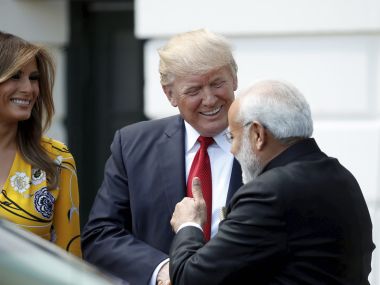
File image of Prime Minister Narendra Modi with US President Donald Trump. AP[/caption]Bar the slim prospect that someone with direct knowledge speaks out, of course, there's no knowing exactly what Modi told Trump. Things aren't helped by the fact that Trump is a pathological fantasist; in his mind, after all, the American revolutionaries seized airports and "manned the air" as they fought imperial Britain in 1775.For all its public protestations about sovereignty, India has often leaned on superpowers to secure strategic ends, just like every other nation-state. Kargil, we know from former External Affairs Minister Jaswant Singh's memoirs, ended on terms shaped by the United States. After the India-Pakistan crisis of 2001-2002, United States diplomacy was again crucial in pushing Pakistan's military ruler General Pervez Musharraf to clamp down on jihadists.Former prime minister Manmohan Singh, in turn, reached out to the United States after 26/11, seeking to ensure Pakistan would act against the Lashkar-e-Taiba and other anti-India jihadist groups.Faced with worries in Moscow that the 1971 war could spiral into a showdown between the Soviet Union and China, Prime Minister Indira Gandhi had to dispatch her close advisor PN Dhar to promise that India would not annex West Pakistani territory.Even the high priest of non-alignment, former prime minister Jawaharlal Nehru, wasn't above enabling Central Intelligence Agency terrorist operations against China, and allowing U2 spy planes to refuel over India after the war with China in 1962.Modi's engagement with Trump is likely driven by three contexts, each a rising threat to India's strategic position in Kashmir. First — braggadocio about how he can ensure a 10-day triumph in Afghanistan notwithstanding — Trump is desperate to exit what he sees as a pointless conflict. His military and intelligence services, though, are warning that withdrawal will leave the United States vulnerable to jihadist threats, a peace deal with the Taliban notwithstanding.To avoid the public relations disaster of the Taliban rolling back into Afghan cities that United States troops died to liberate — and the electoral disaster that will follow future terrorist attacks — Trump needs Pakistan's Inter-Services Intelligence Directorate to be on his side.Modi knows India doesn't have either the muscle, or the money, to exercise leverage over the course of events in Afghanistan. But he wants to ensure whatever deal the United States makes with the ISI takes into account India's concerns about jihadist groups in Kashmir.The second context to India's Kashmir policy is its understanding of the limits of what military force can compel Pakistan to do. For all the thunder and lightning surrounding India's cross-border air and special-forces strikes across the Line of Control, Modi has shown little interest in leading the country towards war. The defence budgets he has run have been the lowest, as a percentage of GDP, since 1962 — ruling out the rapid, large-scale modernisation India's armed forces need to exercise decisive coercive influence.In order to degrade jihadist infrastructure, and coerce the Pakistani state into ending support for terrorism, India will need to mount a sustained military campaign, but that will mean a state of near-war, damaging to India's own economy and growth prospects.Financial pressure from the West, and the crisis in Pakistan's economy, offer tools to secure the same ends, without the same risks — but only if the United States is willing to keep up the pressure. Modi has, most likely, explained to Trump the case for doing so, because an India-Pakistan crisis will undermine the United States' big strategic goal, containing China.Third, there are India's internal concerns in Kashmir. Faced with a youth cohort increasingly influenced by jihadism, and a dysfunctional political class that has shown itself incapable of confronting it, the government is contemplating new strategies. Even though police and military units have shown themselves capable of containing terrorism, many in the government believe new constitutional and political arrangements are needed to reshape the landscape itself.However, little imagination is needed to see that this is a high-stakes gamble. Faced with new legislation or constitutional arrangements, Kashmir's political actors-now sharply divided-could join battle against the Indian State. That would give an unprecedented opportunity to Pakistan.Put simply, the prime minister needs to ensure Islamabad isn't able to sabotage what he's hoping to accomplish — and to that end, again, he needs Trump's help.Loath as Indian leaders have been to acknowledge it to a public for whom memories of colonial rule are still fresh, there is plenty of precedent for such engagement. Following the collapse of the secret discussions on Kashmir held by Niaz Naik and RK Mishra, New Delhi worked hard to pick up from where things had left off. Pakistani-origin businessman Ijaz Mansoor, who claimed influence with President Bill Clinton, was even flown to Srinagar in an Indian government jet, to meet with local politicians in a bid to drum up support for the dialogue.Then, under former prime minister Manmohan Singh and Musharraf, a new secret channel evolved involving diplomats Satinder Lambah and Tariq Aziz, this one focussed on an arrangement that would institutionalise the Line of Control as a border, but make it irrelevant, like that which divides the two sides of Ireland.For decades, New Delhi and Islamabad have used spies to maintain secret contacts. In 1987, Research and Analysis Wing chief AN Verma and ISI Director-General Hamid Gul met to discuss Khalistan terror, in talks brokered by Jordan.In the wake of the 2002 crisis, then-RAW chief CD Sahai, and his ISI counterpart Lieutenant-General Ehsan-ul-Haq met regularly, to stitch up a ceasefire on the Line of Control.Even in the midst of the crisis that followed this year's air strike on Balakot, India's National Security Advisor Ajit Doval, and its former RAW chief, Anil Dhasmana, spoke to high officials in Pakistan.For Modi not to be using the diplomatic and covert resources at his disposal to be talking business on Kashmir would be indefensible, even criminal. There's room, in all fraught geopolitical situations, for quiet conversation where the unimaginable and impossible can be discussed. Trump's inability to keep private conversations private will, without doubt, hurt whatever processes are now underway, involving his country, Pakistan and India. His loud mouth, though, shouldn't be allowed to demolish them.

PM Modi announces fast-track courts for paper leak cases; CJP responds ‘Dharmendra Pradhan must go’
Sikkim tunnel collapse rescue resumes, death toll rises to 22
Delhi Police asks personnel to wear uniform: What the law says on cops in plainclothes during protests
No premium queues, 30-minute target: What changes for Indian passport applicants in UAE
CJP Protest in Delhi Live Updates: PM Modi announces fast-track courts for NEET paper leak cases