


Silence period explained: 48 hours before polls, use of digital or television media verboten for political campaigning
During the silence period, which usually begins 48 hours before the voting day and ends after polling ends, no active campaigning by the candidates or political parties is allowed, and television or any digital media cannot carry any election-related matter.

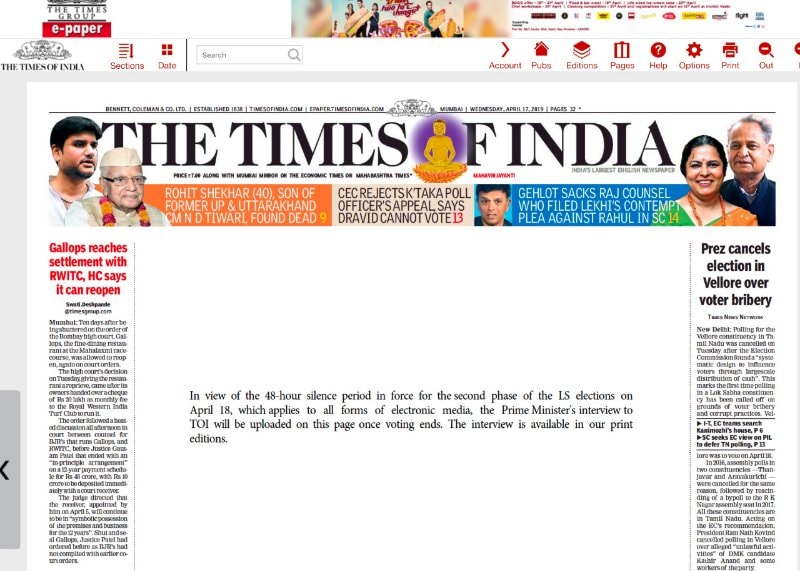
The Times of India's web issue of the 17 April, 2019 edition does not contain Narendra Modi's interview, however, it has been published in its print version.[/caption]According to The Times of India's report, it further sought to add an explanation clause to Section 126(2) to define electronic media as including internet, radio and television including IP television, satellite, terrestrial or cable channels, internet/digital versions of print media, mobile and such other media either owned by the government or private person or both. Print media, if added, would include any newspaper, magazine or periodical, poster, placard, handbill or any other document. The Law Commission, in its 255th report, had recommended amendments to Section 126, the EC said, adding that even former CEC S Y Quraishi, in a letter to the then prime minister Manmohan Singh in April 2012, had recommended that print media be brought within the ambit of the 48-hour campaign ban.Guidelines to follow during the silence periodRecently, ahead of the General Election, ECI put up updated guidelines in accordance with the rules and reasons for the implementation of the silence period.As per the commission's notice, the provisions of Section 126 of the Representation of the People Act, 1951 — inter-alia — prohibit election campaign activities through public meetings, processions, etc, and displaying of election matter by means of television and similar apparatus. The purpose sought to be served by this prohibition is to provide a period of tranquil (silence period) for the electors before the voting day.It further says that issues related to an alleged violation of the provisions of Section 126 have to be raised before the commission; particularly on infringement of the provisions of clause (b) thereof dealing with telecast broadcast of election matters on electronic media during the silence period.The ECI letter states that later, for reviewing the working of Section 126 in the context of advancements in communication technology and rise of social media, a committee was constituted by the commission with the mandate of reviewing the provisions of Section 126 of the Representation of the People Act, 1951 and other related provisions and to make suitable recommendation in this regard. The committee, it says, took views of all recognised national and state parties.In the report, submitted by the committee apart from various recommendations, the committee has proposed for an advisory to political parties for every compliance with the letter and spirit of the provisions of Section 126. The commission also called upon all political parties to instruct and brief their leaders and campaigners to ensure that they observe the silence period on all forms of media as envisaged under the Act, and their leaders and cadres do not commit any act that may violate the spirit of Section 126.As per the ECI directive, in a multi-phased election, the silence period of the last 48 hours may be on in certain constituencies while the campaign is ongoing in other constituencies. In such an event, there should "not be any direct or indirect reference amounting to soliciting support for parties or candidates in the constituencies observing the silence period". That is, the commission has stated that campaigning in one constituency going for polls later, should not affect or disrupt the silence period being observed in another constituency which is scheduled to vote in the immediate next phase.Also, during the silence period, star campaigners and other political leaders are to refrain from addressing the media by way of press conferences and giving interviews on election matters.Meanwhile, with reference to activities on social media, while individual accounts on Facebook advocating for a party do not account for a breach of Section 126, the party’s organisational handles doing so will bring in violation.

Govt to set up fast-track courts for swift punishment in paper leak cases, says PM Modi amid CJP protests
Sikkim tunnel collapse rescue resumes, death toll rises to 22
Delhi Police asks personnel to wear uniform: What the law says on cops in plainclothes during protests
No premium queues, 30-minute target: What changes for Indian passport applicants in UAE
CJP Protest in Delhi Live Updates: PM Modi announces announces fast-track courts for NEET paper leak cases