


Supreme Court likely to pronounce judgment on petition seeking recognition of 'living will' for passive euthanasia today
The Supreme Court is likely to pronounce on Friday its judgement on a petition seeking recognition of 'living will' made by terminally-ill patients for passive euthanasia.

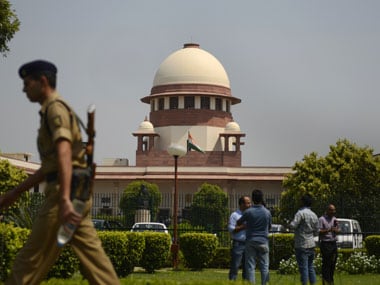
Representational image. AFP[/caption]Passive euthanasia is a condition where there is the withdrawal of medical treatment with the deliberate intention to hasten the death of a terminally-ill patient.A five-judge constitution bench headed by Chief Justice Dipak Misra had on 11 October last year reserved its verdict on the plea.The bench, also comprising justices A K Sikri, A M Khanwilkar, D Y Chandrachud and Ashok Bhushan, had indicated during the hearing that it might recognise the execution of 'living will' in cases of passive euthanasia, as right to die peacefully is part of fundamental right to life under Article 21 of the Constitution.Article 21 provides that "no person shall be deprived of his life or personal liberty except according to procedure established by law."The apex court, however, had observed that there should be adequate safeguards and implementation of living will be subject to medical board's certifying that the patient's comatose state is irreversible.The top court had in 2011 recognised passive euthanasia in Aruna Shanbaug's case by which it had permitted withdrawal of life-sustaining treatment from patients not in a position to make an informed decision.The Centre had opposed recognition of 'living will' and said the consent for removal of artificial support system given by a patient may not be an informed one and without being aware of medical advancements.It had cited examples of various countries in disallowing creation of the living will by patients.Advocate Prashant Bhushan, appearing for petitioner NGO Common Cause, had argued that safeguards were needed while taking a decision by medical boards to withdraw life support of a patient.The bench was hearing the PIL filed in 2005 by the NGO, which said when a medical expert is of the opinion that a person afflicted with a terminal disease has reached a point of no return, he should be given the right to refuse life support.On 15 January, 2016, the Centre had said the 241st report of the Law Commission stated that passive euthanasia should be allowed with certain safeguards and there was also a proposed law --Medical Treatment of Terminally Ill Patient (Protection of Patients and Medical Practitioners) Bill, 2006.It had said that on specific occasions, the question of withdrawing supporting devices to sustain cardio-pulmonary function even after brain death, shall be decided only by a doctors' team and not by the treating physician alone.

Govt to set up fast-track courts for swift punishment in paper leak cases, says PM Modi amid CJP protests
Sikkim tunnel collapse rescue resumes, death toll rises to 22
Delhi Police asks personnel to wear uniform: What the law says on cops in plainclothes during protests
No premium queues, 30-minute target: What changes for Indian passport applicants in UAE
CJP Protest in Delhi Live Updates: PM Modi announces announces fast-track courts for NEET paper leak cases