


SC directs Centre to respond to plea seeking to declare practices of polygamy, nikah halala as unconstitutional
The Supreme Court directed the Centre to respond to a plea seeking to declare the the practices of polygamy and 'nikah halala' as unconstitutional.

New Delhi: The Supreme Court on Monday directed the Centre to respond to a plea seeking to declare the provisions of Muslim Personal Law (Shariat) validating the practice of polygamy and 'nikah halala' as unconstitutional.A bench comprising Chief Justice Dipak Misra and Justices AM Khanwilkar and D Y Chandrachud, while issuing notice to the Centre and the National Commission for Women, also ordered tagging of the petition with other similar pleas which have already been referred to a five-judge constitution bench for further hearing.The order came on a separate petition, filed by Lucknow resident Naish Hasan.Senior lawyer VK Shukla and advocate Ashwini Kumar Upadhyay representing Hasan said similar pleas have already been admitted for hearing by a five-judge constitution bench."Declare Section 2 of the Muslim Personal Law (Shariat) Application Act, 1937, unconstitutional and violative of Articles 14 (Equality before law), 15 (Prohibition of discrimination on grounds of religion, race, caste, sex or place of birth) and 21 (Protection of life and personal liberty) of the Constitution, in so far as it seeks to recognise and validate the practice of polygamy, nikah halala, nikah mutah and nikah misyar," the plea said.[caption id="attachment_4443121" align="alignleft" width="380"]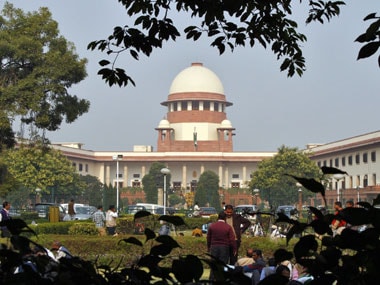 File image of Supreme Court. Reuters[/caption]Naish Hasan, in the fresh petition, said the pivotal issue that needed to be answered was whether under a secular Constitution, women, merely by virtue of their religious identity, can be relegated to a status significantly more vulnerable than their counterparts professing other faiths."The practices under challenge are practices which impact the social status and dignity of Muslim women and render them unequal and vulnerable qua men belonging to their own community; women belonging to other communities and also Muslim women outside India," Hasan said.'Nikah mutah' and 'nikah misyar' are both temporary marriages where the duration of the relationship is specified and agreed upon in advance.The apex court had on 26 March referred a batch of pleas challenging the practice of polygamy and others to the constitution bench.The bench had considered the submission that an earlier five-judge constitution bench, in its 2017 verdict, had kept open the issue of polygamy and 'nikah halala' while quashing triple talaq.While polygamy allows a Muslim man to have four wives, 'nikah halala' deals with the process in which a Muslim woman, who wants to remarry her husband after divorce, has to first marry another person and get divorce from him after consummation.By a majority of 3:2, a five-judge constitution bench, on 22 August last year, had banned the 1,400 year-old practice of instant 'triple talaq' among Sunni Muslims and set it aside on several grounds including that it was against the basic tenets of the Holy Quran and violated the Islamic law Shariat.

Govt to set up fast-track courts for swift punishment in paper leak cases, says PM Modi amid CJP protests
Sikkim tunnel collapse rescue resumes, death toll rises to 22
Delhi Police asks personnel to wear uniform: What the law says on cops in plainclothes during protests
No premium queues, 30-minute target: What changes for Indian passport applicants in UAE
CJP Protest in Delhi Live Updates: PM Modi announces announces fast-track courts for NEET paper leak cases