


RSS is changing its tune, but are its lyrics still the same? It needs to clarify, especially on the Muslim question
The true test of the RSS worldview, in the final analysis, would lie not in the lofty speeches of its leaders but by the banter that we hear among its cadres

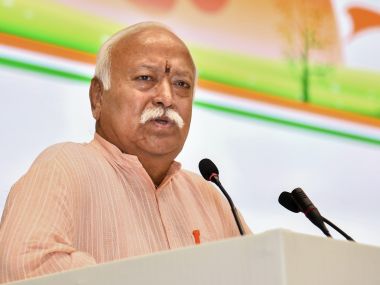
File image of RSS chief Mohan Bhagwat. PTI[/caption]The hard fact is that the RSS was not significantly active in the movement against British rule that was led by the Indian National Congress. While it is great to see the RSS recognising the Congress' role in the movement, the deeper question is of whether it is for Congress to recognise the RSS role in India's nationalist awakening or the other way around. Muslim leaders including Maulana Azad and Shahnawaz Khan were part of the fight against British rule and the RSS needs to reaffirm itself as an equal participant in nation-building rather than a patronising force.Bhagwat quoted Ambedkar, the leading figure in the authoring of the Indian Constitution, as backing a Buddhist view of "fraternity" rather than one inspired by the French Revolution. Much as it sounds good, the fact is that the French Revolution has inspired modern democracies with a sense of equality. In this view, diversity forms the very basis of fraternity, not just an "accommodation"."The Sangh works towards universal brotherhood and the cardinal principle of this brotherhood is diversity. This thought comes from our culture, which the world calls Hindutva," Bhagwat said. The fact is that the term Hindutva is itself one of recent vintage and less than 100 years old. It is used more in the lexicon of contemporary Indian politics than by the world at large.There is in the backdrop of all this the term "Hindu" itself. The flexible use of the word to sometimes mean the followers of a broad socio-religious regime representing an "Eternal Order" (Sanatana Dharma) and at other times meaning inhabitants of a landmass south of the Indus (Sindhu) since ancient times gives it a complex character that critics will see as a double-faced one.The RSS may be justified in having ideological worries linked to invasions, incursions or waves of immigration by Muslim warriors of Turkish, Afghan, Mongol (Mughal) or Persian descent, but it has to see the descendants of these people as equal citizens of a modern India and not as heirs of invaders or "foreigners", who need to be included from above by traditional inheritors of a homeland.A more articulate clarification on this would be appropriate on this issue as citizenship is increasingly defined by adherence to constitutional values than issues concerning race or origin.
The RSS chief has been making his conciliatory speeches at Vigyan Bhavan, named after science. A scientific contextualisation of his speech should include a clear-cut understanding of whether the Sangh is only softening its posture or whether it has had a clear change of heart and mind.RSS has its intellectual defenders, some of whom say the latest conference is a "turning point" and a "coming out party" for the RSS. If that is indeed the case, it is not old wine in a new bottle but a new brew altogether. For the world at large to believe that to be true, the RSS must say so clearly. It is one thing for apologists to say it has changed and another thing for the organisation itself to assert that it is not what it used to be. Even as recently as this month, the RSS gave a muted acceptance of the Supreme Court verdict that decriminalised same-sex relationships, calling it "unnatural" and against Indian tradition.Such views would make the RSS an organisation of reluctant constitutionalists, although Bhagwat must be lauded for explicitly saying, "The Constitution is the consensus of our country. Following the Constitution is everyone's duty."The true test of the RSS worldview, in the final analysis, would lie not in the lofty speeches of its leaders but by the banter that we hear among its cadres. It is not the nuanced words at Vigyan Bhavan that matter as much as how much the average "pracharak" knows of these words and shows in his behaviour. It is time for us to overhear conversations in the "chai pe charcha" at small-town tea shops where values of citizenship are discussed after a 'shakha' meeting.The author is a senior journalist. He tweets as @madversity

Govt to set up fast-track courts for swift punishment in paper leak cases, says PM Modi amid CJP protests
Sikkim tunnel collapse rescue resumes, death toll rises to 22
Delhi Police asks personnel to wear uniform: What the law says on cops in plainclothes during protests
No premium queues, 30-minute target: What changes for Indian passport applicants in UAE
CJP Protest in Delhi Live Updates: PM Modi announces announces fast-track courts for NEET paper leak cases