


Recent spate of nationwide protests underline impact of citizens' ideological assertion on Indian policy
Against the backdrop of violence in JNU and ideological fault lines running deeper than any other social cleavage, we need to take cognisance of a significant trend that has emerged in the past few years; ie ideological assertion by citizens and its impact on various fields including economy, foreign policy, education, defence

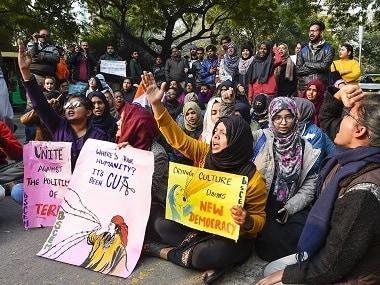
Women hold placards as they raise slogans during a demonstration at Delhi's Jantar Mantar. PTI[/caption]While the struggle for the masses to economically and socially empower themselves was incremental, Indira Gandhi's decision to impose Emergency played the role of a catalyst. When India elected her, she represented someone who had inherited the right to rule India (it was largely acceptable, since dynastic politics had not become deleterious as yet); when she imposed Emergency, she represented her who had also inherited the right to trample India. The 18 months of Emergency activated the known unknown among Indians; common Indians who otherwise didn't mind being ruled and controlled, hit the streets. India was divided between those who were determined to speak and those who wouldn't let them speak. The dormant seed of ideology had germinated.As the masses empowered themselves and reached the minimum economic threshold where they could afford to spend time and energy to ponder over issues beyond their daily bread, they wanted a say and stake rather than just universal adult suffrage. This included representatives who represented their lives, outfits that essayed their demands, activists who stood for their struggles, intellectuals who articulated their arguments, artists who narrated their story, newspapers that carried their voice etc.Humble families focussed on education; students worked hard to crack JEE/UPSC/AIIMS; and eventually became a part of those corridors that controlled the country in more ways than one. Ironically, as economic and social variables of the masses converged with the select few, the two groups never assimilated. The climbers were determined to take charge from inheritors and challenge the status quo strengthened with every passing decade. This was also the reason why the middle-class of India emerged as an identity, bound by a common value system, irrespective of their ethnic individualities.It is important to grasp the historical context to appreciate the rising assertion of the non-Left ideology (hereafter referred to as Neo-Right) in India. In the Triangle of Communication, from ideas to discussion to discourse to ideology, it has taken decades of persistence for the Neo-Right to equip itself with vocabulary and vehicles to communicate what it stands for. Conspicuous by their middle-income status, and unwillingness to compromise their value system, the Neo-Right held the inheritors responsible for their delayed access to resources and the permanent 'developing nation' status of India.For example, there were multiple efforts to give Ram Janmabhoomi the shape of a country-wide movement. Right from the 1950s to the Dharma Sansad in 1984, the struggle was united by cause but limited by means. It was only in 1990s, when the middle-class had found a voice for itself across cinema, literature, media, and politics that LK Advani's rath yatra established a connection with this section of society. Similarly, it has taken three decades for the rendition of Kashmiri Pandits to become a mainstream issue.With this in view, to say that policymaking is divorced from ideological bent would be grossly incorrect. Every policy has an objective. This objective is linked to the larger vision of the policy makers (here: Lawmakers). For example, the Pradhan Mantri Ujjwala Yojana is a policy intervention guided by the intention to reduce in house air pollution improve ease of living, dominated by the larger objective of women empowerment. MUDRA is a policy intervention to buttress entrepreneurship and eventually drive India towards a self-sufficient nation, guided by the principle of Swadesi. The Citizenship Amendment Act which aims to provide dignity to those religious minorities who have been denied their basic rights due to their belief system, is influenced by the overarching sentiment against partition of India on religious lines. Free market philosophy is reflected in increased privatisation and new liberties for businesses.Strong alignment of policymaking with the overarching ideology makes for robust political communication too. Between a party that spells out its promises and a party that presents a blueprint, the choices are obviously in favour of unambiguity. As India grows economically and the masses catch up with the classes, political parties will need to offer ideological coherence with their promises and express what they stand for. They will no more be able to balance their vote banks by toggling on their stance based on convenience; If they stand for minorities, they will have to do so for minorities of Pakistan too; if they support gender equality, they will have to oppose practices like triple talaq.This is perhaps also the rise of an India where the common citizens have staked their claim and demand their due share across dimensions of nation-building.

Bharat Forge, Flying Whales sign pact to develop 60-tonne airships for India’s defence logistics
Air India to cut Delhi-Toronto flight time by 3 hours, resume non-stop services from August 1
J&K cop on Amarnath Yatra duty shot dead in Anantnag terror attack; TRF claims responsibility
Jaishankar meets Canada's Anita Anand, discusses bilateral cooperation and shared interests
Delhi, Bengaluru, Hyderabad... Neet paper leak protest spreads nationwide even as govt reaches out to CJP, Opposition