
Advertisement


Sections
Prevention of Corruption Act: Watered down version will make scamsters look like saints
The government's decision to allow the Prevention of Corruption Bill, a ludicrously watered down version, casts a shadow on its real intent and long term vision on reigning in corruption

It might be fashionable to beat one's chest in public about corruption, and undertake financial lynching pogroms like the demonetisation scheme, but in reality, much of the government's back room activity, drafted by the powerful and highly corrupt IAS lobby, continues to prioritise protecting — or even empowering — the corrupt.A strong whiff of this comes from the NDA government's decision to back the passage of the Prevention of Corruption (PC) Bill, 2013, a ludicrously whittled down version of the Prevention of Corruption Act, 1988, which has been carefully designed to make the accused in the 2G, CWG, Coalgate and AgustaWestland scams look like saints.Offences defined by the existing Act fall into three broad categories: Trap cases in which corrupt public servants, middlemen, etc, are caught red-handed taking bribes; abuse of official position which targets corruption at higher places; and disproportionate assets.[caption id="attachment_3154478" align="alignleft" width="380"]![Accused in big ticket corruption scandals like AgustaWestland scam may now have an easier time. Reuters file image]() Accused in big ticket corruption scandals like AgustaWestland scam may now have an easier time. Reuters file image[/caption]The proposed amendments, which have been cleared by a Rajya Sabha select committee on the PC Act, severely limit the probability of corrupt public servants being caught taking bribes red handed, restrict the capacity of investigating agencies to prosecute corrupt public servants accused of owning disproportionate assets, and severely dilute the offence of abuse of official position. As a result, senior government officials will have fewer chances of getting caught or being punished.It further emasculates the Lokpal Act, which is supposed to fight corruption at higher levels. However, if acts of commission and omission by senior government officials are sought to be blatantly decriminalised through these proposed amendments, what can the Lokpal be expected to do?What is most curious is how the entire Rajya Sabha committee, including Members of Parliament of varying political colour — who are often heard lending high decibel disapproval towards big corruption in the media — have consented to this damning piece of legislation.The committee on corruption:
Accused in big ticket corruption scandals like AgustaWestland scam may now have an easier time. Reuters file image[/caption]The proposed amendments, which have been cleared by a Rajya Sabha select committee on the PC Act, severely limit the probability of corrupt public servants being caught taking bribes red handed, restrict the capacity of investigating agencies to prosecute corrupt public servants accused of owning disproportionate assets, and severely dilute the offence of abuse of official position. As a result, senior government officials will have fewer chances of getting caught or being punished.It further emasculates the Lokpal Act, which is supposed to fight corruption at higher levels. However, if acts of commission and omission by senior government officials are sought to be blatantly decriminalised through these proposed amendments, what can the Lokpal be expected to do?What is most curious is how the entire Rajya Sabha committee, including Members of Parliament of varying political colour — who are often heard lending high decibel disapproval towards big corruption in the media — have consented to this damning piece of legislation.The committee on corruption:![Corruption committee]() The most damning feature of the PC Bill:The biggest giveaway of the real intent behind the redrafting of the PC Act is the deletion of Section 13(1)(d) in its entirety, despite it being the only provision which made senior government officials liable for criminal action in a multitude of big ticket corruption scandals like Bofors, 2G spectrum, CWG, Coalgate, AgustaWestland, etc. This section defines 'Abuse of Official Position' under the overall category of ‘Criminal misconduct by a public servant’.It's inexplicable that the entire section has been deleted, despite the fact that criticism from the bureaucracy has been limited to sub-clause (iii) relating to "public interest": A public servant is said to commit the offense of criminal misconduct, if he, while holding office as a public servant, obtains for any person any valuable thing or pecuniary advantage without any public interest.Although even criticism of this sub-clause is misplaced, considering that data shows that not many public servants have actually been charged on this count. Maximum cases involving 'Abuse of Official Position' have been registered under the first two sub-clauses of section 13(1)(d), which have attracted no dispute. And yet, strangely, the bill proposes to delete all three sub-clauses, ie the entire Section 13(1)(d) of the PC Act.The government's likely defence will be that Section 13(1)(d) has been merged with Section 7, not deleted. The argument is specious considering that the expanded Section 7 of the new bill relates to the offence of direct bribing (like bribing a traffic policeman, revenue official or junior engineer). The bigger offense of 'Abuse of Official Position' has been relegated to a small clause, hanging weakly to Section 7 by the slender rope of Explanation 2 Clause (i).Explanations in law are meant to clear doubts, not to define substantive offences. Merging a bigger offence like a sub-clause with a smaller one is like clubbing murder (Section 302 IPC) with causing hurt/injury (Section 323 IPC). The move affords multiple complications without any gains whatsoever.Presently, in order to prove abuse of official position (criminal misconduct) as defined in Section 13(1)(d), of the Prevention of Corruption Act, 1988, all that an investigating officer has to do is to prove violation of legal provisions, rules, guidelines or procedures and resultant undue pecuniary advantage accrued to anyone, including a third party (not necessarily the accused himself). There is no need to prove any bribery or direct quid pro quo in the transaction. This provision was inserted to deal with corruption in high places, where a public servant may receive illegal gratification in a clandestine manner (off-shore transactions or non-monetary considerations, like a better posting, post-retirement benefits, etc).Delinking acts of abuse of official position (criminal misconduct) from Section 13, and clubbing it with Section 7 (bribery) only serves to place the additional burden of proving bribery or direct quid pro quo on the investigating officer.Further, the amendments have purportedly been introduced for the purpose of compliance with the United Nations Convention against Corruption (UNCAC). Article 19 of the UNCAC relating to "Abuse of Functions" is the same as "Criminal Misconduct" as defined under Section 13(1)(d). Deletion of this provision, therefore, is in violation of the UNCAC as well.Multiple getaway options scripted for the corrupt:Section 7 (Public servant taking gratification other than legal remuneration in respect of an official act) has been completely rephrased under the guise of drafting a "comprehensive definition of bribery". The inherent danger in changing the language is that it opens it up to fresh legal interpretation, which had been settled though several court judgements over the years.Sections 8, 9 and 10 (Offences relating to public servant(s) being bribed; to bribing a public servant; and bribing a public servant by a commercial organisation, respectively) were all deleted on grounds that these are covered under the new definition of bribery.The existing Sections 8 and 9 are very important provisions in the PC Act, as they are meant to penalise middlemen who act as conduits for dishonest civil servants. Since middlemen are rampant in most public offices, taking bribes from them was made a substantive offence. The proposed amendments ensure that these undesirable elements are only dealt with indirectly, under Section 12, which deals with abetment. This will also make it harder to deal with the menace of touts.In summary, no effective substitutes for these three offences are spelled out in the proposed bill, especially Section 10, since while abetment of an offence is an offence, the abetment of abetment is not.Section 11 (Public servant obtaining a valuable thing without consideration from person concerned in proceeding or business transacted by such public servant) has also been deleted without providing any substitute, contrary to claims made in the statement of objects and reasons. Therefore, corruption/misconduct of this nature will now only be dealt with under the conduct rules, which have long become defunct, with no action taken for violations despite detailed media exposes, as in the case of NABARD's former chairman, Prakash Bakshi.The proposed Bill extends the benefit of Section 19 (previous sanction necessary for prosecution) to retired public servants as well. In addition, it makes seeking of prosecution sanction by private persons more difficult by putting in a requirement of a court order to that effect. This is aimed at discouraging anti-corruption crusaders from petitioning the government seeking prosecution sanction against political bigwigs.If the new bill is enacted, disproportionate assets (DA) cases, which are already hard to prove, will be hit harder vide two major changes:
The most damning feature of the PC Bill:The biggest giveaway of the real intent behind the redrafting of the PC Act is the deletion of Section 13(1)(d) in its entirety, despite it being the only provision which made senior government officials liable for criminal action in a multitude of big ticket corruption scandals like Bofors, 2G spectrum, CWG, Coalgate, AgustaWestland, etc. This section defines 'Abuse of Official Position' under the overall category of ‘Criminal misconduct by a public servant’.It's inexplicable that the entire section has been deleted, despite the fact that criticism from the bureaucracy has been limited to sub-clause (iii) relating to "public interest": A public servant is said to commit the offense of criminal misconduct, if he, while holding office as a public servant, obtains for any person any valuable thing or pecuniary advantage without any public interest.Although even criticism of this sub-clause is misplaced, considering that data shows that not many public servants have actually been charged on this count. Maximum cases involving 'Abuse of Official Position' have been registered under the first two sub-clauses of section 13(1)(d), which have attracted no dispute. And yet, strangely, the bill proposes to delete all three sub-clauses, ie the entire Section 13(1)(d) of the PC Act.The government's likely defence will be that Section 13(1)(d) has been merged with Section 7, not deleted. The argument is specious considering that the expanded Section 7 of the new bill relates to the offence of direct bribing (like bribing a traffic policeman, revenue official or junior engineer). The bigger offense of 'Abuse of Official Position' has been relegated to a small clause, hanging weakly to Section 7 by the slender rope of Explanation 2 Clause (i).Explanations in law are meant to clear doubts, not to define substantive offences. Merging a bigger offence like a sub-clause with a smaller one is like clubbing murder (Section 302 IPC) with causing hurt/injury (Section 323 IPC). The move affords multiple complications without any gains whatsoever.Presently, in order to prove abuse of official position (criminal misconduct) as defined in Section 13(1)(d), of the Prevention of Corruption Act, 1988, all that an investigating officer has to do is to prove violation of legal provisions, rules, guidelines or procedures and resultant undue pecuniary advantage accrued to anyone, including a third party (not necessarily the accused himself). There is no need to prove any bribery or direct quid pro quo in the transaction. This provision was inserted to deal with corruption in high places, where a public servant may receive illegal gratification in a clandestine manner (off-shore transactions or non-monetary considerations, like a better posting, post-retirement benefits, etc).Delinking acts of abuse of official position (criminal misconduct) from Section 13, and clubbing it with Section 7 (bribery) only serves to place the additional burden of proving bribery or direct quid pro quo on the investigating officer.Further, the amendments have purportedly been introduced for the purpose of compliance with the United Nations Convention against Corruption (UNCAC). Article 19 of the UNCAC relating to "Abuse of Functions" is the same as "Criminal Misconduct" as defined under Section 13(1)(d). Deletion of this provision, therefore, is in violation of the UNCAC as well.Multiple getaway options scripted for the corrupt:Section 7 (Public servant taking gratification other than legal remuneration in respect of an official act) has been completely rephrased under the guise of drafting a "comprehensive definition of bribery". The inherent danger in changing the language is that it opens it up to fresh legal interpretation, which had been settled though several court judgements over the years.Sections 8, 9 and 10 (Offences relating to public servant(s) being bribed; to bribing a public servant; and bribing a public servant by a commercial organisation, respectively) were all deleted on grounds that these are covered under the new definition of bribery.The existing Sections 8 and 9 are very important provisions in the PC Act, as they are meant to penalise middlemen who act as conduits for dishonest civil servants. Since middlemen are rampant in most public offices, taking bribes from them was made a substantive offence. The proposed amendments ensure that these undesirable elements are only dealt with indirectly, under Section 12, which deals with abetment. This will also make it harder to deal with the menace of touts.In summary, no effective substitutes for these three offences are spelled out in the proposed bill, especially Section 10, since while abetment of an offence is an offence, the abetment of abetment is not.Section 11 (Public servant obtaining a valuable thing without consideration from person concerned in proceeding or business transacted by such public servant) has also been deleted without providing any substitute, contrary to claims made in the statement of objects and reasons. Therefore, corruption/misconduct of this nature will now only be dealt with under the conduct rules, which have long become defunct, with no action taken for violations despite detailed media exposes, as in the case of NABARD's former chairman, Prakash Bakshi.The proposed Bill extends the benefit of Section 19 (previous sanction necessary for prosecution) to retired public servants as well. In addition, it makes seeking of prosecution sanction by private persons more difficult by putting in a requirement of a court order to that effect. This is aimed at discouraging anti-corruption crusaders from petitioning the government seeking prosecution sanction against political bigwigs.If the new bill is enacted, disproportionate assets (DA) cases, which are already hard to prove, will be hit harder vide two major changes:
 Accused in big ticket corruption scandals like AgustaWestland scam may now have an easier time. Reuters file image[/caption]The proposed amendments, which have been cleared by a Rajya Sabha select committee on the PC Act, severely limit the probability of corrupt public servants being caught taking bribes red handed, restrict the capacity of investigating agencies to prosecute corrupt public servants accused of owning disproportionate assets, and severely dilute the offence of abuse of official position. As a result, senior government officials will have fewer chances of getting caught or being punished.It further emasculates the Lokpal Act, which is supposed to fight corruption at higher levels. However, if acts of commission and omission by senior government officials are sought to be blatantly decriminalised through these proposed amendments, what can the Lokpal be expected to do?What is most curious is how the entire Rajya Sabha committee, including Members of Parliament of varying political colour — who are often heard lending high decibel disapproval towards big corruption in the media — have consented to this damning piece of legislation.The committee on corruption:
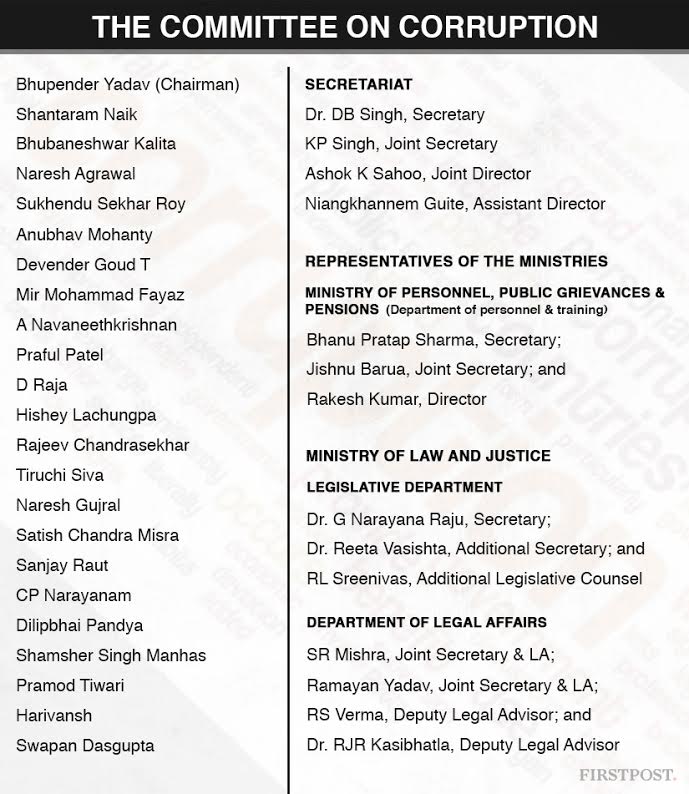 The most damning feature of the PC Bill:The biggest giveaway of the real intent behind the redrafting of the PC Act is the deletion of Section 13(1)(d) in its entirety, despite it being the only provision which made senior government officials liable for criminal action in a multitude of big ticket corruption scandals like Bofors, 2G spectrum, CWG, Coalgate, AgustaWestland, etc. This section defines 'Abuse of Official Position' under the overall category of ‘Criminal misconduct by a public servant’.It's inexplicable that the entire section has been deleted, despite the fact that criticism from the bureaucracy has been limited to sub-clause (iii) relating to "public interest": A public servant is said to commit the offense of criminal misconduct, if he, while holding office as a public servant, obtains for any person any valuable thing or pecuniary advantage without any public interest.Although even criticism of this sub-clause is misplaced, considering that data shows that not many public servants have actually been charged on this count. Maximum cases involving 'Abuse of Official Position' have been registered under the first two sub-clauses of section 13(1)(d), which have attracted no dispute. And yet, strangely, the bill proposes to delete all three sub-clauses, ie the entire Section 13(1)(d) of the PC Act.The government's likely defence will be that Section 13(1)(d) has been merged with Section 7, not deleted. The argument is specious considering that the expanded Section 7 of the new bill relates to the offence of direct bribing (like bribing a traffic policeman, revenue official or junior engineer). The bigger offense of 'Abuse of Official Position' has been relegated to a small clause, hanging weakly to Section 7 by the slender rope of Explanation 2 Clause (i).Explanations in law are meant to clear doubts, not to define substantive offences. Merging a bigger offence like a sub-clause with a smaller one is like clubbing murder (Section 302 IPC) with causing hurt/injury (Section 323 IPC). The move affords multiple complications without any gains whatsoever.Presently, in order to prove abuse of official position (criminal misconduct) as defined in Section 13(1)(d), of the Prevention of Corruption Act, 1988, all that an investigating officer has to do is to prove violation of legal provisions, rules, guidelines or procedures and resultant undue pecuniary advantage accrued to anyone, including a third party (not necessarily the accused himself). There is no need to prove any bribery or direct quid pro quo in the transaction. This provision was inserted to deal with corruption in high places, where a public servant may receive illegal gratification in a clandestine manner (off-shore transactions or non-monetary considerations, like a better posting, post-retirement benefits, etc).Delinking acts of abuse of official position (criminal misconduct) from Section 13, and clubbing it with Section 7 (bribery) only serves to place the additional burden of proving bribery or direct quid pro quo on the investigating officer.Further, the amendments have purportedly been introduced for the purpose of compliance with the United Nations Convention against Corruption (UNCAC). Article 19 of the UNCAC relating to "Abuse of Functions" is the same as "Criminal Misconduct" as defined under Section 13(1)(d). Deletion of this provision, therefore, is in violation of the UNCAC as well.Multiple getaway options scripted for the corrupt:Section 7 (Public servant taking gratification other than legal remuneration in respect of an official act) has been completely rephrased under the guise of drafting a "comprehensive definition of bribery". The inherent danger in changing the language is that it opens it up to fresh legal interpretation, which had been settled though several court judgements over the years.Sections 8, 9 and 10 (Offences relating to public servant(s) being bribed; to bribing a public servant; and bribing a public servant by a commercial organisation, respectively) were all deleted on grounds that these are covered under the new definition of bribery.The existing Sections 8 and 9 are very important provisions in the PC Act, as they are meant to penalise middlemen who act as conduits for dishonest civil servants. Since middlemen are rampant in most public offices, taking bribes from them was made a substantive offence. The proposed amendments ensure that these undesirable elements are only dealt with indirectly, under Section 12, which deals with abetment. This will also make it harder to deal with the menace of touts.In summary, no effective substitutes for these three offences are spelled out in the proposed bill, especially Section 10, since while abetment of an offence is an offence, the abetment of abetment is not.Section 11 (Public servant obtaining a valuable thing without consideration from person concerned in proceeding or business transacted by such public servant) has also been deleted without providing any substitute, contrary to claims made in the statement of objects and reasons. Therefore, corruption/misconduct of this nature will now only be dealt with under the conduct rules, which have long become defunct, with no action taken for violations despite detailed media exposes, as in the case of NABARD's former chairman, Prakash Bakshi.The proposed Bill extends the benefit of Section 19 (previous sanction necessary for prosecution) to retired public servants as well. In addition, it makes seeking of prosecution sanction by private persons more difficult by putting in a requirement of a court order to that effect. This is aimed at discouraging anti-corruption crusaders from petitioning the government seeking prosecution sanction against political bigwigs.If the new bill is enacted, disproportionate assets (DA) cases, which are already hard to prove, will be hit harder vide two major changes:
- In addition to proving disproportion (excess assets acquired by the public servant over known sources of his income over a period of time), the investigator will now also have to prove that the said disproportion is on account of "intentional enrichment by the public servant in an illicit manner".
- The term "known sources of income" in the existing act is very specific and means income received from any lawful source, and such receipt has been intimated in accordance with the provisions of any law, rules or orders for the time being applicable to a public servant.
First Published:Dec 13, 2016, 16:35:45 IST
Advertisement
Advertisement

CJP protest in Delhi: New videos of stone pelting, violence emerge as police, agitators trade charges
Fresh videos of violence that broke out during the Cockroach Janta Party's (CJP) protest in Delhi have surfaced, with the police releasing footage showing alleged stone pelting, vandalism and attacks on security personnel
3 min read
'From make in India to launch from India': Skyroot COO on why Vikram-1 could change India’s space sector
Skyroot Aerospace’s successful Vikram-1 mission marks a major milestone for India’s private space sector, as the country seeks to shift from “Make in India” to “Launch from India” and compete in the global commercial satellite launch market
8 min read
Choke terror funding, keep international shipping lanes safe: Jaishankar at Asean Regional Forum
Jaishankar's remarks came against the backdrop of recent terror attacks targeting India and growing threats to commercial shipping amid conflicts in West Asia and Europe
2 min read
PM Modi announces fast-track courts for paper leak cases; CJP responds ‘Dharmendra Pradhan must go’
Amid protests demanding accountability for the leak of medical entrance test Neet and other irregularities in the education system, Prime Minister Narendra Modi has announced that the government has decided to set up fast-track courts to ensure swift and stringent punishment for those involved in paper leaks.
3 min read
Sikkim tunnel collapse rescue resumes, death toll rises to 22
The death toll at the collapsed tunnel at Sikkim's Namchi district rose to 22 after nine more bodies were recovered overnight. At least 27 workers were trapped in a tunnel at an NHPC project after a sudden burst of suspected methane gas trapped within rock formations triggered an explosion.
2 min read
Advertisement
Advertisement