
Advertisement


Sections
PM Modi to inaugurate underground museum in Mumbai: What you need to know
While the museum is special for its theme of the Indian Independence Movement, its location is equally significant as it has come up in a network of pre-World War I British-era bunkers that were discovered under the Raj Bhavan in 2016

Prime Minister Narendra Modi will inaugurate the country's first-ever underground 'Gallery of Revolutionaries', a museum dedicated to the luminaries of the Indian Independence Movement, created at the Maharashtra Raj Bhavan, on Tuesday.While the museum is special for its theme, its location is equally significant as it has come up in a network of pre-World War I British-era bunkers. Here is everything you need to know about the museum:The Prime Minister will throw open the gallery themed 'Revolution Saga' that has come up in the subterranean network of 13 pre-World War-I (First WW) British era bunkers, discovered in the sprawling Raj Bhavan campus in August 2016 during the tenure of the then Governor C. Vidyasagar Rao.Later, current Governor Bhagat Singh Koshyari oversaw the setting up of the ‘Gallery of Revolutionaries’ under the guidance of historian Vikram Sampat and help from South Central Cultural Centre, Nagpur.[caption id="attachment_10793231" align="alignnone" width="640"]![The external and interior view of the Gallery of Revolutionaries museum at Mumbai's Raj Bhavan.]() The external and interior view of the Gallery of Revolutionaries museum at Mumbai's Raj Bhavan.[/caption]In the first phase, the museum features rebels like Vasudev Balwant Phadke, Damodar Hari Chapekar and Vishnu Hari Chapekar (Chapekar Brothers), Lokmanya Bal Gangadhar Tilak, the Savarkar Brothers - Vinayak Damodar Savarkar (Veer Savarkar) and Ganesh Damodar Savarkar (Babarao Savarkar), Anant Laxman Kanhere, Vishnu Ganesh Pingale, Vasudev Balwant Gogate, Krantiguru Lahuji Raghoji Salve, Bhikaiji Rustom Cama (Madam Cama), Shivran H. Rajguru, the country's first armed fighter organisation 'Abhinav Bharat', 'Patri Sarkar', etc.There will be hundreds of others, known and unknown, who will figure at the museum in its later phases, depicting the entire 'Revolution Saga' of 90 years, from the First War of Independence in 1857 to India's Freedom in 1947, said Raj Bhavan officials.The gallery includes information on the freedom heroes, their role in the Independence movement, sculptures, rare photographs, murals and even details on tribal revolutionaries drawn by school kids.The stuff on display has been sourced from the State Archives Department, Asiatic Society, Kesari Archives, Savarkar Museum, etc, and also includes a scene from the historic Coronation of Chhatrapati Shivaji Maharaj in the hall of the underground hall of the bunkers.The historic underground siteSoon after the bunker's discovery in August 2016, the government ordered the conservation of the underground structure which was neglected for over a century with the constant water leakages rendering the 'Jalbhushan' building standing above it architecturally unsafe."The bunker has been conserved without compromising the security of the historic building which is the heritage of Raj Bhavan and the Governor's residence and office, 'Jalbhushan' stands on the upper side of it," said an official.A structural audit of the underground bunker - comprising 13 rooms of various sizes plus a grand 20-feet-tall entrance, a fort-like structure with a long ramp to take guns inside - was carried out and then it was strengthened by expert teams.[caption id="attachment_10793221" align="alignnone" width="640"]
The external and interior view of the Gallery of Revolutionaries museum at Mumbai's Raj Bhavan.[/caption]In the first phase, the museum features rebels like Vasudev Balwant Phadke, Damodar Hari Chapekar and Vishnu Hari Chapekar (Chapekar Brothers), Lokmanya Bal Gangadhar Tilak, the Savarkar Brothers - Vinayak Damodar Savarkar (Veer Savarkar) and Ganesh Damodar Savarkar (Babarao Savarkar), Anant Laxman Kanhere, Vishnu Ganesh Pingale, Vasudev Balwant Gogate, Krantiguru Lahuji Raghoji Salve, Bhikaiji Rustom Cama (Madam Cama), Shivran H. Rajguru, the country's first armed fighter organisation 'Abhinav Bharat', 'Patri Sarkar', etc.There will be hundreds of others, known and unknown, who will figure at the museum in its later phases, depicting the entire 'Revolution Saga' of 90 years, from the First War of Independence in 1857 to India's Freedom in 1947, said Raj Bhavan officials.The gallery includes information on the freedom heroes, their role in the Independence movement, sculptures, rare photographs, murals and even details on tribal revolutionaries drawn by school kids.The stuff on display has been sourced from the State Archives Department, Asiatic Society, Kesari Archives, Savarkar Museum, etc, and also includes a scene from the historic Coronation of Chhatrapati Shivaji Maharaj in the hall of the underground hall of the bunkers.The historic underground siteSoon after the bunker's discovery in August 2016, the government ordered the conservation of the underground structure which was neglected for over a century with the constant water leakages rendering the 'Jalbhushan' building standing above it architecturally unsafe."The bunker has been conserved without compromising the security of the historic building which is the heritage of Raj Bhavan and the Governor's residence and office, 'Jalbhushan' stands on the upper side of it," said an official.A structural audit of the underground bunker - comprising 13 rooms of various sizes plus a grand 20-feet-tall entrance, a fort-like structure with a long ramp to take guns inside - was carried out and then it was strengthened by expert teams.[caption id="attachment_10793221" align="alignnone" width="640"]![A replica of a cannon used during the times of the British Raj.]() A replica of a cannon used during the times of the British Raj.[/caption]The cells in the bunker were known as 'Shell Store', 'Gun Shell', 'Cartridge Store', 'Shell Lift', 'Central Artillery Room', 'Workshop', etc, it had a proper drainage system, clean air and natural light plus lamp recesses kept in different places to illuminate it at night.The conservationists took full care to preserve all the original features while restoring the bunker as well as now hosting the gallery of revolutionaries in that place.Incidentally, on August 18, 2019, President Ram Nath Kovind had inaugurated a virtual reality museum in the bunker, but many other rooms were empty and now have been utilised for the Revolution Saga gallery.All photos by Suryasarathi Bhattacharya for FirstpostWith inputs from agenciesRead all the Latest News, Trending News, Cricket News, Bollywood News,India News and Entertainment News here. Follow us on Facebook, Twitter and Instagram.
A replica of a cannon used during the times of the British Raj.[/caption]The cells in the bunker were known as 'Shell Store', 'Gun Shell', 'Cartridge Store', 'Shell Lift', 'Central Artillery Room', 'Workshop', etc, it had a proper drainage system, clean air and natural light plus lamp recesses kept in different places to illuminate it at night.The conservationists took full care to preserve all the original features while restoring the bunker as well as now hosting the gallery of revolutionaries in that place.Incidentally, on August 18, 2019, President Ram Nath Kovind had inaugurated a virtual reality museum in the bunker, but many other rooms were empty and now have been utilised for the Revolution Saga gallery.All photos by Suryasarathi Bhattacharya for FirstpostWith inputs from agenciesRead all the Latest News, Trending News, Cricket News, Bollywood News,India News and Entertainment News here. Follow us on Facebook, Twitter and Instagram.
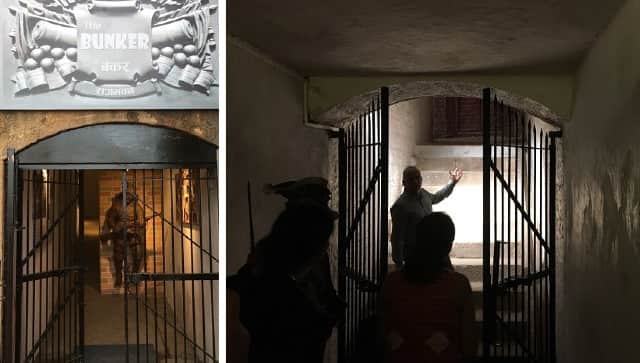 The external and interior view of the Gallery of Revolutionaries museum at Mumbai's Raj Bhavan.[/caption]In the first phase, the museum features rebels like Vasudev Balwant Phadke, Damodar Hari Chapekar and Vishnu Hari Chapekar (Chapekar Brothers), Lokmanya Bal Gangadhar Tilak, the Savarkar Brothers - Vinayak Damodar Savarkar (Veer Savarkar) and Ganesh Damodar Savarkar (Babarao Savarkar), Anant Laxman Kanhere, Vishnu Ganesh Pingale, Vasudev Balwant Gogate, Krantiguru Lahuji Raghoji Salve, Bhikaiji Rustom Cama (Madam Cama), Shivran H. Rajguru, the country's first armed fighter organisation 'Abhinav Bharat', 'Patri Sarkar', etc.There will be hundreds of others, known and unknown, who will figure at the museum in its later phases, depicting the entire 'Revolution Saga' of 90 years, from the First War of Independence in 1857 to India's Freedom in 1947, said Raj Bhavan officials.The gallery includes information on the freedom heroes, their role in the Independence movement, sculptures, rare photographs, murals and even details on tribal revolutionaries drawn by school kids.The stuff on display has been sourced from the State Archives Department, Asiatic Society, Kesari Archives, Savarkar Museum, etc, and also includes a scene from the historic Coronation of Chhatrapati Shivaji Maharaj in the hall of the underground hall of the bunkers.The historic underground siteSoon after the bunker's discovery in August 2016, the government ordered the conservation of the underground structure which was neglected for over a century with the constant water leakages rendering the 'Jalbhushan' building standing above it architecturally unsafe."The bunker has been conserved without compromising the security of the historic building which is the heritage of Raj Bhavan and the Governor's residence and office, 'Jalbhushan' stands on the upper side of it," said an official.A structural audit of the underground bunker - comprising 13 rooms of various sizes plus a grand 20-feet-tall entrance, a fort-like structure with a long ramp to take guns inside - was carried out and then it was strengthened by expert teams.[caption id="attachment_10793221" align="alignnone" width="640"]
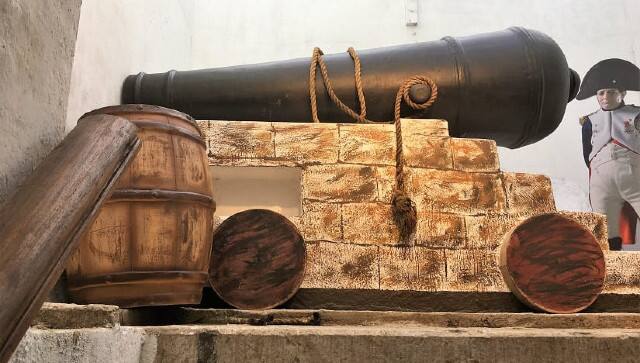 A replica of a cannon used during the times of the British Raj.[/caption]The cells in the bunker were known as 'Shell Store', 'Gun Shell', 'Cartridge Store', 'Shell Lift', 'Central Artillery Room', 'Workshop', etc, it had a proper drainage system, clean air and natural light plus lamp recesses kept in different places to illuminate it at night.The conservationists took full care to preserve all the original features while restoring the bunker as well as now hosting the gallery of revolutionaries in that place.Incidentally, on August 18, 2019, President Ram Nath Kovind had inaugurated a virtual reality museum in the bunker, but many other rooms were empty and now have been utilised for the Revolution Saga gallery.All photos by Suryasarathi Bhattacharya for FirstpostWith inputs from agenciesRead all the Latest News, Trending News, Cricket News, Bollywood News,India News and Entertainment News here. Follow us on Facebook, Twitter and Instagram.
First Published:Jun 14, 2022, 15:43:39 IST
Advertisement
Advertisement

'From make in India to launch from India': Skyroot COO on why Vikram-1 could change India’s space sector
Skyroot Aerospace’s successful Vikram-1 mission marks a major milestone for India’s private space sector, as the country seeks to shift from “Make in India” to “Launch from India” and compete in the global commercial satellite launch market
8 min read
Choke terror funding, keep international shipping lanes safe: Jaishankar at Asean Regional Forum
Jaishankar's remarks came against the backdrop of recent terror attacks targeting India and growing threats to commercial shipping amid conflicts in West Asia and Europe
2 min read
PM Modi announces fast-track courts for paper leak cases; CJP responds ‘Dharmendra Pradhan must go’
Amid protests demanding accountability for the leak of medical entrance test Neet and other irregularities in the education system, Prime Minister Narendra Modi has announced that the government has decided to set up fast-track courts to ensure swift and stringent punishment for those involved in paper leaks.
3 min read
Sikkim tunnel collapse rescue resumes, death toll rises to 22
The death toll at the collapsed tunnel at Sikkim's Namchi district rose to 22 after nine more bodies were recovered overnight. At least 27 workers were trapped in a tunnel at an NHPC project after a sudden burst of suspected methane gas trapped within rock formations triggered an explosion.
2 min read
Delhi Police asks personnel to wear uniform: What the law says on cops in plainclothes during protests
The Delhi Police has instructed all its personnel to wear uniforms when they report for duty at Jantar Mantar for crowd control. This comes after outrage grew over videos of men in civilian clothes or without name tags hitting protesters in the Capital. Is it legal for the police to ditch uniforms during protests?
4 min read
Advertisement
Advertisement