
Advertisement


Sections
No water in taps: Why Delhi has issued a water SOS to Haryana
The Delhi Jal Board has asked Haryana to send an additional 150 cusecs of water, as water levels at the Wazirabad pond have reduced due to less flow in the Yamuna river

Delhi’s woes don’t seem to be stopping.After facing a blistering heatwave, an acute shortage of coal, now, the Capital is staring at a water crisis.People living in northeast Delhi, west Delhi, north Delhi, central Delhi, south Delhi, including Delhi Cantonment, and New Delhi Municipal Council areas are struggling with less water.The Vasant Vihar Welfare Association took to Twitter to share their complaints about water shortage.Elsewhere, Sadh Nagar resident Vimla was quoted as telling Navbharat Times that previously, water would come for 10 minutes around 4 am each day during which she would fill one to two buckets of water and resume work. However, in the last few days, there has been no water. She is continuously waking up, checking the taps, and returning dissatisfied.Residents of New Gupta Colony Sector-10 also have the same complaint — that they get up early every morning and wait until late at night for water, but there has been no water for several days.Shahbaz Singh, a resident of west Delhi’s Rajouri Garden, was quoted as telling Hindustan Times that a similar situation prevailed in J-12 block of the area where “taps have been running dry for the last three days”.The situation has become so dire that the Aam Aadmi Party-led government in the Capital has written to the Haryana Irrigation Department, for a second time in a week, asking it to release additional water in the Yamuna to prevent disruption in water supply in the capital.We take a closer look at Delhi’s water shortage and the reason behind it.Delhi’s water woesThe production levels at two of Delhi's Jal Board's (DJB) biggest water treatment plants has reduced drastically.According to officials, the water level at the Wazirabad pond has dropped to a critically low level of 672.6 feet, against the normal of 674.5 feet.Moreover, the output at the Haiderpur plant has also dipped. The Haiderpur WTP, the largest in Delhi supplying around 225 MGD of water to the city residents, is facing operational issues.The DJB said that there was excessive floating material choking the filter beds, causing problems.The flow in the Carried Lined Channel (CLC) and Delhi Sub-Branch (DSB), the channels that bring river water into Delhi from Haryana, is also “fluctuating”. The flow in the CLC was 563 cusecs against a normal of 683 cusecs.[caption id="attachment_10632771" align="alignnone" width="640"]![Residents use hoses to collect drinking water from a tanker truck during a hot summer day in New Delhi. AFP]() Residents use hoses to collect drinking water from a tanker truck during a hot summer day in New Delhi. AFP[/caption]Reason for water scarcityAccording to officials, the sweltering heat is the driving factor for the water scarcity in the Capital.A senior official of the DJB said the level of the Yamuna has been depleting with the heat, owing to which water production at the plants has reduced.Also, the climb in mercury levels in the Capital has led to an increase in water consumption. Just recently, the Delhi government announced that it would provide 1,000 million gallons of drinking water every day during the summer season as against 935 MGD earlier to meet the rising demand.Another cause for the water shortage could be attributed to the fact that several water bodies — lakes, ponds, moats that existed far back in the 20th century — have been encroached upon.A 2014-report by Delhi Parks and Gardens Society had revealed that the Capital had lost over 200 water bodies had been encroached upon. Reports state that these lost water bodies have illegally been turned into cremation grounds, temples, a government school, stadium, and even a bus terminal of the Delhi Transport Corporation.Another component to Delhi's water bankruptcy is the unchecked use of borewells and tubewells. Veena Khanduri, executive secretary of the non-profit India Water Partnership, told Mongabay in a 2019 report, "We have withdrawn 25 per cent more groundwater than the natural recharge rate in Delhi."Water deficiencyDelhi is water deficient; in 2021, the requirement of water was 1,380 MGD, but the government was only able to provide 998 MGD.In early April too, the Capital recorded water scarcity when ammonia levels in the Yamuna river were high. The concentration of ammonia in the river was 7.4 ppm (parts per million), seven times the level of around 1 ppm that the Delhi Jal Board’s water treatment plants (WTPs) can process, reported the Indian Express.In 2019 too, Delhi suffered an acute shortage of water with the poor having to stand in serpentine queues just to get their hands on a bucket of water.How Haryana has reacted?An official on the Haryana side said that the DJB is being provided with their due share of water.“We have been providing the mandated share. As far as extra water is concerned, there is a shortage on the Haryana side as well. Demand is on the rise, and there is definitely a shortage in the summer,” the official was quoted as telling Indian Express.With inputs from agenciesRead all the Latest News, Trending News, Cricket News, Bollywood News,India News and Entertainment News here. Follow us on Facebook, Twitter and Instagram.
Residents use hoses to collect drinking water from a tanker truck during a hot summer day in New Delhi. AFP[/caption]Reason for water scarcityAccording to officials, the sweltering heat is the driving factor for the water scarcity in the Capital.A senior official of the DJB said the level of the Yamuna has been depleting with the heat, owing to which water production at the plants has reduced.Also, the climb in mercury levels in the Capital has led to an increase in water consumption. Just recently, the Delhi government announced that it would provide 1,000 million gallons of drinking water every day during the summer season as against 935 MGD earlier to meet the rising demand.Another cause for the water shortage could be attributed to the fact that several water bodies — lakes, ponds, moats that existed far back in the 20th century — have been encroached upon.A 2014-report by Delhi Parks and Gardens Society had revealed that the Capital had lost over 200 water bodies had been encroached upon. Reports state that these lost water bodies have illegally been turned into cremation grounds, temples, a government school, stadium, and even a bus terminal of the Delhi Transport Corporation.Another component to Delhi's water bankruptcy is the unchecked use of borewells and tubewells. Veena Khanduri, executive secretary of the non-profit India Water Partnership, told Mongabay in a 2019 report, "We have withdrawn 25 per cent more groundwater than the natural recharge rate in Delhi."Water deficiencyDelhi is water deficient; in 2021, the requirement of water was 1,380 MGD, but the government was only able to provide 998 MGD.In early April too, the Capital recorded water scarcity when ammonia levels in the Yamuna river were high. The concentration of ammonia in the river was 7.4 ppm (parts per million), seven times the level of around 1 ppm that the Delhi Jal Board’s water treatment plants (WTPs) can process, reported the Indian Express.In 2019 too, Delhi suffered an acute shortage of water with the poor having to stand in serpentine queues just to get their hands on a bucket of water.How Haryana has reacted?An official on the Haryana side said that the DJB is being provided with their due share of water.“We have been providing the mandated share. As far as extra water is concerned, there is a shortage on the Haryana side as well. Demand is on the rise, and there is definitely a shortage in the summer,” the official was quoted as telling Indian Express.With inputs from agenciesRead all the Latest News, Trending News, Cricket News, Bollywood News,India News and Entertainment News here. Follow us on Facebook, Twitter and Instagram.
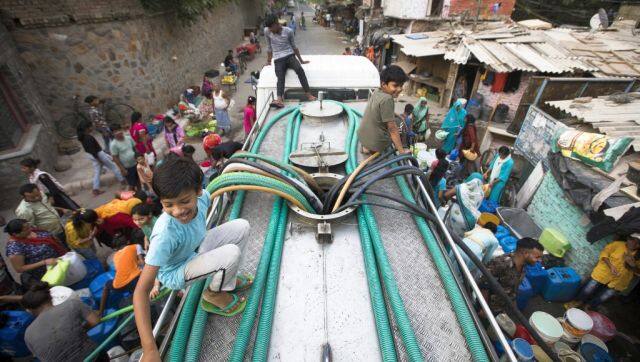 Residents use hoses to collect drinking water from a tanker truck during a hot summer day in New Delhi. AFP[/caption]Reason for water scarcityAccording to officials, the sweltering heat is the driving factor for the water scarcity in the Capital.A senior official of the DJB said the level of the Yamuna has been depleting with the heat, owing to which water production at the plants has reduced.Also, the climb in mercury levels in the Capital has led to an increase in water consumption. Just recently, the Delhi government announced that it would provide 1,000 million gallons of drinking water every day during the summer season as against 935 MGD earlier to meet the rising demand.Another cause for the water shortage could be attributed to the fact that several water bodies — lakes, ponds, moats that existed far back in the 20th century — have been encroached upon.A 2014-report by Delhi Parks and Gardens Society had revealed that the Capital had lost over 200 water bodies had been encroached upon. Reports state that these lost water bodies have illegally been turned into cremation grounds, temples, a government school, stadium, and even a bus terminal of the Delhi Transport Corporation.Another component to Delhi's water bankruptcy is the unchecked use of borewells and tubewells. Veena Khanduri, executive secretary of the non-profit India Water Partnership, told Mongabay in a 2019 report, "We have withdrawn 25 per cent more groundwater than the natural recharge rate in Delhi."Water deficiencyDelhi is water deficient; in 2021, the requirement of water was 1,380 MGD, but the government was only able to provide 998 MGD.In early April too, the Capital recorded water scarcity when ammonia levels in the Yamuna river were high. The concentration of ammonia in the river was 7.4 ppm (parts per million), seven times the level of around 1 ppm that the Delhi Jal Board’s water treatment plants (WTPs) can process, reported the Indian Express.In 2019 too, Delhi suffered an acute shortage of water with the poor having to stand in serpentine queues just to get their hands on a bucket of water.How Haryana has reacted?An official on the Haryana side said that the DJB is being provided with their due share of water.“We have been providing the mandated share. As far as extra water is concerned, there is a shortage on the Haryana side as well. Demand is on the rise, and there is definitely a shortage in the summer,” the official was quoted as telling Indian Express.With inputs from agenciesRead all the Latest News, Trending News, Cricket News, Bollywood News,India News and Entertainment News here. Follow us on Facebook, Twitter and Instagram.
First Published:May 04, 2022, 16:47:02 IST
Advertisement
Advertisement

CJP protest in Delhi: New videos of stone pelting, violence emerge as police, agitators trade charges
Fresh videos of violence that broke out during the Cockroach Janta Party's (CJP) protest in Delhi have surfaced, with the police releasing footage showing alleged stone pelting, vandalism and attacks on security personnel
3 min read
'From make in India to launch from India': Skyroot COO on why Vikram-1 could change India’s space sector
Skyroot Aerospace’s successful Vikram-1 mission marks a major milestone for India’s private space sector, as the country seeks to shift from “Make in India” to “Launch from India” and compete in the global commercial satellite launch market
8 min read
Choke terror funding, keep international shipping lanes safe: Jaishankar at Asean Regional Forum
Jaishankar's remarks came against the backdrop of recent terror attacks targeting India and growing threats to commercial shipping amid conflicts in West Asia and Europe
2 min read
PM Modi announces fast-track courts for paper leak cases; CJP responds ‘Dharmendra Pradhan must go’
Amid protests demanding accountability for the leak of medical entrance test Neet and other irregularities in the education system, Prime Minister Narendra Modi has announced that the government has decided to set up fast-track courts to ensure swift and stringent punishment for those involved in paper leaks.
3 min read
Sikkim tunnel collapse rescue resumes, death toll rises to 22
The death toll at the collapsed tunnel at Sikkim's Namchi district rose to 22 after nine more bodies were recovered overnight. At least 27 workers were trapped in a tunnel at an NHPC project after a sudden burst of suspected methane gas trapped within rock formations triggered an explosion.
2 min read
Advertisement
Advertisement