


National Health Policy 2017: Experts say expenditure target low as compared to neighbouring countries
The target of increasing health expenditure to 2.5% of GDP by 2025, set by the National Health Policy 2017, is very low in comparison to what has been achieved by the neighbouring countries

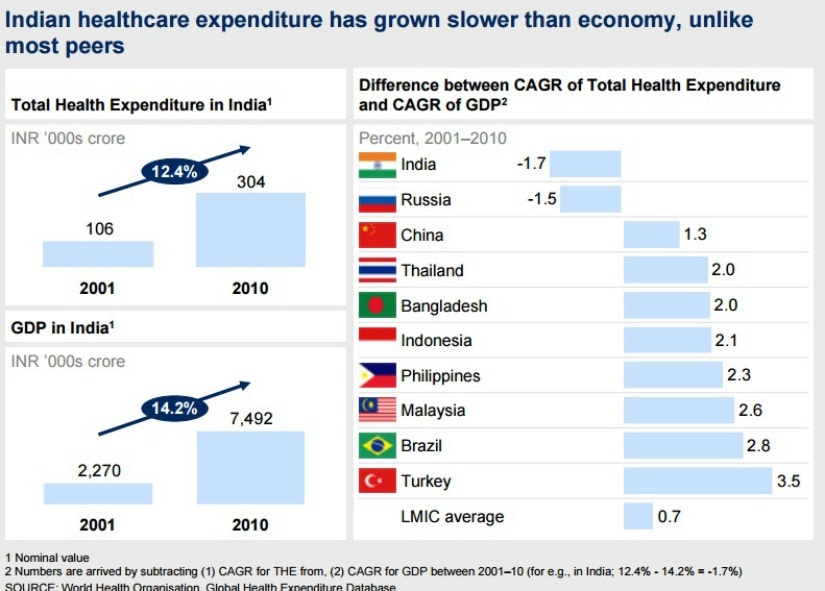
A data of the recent trends in health. Firstpost[/caption]On the other hand, China and Sri Lanka spend 3.1% and 2% of their respective GDPs on health expenditures. Dismal health expenditure figure has caused massive pressure on the existing health infrastructure, says Aggarwal. “Most of the government hospitals fail to meet the growing patient demands. Many of these hospitals are overcrowded making treatment nearly impossible,” he adds. He also says that since many of the hospitals lack required infrastructure, a patient is often referred from one to another for treatment as a result of which hospitals in Delhi get nearly 40% of its patients from other states.“ It not only increases the time required for treatment, but also the expenditure, as many government hospitals also charge money for many treatment and services,” he laments. “I have met a person who was asked eight lakhs for kidney transplantion by AIIMS,” he cites an example. Low health budget, he says that also leads to low insurance coverage and high out-of-pocket expenditure.As per a World Health Organisation study, India features among the countries with high out-of-pocket expenditure where 89.2% of the expenses of medical treatment is borne by the patients.“In our country high out-of-pocket expenditure in healthcare makes the condition of the patient and his or her family not better than that of a beggar,” he says.Even the National Health Policy admits that yearly 63 million people are pushed to poverty due to health care costs, thus causing further economic disparity. Not only the goal of increasing health expenditure is low, but also lacks adequate orientation says Dr Jayalakshmi Sridhar to Firstpost. “The National Health Policy 2017 speaks of increasing the health budget in a time-bound manner stepwise. But it does not mention in which year how much of it is going to be increased,” she says.To attain the target, she says that India needs better budgetary oversight, as to keep tab of how the money is spent and whether it is spent within stipulated time. “We often see cancellation of funds to the central pool due to lack of manpower to implement projects and projects not taking off. To plug this lacuna, the government needs to audit the health sector throughout the year and thus ensure that no fund goes back,” she said.The earlier health budget accepted during the previous NDA regime, in the year 2002, had set the goal of increasing health expenditure by 2%. But a study conducted by McKinsey and Company shows that during the period 2001 to 2010 India’s investment in health rather declined in comparison the increase of GDP. During the above mentioned period, India’s GDP grew by 14.2% and health expenditure by 12.4%. The difference between Compound Annual Growth Rate of the economy and health expenditure was -1.7%.

China has dominated Myanmar’s rare earth mines — now India eyes deal to harness country’s critical minerals
CJP protest in Delhi: New videos of stone pelting, violence emerge as police, agitators trade charges
'From make in India to launch from India': Skyroot COO on why Vikram-1 could change India’s space sector
Choke terror funding, keep international shipping lanes safe: Jaishankar at Asean Regional Forum
PM Modi announces fast-track courts for paper leak cases; CJP responds ‘Dharmendra Pradhan must go’