


Manipur Election 2017: Ethnic conflict in state overshadows India's lowest infant mortality rate
The economic blockade of the Imphal-Dimapur road and the Imphal-Silchar road has overshadowed all other issues this election year in Manipur.

 Representational image. Reuters[/caption]The economic blockade–a manifestation of the state’s ethnic conflict–is the “burning problem” right now, said Binod Kumai, a research associate with the Institute for Conflict Management, a New Delhi-based nonprofit. Prices of necessary commodities have skyrocketed, with cooking gas cylinders being sold for Rs 1,000 (Rs 651.50 in the national capital) and a litre of petrol for Rs 200 (Rs 71.33 in the national capital), he explained.“People are not able to see beyond the hope of peace,” said Pradip Phanjoubam, editor of the Imphal Free Press, on the blockade ongoing since November 1, 2016.On December 8, 2016, the Manipur government issued a gazette notification dividing seven districts into 14 districts.The blockade has been imposed by the United Naga Council, which demands the government go back on its decision to create new districts in the hill areas of Manipur, Firstpost reported in February 2017. The group contends that Naga groups were not consulted before the decision, and some new districts divide what Nagas consider their ancestral land.The government, led by chief minister Okram Ibobi Singh, said that new districts will help administer the region better, as the Hindustan Times reported in January 2017. The new districts do not change assembly constituencies.But the focus on the blockade has pushed other important issues in Manipur to the background.Low per capita income, unsteady growthThe per capita income of Manipur of Rs 24,042 is one of the lowest in the country, and trends over the last 10 years show a slow increase, and sometimes, even contraction in both the net domestic product and the per capita income of the state, according to information compiled by the NITI Aayog.
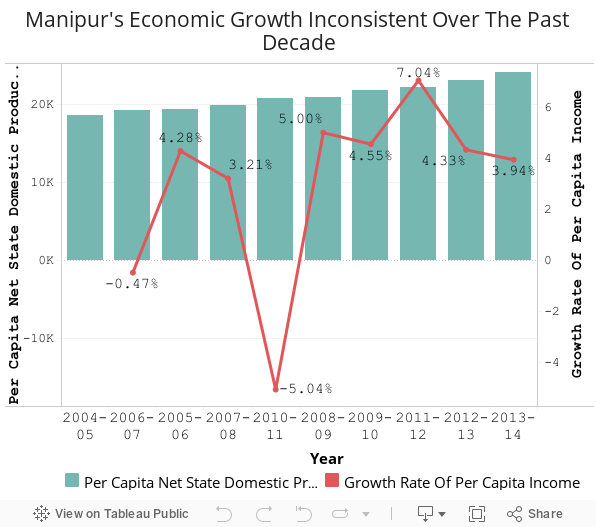 Source: NITI AayogTepid growth is also one of the causes of high urban unemployment. As many as 188 out of 1,000 people between the ages of 18 and 29 years in urban areas of Manipur are unemployed, compared to the Indian average of 139 people per 1,000–a challenge in a state with 23.3% of its population between the age of 18 and 29 years.“Unemployment should have been a big issue, but isn’t because of the blockade,” said Phanjoubam, editor of the Imphal Free Press. “This election is removed from everyday realities.”
Another issue of contention is the 59-year-old Armed Forces (Special Powers) Act (AFSPA), which provides special powers to Indian armed forces in disturbed areas of Arunachal Pradesh, Assam, Manipur, Meghalaya, Mizoram, Nagaland and Tripura. These include the power to fire, even if it causes death, at any person who breaks a law, including assemblies with more than five people.The AFSPA also gives an officer the power to arrest without a warrant a person who has committed a cognisable offence (serious crimes for which a police officer can start investigation without permission of the court), or if the officer has suspicions that the person might commit one. An officer working under this Act cannot be prosecuted without the sanction of the central government.Detractors say it gives armed forces too much power and allows them to act with impunity. Residents have demanded the act be rescinded from Manipur.

Govt to set up fast-track courts for swift punishment in paper leak cases, says PM Modi amid CJP protests
Sikkim tunnel collapse rescue resumes, death toll rises to 22
Delhi Police asks personnel to wear uniform: What the law says on cops in plainclothes during protests
No premium queues, 30-minute target: What changes for Indian passport applicants in UAE
CJP Protest in Delhi Live Updates: PM Modi announces fast-track courts for NEET paper leak cases