
Advertisement


Sections
Madhya Pradesh's dismal child health indicators can improve with better sanitation, focus on maternal care
Women's empowerment, better sanitation, and improvement in maternal health could improve the nutritional status of children in Madhya Pradesh.

 Representational image. Reuters[/caption]Madhya Pradesh has 6.6 percent of the country's child population under the age of five years, children who will makeup 158.7 million of India’s demographic dividend.Over the past decade, the rate of stunting in Madhya Pradesh has reduced from 50 percent of children under five years in 2005-06 to 42 percent in 2015-16, infant mortality has fallen from 70 per 1000 births in 2005-06 to 51 per 1000 births in 2015-16, the proportion of women who had studied for 10 years or more has increased from 14 percent in 2005-06 to 23.2 percent in 2015-16, but the state is still one of the worst in the country, show its health, nutrition and education indicators.Further, data from the state’s 51 districts show wide variations in indicators of maternal, child healthcare and women empowerment in Madhya Pradesh, suggesting that solutions to improve health need to be sensitive to local realities.For example, the rate of stunting in Sheopur (52.1 percent) is equivalent to Haiti – a poor country that repeatedly faces natural disasters, while the district of Balaghat with 32 percent of its children stunted, has a rate similar to that of Bolivia – one of the fastest growing economies in South America.
 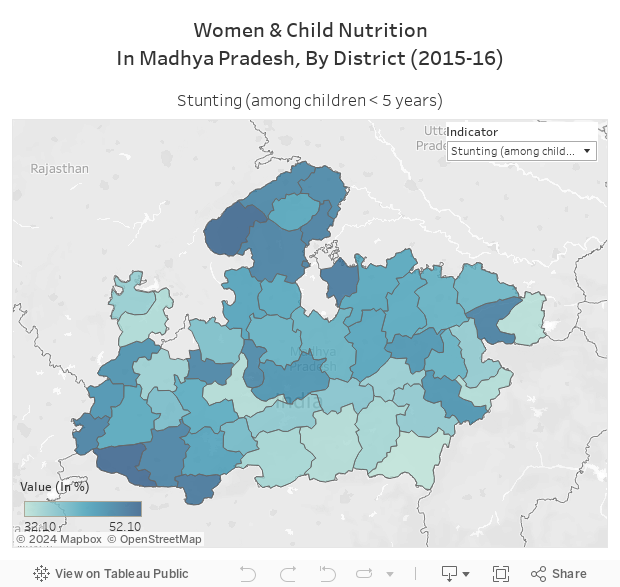 Source: National Family Health Survey 2015-16 Better maternal care could improve child nutritionTo improve child health in the state, Madhya Pradesh should pay more attention to breastfeeding and antenatal care, both of which are linked to better health outcomes for children.In Madhya Pradesh, out of 21 districts in which breastfeeding rates were below the state average of 58.2 percent, 16 districts had a higher proportion of severely wasted children than the state average of 9.2 percent.For instance, Bhind district, where only about a third of women (33.3 percent) gave only breast milk to the child upto the age of 6 months – the third lowest in the state – had the fourth highest proportion (30.6 percent) of children under five years who were severely wasted.Exclusive breastfeeding for six months, as recommended by the World Health Organisation, is linked to a reduction in the levels of stunting and wasting in children, according to this study from 2013.As an example, a higher proportion (67.6 percent) of children in Balaghat district in MP were breastfed, and the district also had the lowest rate of stunting in the state (32.1 percent).Data from districts in Madhya Pradesh, as well as research evidence, show a link between maternal care and improved child mortality and child nutrition, as IndiaSpend reported in January 2016. Antenatal care also reduces the risk of stillbirth, according to this IndiaSpend article from February 2017.Institutional births ensure prenatal and neonatal care for the child and the mother, as IndiaSpend reported in July 2015.Of the 21 districts that had a lower rate of institutional births than the state average, 16 districts had stunting rates higher than the state average. Similarly, nine of the 21 districts that reported low institutional births had a higher percentage of severely wasted children – with very low weight for height – than the state average.
 For instance, Singrauli, with one of the lowest rates of institutional births (43.5 percent of all births) also had the second-highest proportion of children (34 percent) who were severely wasted. Barwani district, with the second highest rate of stunting (52 percent) had the lowest institutional birth rates in the state with 50.7 percent of all births in medical institutions.On the other hand, Indore, with the highest percentage of women giving birth in hospitals at 94.7 percent, had the second lowest proportion of children who were wasted (16.9 percent), data from 2015-16 show.But institutional births are not enough. The government must focus on the quality of care provided to pregnant mothers; the state has made great strides in ensuring deliveries are registered, but the service quality remains poor, said Purnima Menon, senior research fellow at the Washington-DC based International Food Policy Research Institute (IFPRI), that works on issues related to agriculture and nutrition.By improving mothers' micronutrient intake, Madhya Pradesh could improve the mother's and the child's health. For instance, iron and folic acid supplements during pregnancy help fulfill the nutrition requirements of the mother and the developing foetus, according to this IndiaSpend article from January 2016.A positive correlation also exists between the consumption of iron and folic acid (IFA) tablets by mothers and reduced risk of stunting, per this 2016 study by the United Nations Children’s Fund.In MP, 13 of 32 districts that had a lower percentage of pregnant women consuming IFA tablets than the state average of 23.6 percent, had higher stunting rates than the state average.
 Source: National Family Health Survey 2015-16 If women were more educated, children would be healthierWe analysed some indirect factors, such as years of schooling, age at marriage, and access to sanitation, which do not directly affect nutrition, but are preconditions or determinants of nutrition. These are conditions outside the confines of the medical system, and are found within society, in neighbourhoods and within families.For better health indicators, "the state needs to focus on reduction of early marriage for girls, improvement in women’s education and improvement in coverage of sanitation," said Menon of IFPRI.The level of education of a woman has a direct impact on child health, as states with more educated women show better health outcomes for children, IndiaSpend reported in March 2017.The same trend can be seen in Madhya Pradesh. Sheopur district, which had the highest rate of stunting (52.1 percent) in the state, and the lowest percentage of women who had had four antenatal visits (18.7 percent), also had one of the lowest proportion (11.8 percent) of women who had completed 10 years of schooling, an analysis of NFHS data show.Preventing early marriages is also linked with a reduction in adolescent pregnancies, which helps improve the nutritional status of, and healthcare service use among women, according to this 2015 study.The district of Tikamgarh, for instance, where about half (49.5 percent) of the female population were married before they turned 18 years – the highest in the state – had the fourth highest rate of stunting among children (49.7 percent), the lowest consumption of IFA tablets (14 percent), and the lowest proportion of women who had had at least four antenatal visits (18.9 percent).
Source: National Family Health Survey 2015-16 Lack of sanitation could also lead to stunting in children, and anaemia, according to articles from IndiaSpend, published in April 2017, and September 2016.For instance, Indore with one of the highest percentage of households with improved sanitation (74.2 percent) in the state, had the second lowest rate of wasting among children (17.8 percent).Salve is an analyst with IndiaSpend.
First Published:Dec 16, 2017, 13:07:37 IST
Advertisement
Advertisement

Choke terror funding, keep international shipping lanes safe: Jaishankar at Asean Regional Forum
Jaishankar's remarks came against the backdrop of recent terror attacks targeting India and growing threats to commercial shipping amid conflicts in West Asia and Europe
2 min read
PM Modi announces fast-track courts for paper leak cases; CJP responds ‘Dharmendra Pradhan must go’
Amid protests demanding accountability for the leak of medical entrance test Neet and other irregularities in the education system, Prime Minister Narendra Modi has announced that the government has decided to set up fast-track courts to ensure swift and stringent punishment for those involved in paper leaks.
3 min read
Sikkim tunnel collapse rescue resumes, death toll rises to 22
The death toll at the collapsed tunnel at Sikkim's Namchi district rose to 22 after nine more bodies were recovered overnight. At least 27 workers were trapped in a tunnel at an NHPC project after a sudden burst of suspected methane gas trapped within rock formations triggered an explosion.
2 min read
Delhi Police asks personnel to wear uniform: What the law says on cops in plainclothes during protests
The Delhi Police has instructed all its personnel to wear uniforms when they report for duty at Jantar Mantar for crowd control. This comes after outrage grew over videos of men in civilian clothes or without name tags hitting protesters in the Capital. Is it legal for the police to ditch uniforms during protests?
4 min read
No premium queues, 30-minute target: What changes for Indian passport applicants in UAE
Indian passport applicants in the UAE can now access passport, visa and attestation services through Alhind’s 16 centres, with no premium queues, a Dh19 service fee and a target of completing applications within 30 minutes
4 min read
Advertisement
Advertisement