


Leadership vaccuum, economic oppression, demonisation pushed Indian Muslim into corner, ex-RS MP Mohammed Adeeb tells Firstpost
Over the course of this conversation with Firstpost, former Rajya Sabha MP Mohammed Adeeb explains how Uttar Pradesh turned into a communal battleground and why the Muslim community has little to no political representation in the state

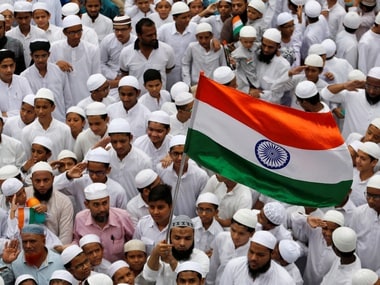
Representational image. Reuters[/caption]A leadership vacuum"Unfortunately, my community has never chosen a Muslim as its leader since Independence. We are neither in the Assembly, nor in Parliament in Uttar Pradesh. The biggest Muslim leader to emerge in the state after 1947 was Dr Abdul Jaleel Faridi of the Muslim Majlis, and even he managed to garner only two to four percent of the votes. Muslims have never considered Muslim politicians to be their leaders," says Adeeb. The other criticism he has in the context of electoral politics is that Muslim leaders only speak about issues concerning Muslims, not national issues.The general lack of display of dissent or solidarity is but one of the symptoms of this political vacuum, he adds. "When Article 370 was abrogated, when there was violence in Kashmir, during the Triple Talaq Bill or after the Babri Masjid verdict, the Muslim did not take to the streets. But when it was a matter related to the Constitution — our only hope in these times — and tearing it apart, then the Muslim decided to protest. He found support amid secular Hindus," he notes.This vacuum in political representation is accompanied by a fragmentation of Muslim votes; the community is not a monolith at voting booths. In 2017, Muslims voted for the Samajwadi Party, Bahujan Samaj Party, AIMIM and RLD.Lack of adequate support or representation in secular partiesAdeeb says that the community has been betrayed on multiple occasions by secular parties — a factor he considers as grave as the lack of Muslim leadership. The tendency of the Congress in particular to abandon the community has caused Muslims to chase after Mulayam Singh, VP Singh and Mayawati — leaders who worked for their own communities, he says."I call myself a Congressi, but I’m not part of the Congress party because I think it has taken a departure from its own ideology. I wrote to Sonia Gandhi recently about how Rahul Gandhi was the first from his family to directly attack the RSS. But why did he have to call himself a janeudhari Brahmin? This means that you're accepting Hindu ideology," he points out.Betrayal at the hands of secular parties and a lack of Muslim leaders resulted in many gravitating towards maulvis, which greatly damaged the community, he adds.Police brutalityAdeeb says that the police force has been communalised such that it metes out unwarranted violence against Muslims. "Not only is the police unprincipled, it is also communal. When they hit Muslims, they use the worst expletives and ask, 'Why are you here? You're a traitor, go to Pakistan'. They did exactly this in Aligarh and Jamia Millia Islamia. What should we do as Muslims, considering these factors? Whenever the police is deployed in Muslim-dominated areas, their goal is always to "teach a lesson" — whether in Uttar Pradesh or even in Delhi, as we saw recently," he says.Communal forces and fear at the grassroots levelEarlier this year, Reuters reported that in the Nayabans village of Uttar Pradesh, Muslims were moving out, as the divide between them and Hindus was only widening. The community was accused of slaughtering cows and was disallowed from using a microphone at a madrassa, which also functions as a mosque. Uttar Pradesh is also the state that witnessed the Muzaffarnagar violence of 2013 and last week.Adeeb says that overt discrimination has been emboldened over the past couple of years. "I am from Barabanki, which is 50 kilometres away from Ayodhya. I have never seen Uttar Pradesh so communalised. Hatred has grown so much that I was forced to sell the land I owned in the village and move out to Gurgaon. Communalism has become entrenched in the villages," he says.The villainisation of Muslims before 2014... and afterThe strategy of the RSS is to create an environment where Muslims have to constantly defend themselves, Adeeb offers. "We've constantly been asked why we live here despite the existence of Pakistan next door. We were asked to constantly defend ourselves — and this has been the RSS' game since the start — because they want to weaken us and make us slaves."Apart from the Narendra Modi and Yogi Adityanath government machinery, he holds the media responsible for drumming up hate against the community. "The RSS was not able to divide hearts the way the pliant media has been able to… A new, young class of people has been created that outright hates Muslims — this hate has trumped all issues like the economy, unemployment etc. The idea that Muslims must be 'fixed' has turned into the ultimate goal," he says. Vitriolic messages on WhatsApp have contributed greatly to this problem, he adds.Adeeb does not recommend that Muslims should create a religion-centric party in Uttar Pradesh to ensure better representation. But he is hopeful about the movement that is underway, because Muslims have the support of the secular Hindus, and because inquilab is being led by the young.

Sikkim tunnel collapse rescue resumes, death toll rises to 22
Delhi Police asks personnel to wear uniform: What the law says on cops in plainclothes during protests
No premium queues, 30-minute target: What changes for Indian passport applicants in UAE
CJP Protest in Delhi Live Updates: PM Modi announces announces fast-track courts for NEET paper leak cases
Bharat Forge, Flying Whales sign pact to develop 60-tonne airships for India’s defence logistics