
Advertisement


Sections
Karnataka Assembly polls: State has India's second lowest unemployment rate, lags on women's empowerment
Karnataka has amongst India's best economic and child health outcomes, but women’s empowerment lags some of India’s poorest states, data shows.

 Representational image. 101Reporters[/caption]For the period of analysis (2005-06 to 2015-16), the Bharatiya Janata Party (BJP) governed Karnataka for seven years until Congress took over in 2013–the last assembly elections. Of the other nine states, six–Madhya Pradesh, Maharashtra, Rajasthan, Uttar Pradesh, Goa and Gujarat–currently have BJP governments. Kerala has the government of Left Democratic Front, while Tamil Nadu and Andhra Pradesh are ruled by the All India Anna Dravida Munnetra Kazhagam and Telugu Desam Party, respectively.Karnataka has among country’s lowest child mortality ratesIn 2015-16, Karnataka’s infant mortality rate (IMR)–the probability that a child born in a particular year will die before reaching the age of one–was 26.9 per 1,000 live births, down from 43.2 in 2005-06. Karnataka’s IMR was lower than the national average (40.7) and ranked fifth among the 10 states considered for the analysis.At 31.5 deaths per 1,000 live births, the state’s under-five mortality rate also ranked fifth among the 10 states–worse than Kerala, Goa, Tamil Nadu and Maharashtra.
 Source: National Family Health Survey 2015-16; Figures in deaths per 1,000 live birthIn 2015-16, 62.6 percent children–just above the national average of 62 percent–aged 12-23 months received all basic vaccinations in Karnataka, up from 55 percent in 2005-06, according to national health data.To have received all basic vaccinations, a child must receive at least one dose of BCG vaccine, which protects against tuberculosis, three doses of DPT vaccine, which protects against diphtheria, pertussis (whooping cough), and tetanus, three doses of polio vaccine and one dose of measles vaccine.Karnataka ranked fifth among the 10 states considered for the analysis.
Karnataka lags poorer states on women empowermentMore than 50 percent women in Karnataka were not involved in household decision making, according to national data. This includes decisions regarding one’s own healthcare, major purchases, daily household purchases and the decision to visit her family or relatives.At 49.3 percent, Karnataka’s figure–lowest among the 10 states evaluated–is nearly 10 percentage points below the national average (59.2 percent), and is better only than that of, as we said, Bihar, Telangana and Mizoram.
In 2015-16, 58.1 percent women said it is justified for a husband to hit/beat his wife for any one of seven stated reasons—going out without telling him, neglecting the house or children, arguing with him, refusing sex, not cooking properly, showing disrespect for in-laws or if he suspects she is unfaithful. This was more than the national average of 51.7 percent and worse than poorer states such as Uttar Pradesh (51.3 percent), Bihar (53.4 percent) and Rajasthan (33.4 percent).In the same year, 57.5 percent men in Karnataka said it was justified, more than the national average of 42.2 percent, and worse than poorer states such as Uttar Pradesh (41.6 percent0, Bihar (38.1 percent) and Rajasthan (30.4 percent).Over the decade to 2015-16, the percentage of ever-married women (15-49 years) who have ever faced emotional, physical or sexual violence by husband/previous partners in Karnataka rose from 21.5 percent in 2005-06 to 24.4 percent. Though this is lower than the national average (31 percent), it was higher than in Goa, Kerala, Gujarat and Maharashtra among the 10 states selected.
In 2015-16, 32.7 percent women (15-64 years) in Karnataka were part of the labour force, higher than the national average female labour force participation of 23.7 percent, according to the Ministry of Labour and Employment’s Fifth Annual Employment-Unemployment Survey 2015-16.Karnataka is ranked fourth on this indicator among the 10 states considered for the analysis–behind Andhra Pradesh, Tamil Nadu and Maharashtra.
Seven in 10 Karnataka women are literate, nearly one in two complete 10 years’ educationIn 2015-16, Karnataka’s female literacy rate (71.7 percent) ranked sixth among the 10 states, better only than Andhra Pradesh, Uttar Pradesh and Madhya Pradesh. The state ranked 23rd of 36 states and union territories nationwide.Meanwhile, 45.4 percent women in the state completed 10 or more years of education–behind Kerala, Goa and Tamil Nadu–data from NFHS-4 show.While 85.1 percent men in Karnataka were literate in 2015-16, 55.2 percent completed 10 or more years of education, data show.
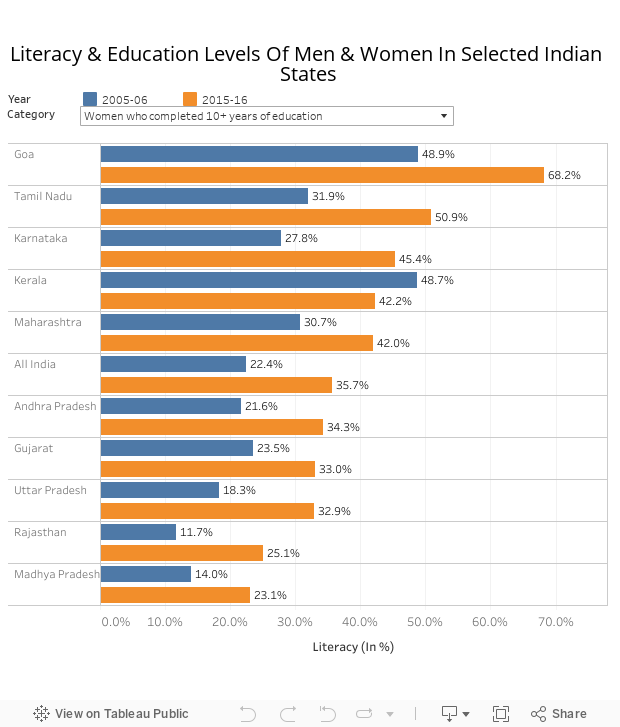 Source: National Family Health Survey 2015-16Overall, 87.9 percent of Karnataka’s children aged six-17 years were attending school in 2015-16, up from 73.3 percent a decade ago. Karnataka ranks fourth among the 10 states on this parameter.
Karnataka lags poorer states in access to drinking water and household toiletsIn 2015-16, 89.3 percent households in Karnataka had access to an improved source of drinking water–including piped connections, public taps, tube wells or boreholes, protected dug wells and springs, rainwater or community reverse osmosis plant. The state ranked seventh of 10 states analysed.Meanwhile, 65.8 percent households in Karnataka had a toilet facility–up from 46.5 percent in 2005-06–ranking fifth among 10 states considered for the analysis.
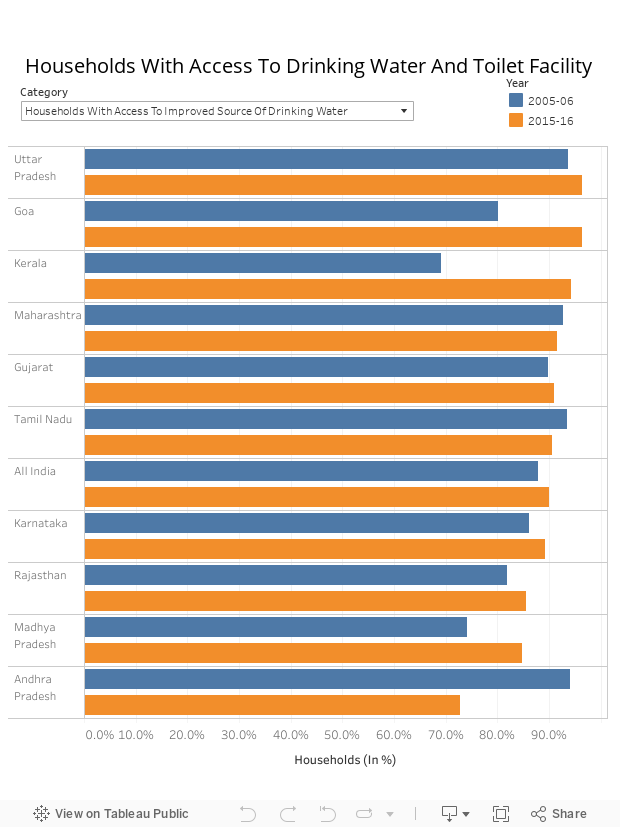 Source: National Family Health Survey, 2015-16Karnataka has India’s second-lowest unemployment rateAt 1.5 percent, Karnataka’s unemployment rate in 2015-16 was India’s second-lowest, behind only Gujarat, according to data from the ministry of labour and employment. The national average was five percent.
The state’s per capita income in 2014-15–year for which latest state-wise data were available–was Rs 125,832, more than the national average of Rs 86,454 that year. Karnataka ranked fourth among the 10 states evaluated.
(Tripathi is a principal correspondent with IndiaSpend.)
First Published:May 11, 2018, 11:44:11 IST
Advertisement
Advertisement

Govt to set up fast-track courts for swift punishment in paper leak cases, says PM Modi amid CJP protests
Amid protests demanding accountability for the leak of medical entrance test Neet and other irregularities in the education system, Prime Minister Narendra Modi has announced that the government has decided to set up fast-track courts to ensure swift and stringent punishment for those involved in paper leaks.
3 min read
Sikkim tunnel collapse rescue resumes, death toll rises to 22
The death toll at the collapsed tunnel at Sikkim's Namchi district rose to 22 after nine more bodies were recovered overnight. At least 27 workers were trapped in a tunnel at an NHPC project after a sudden burst of suspected methane gas trapped within rock formations triggered an explosion.
2 min read
Delhi Police asks personnel to wear uniform: What the law says on cops in plainclothes during protests
The Delhi Police has instructed all its personnel to wear uniforms when they report for duty at Jantar Mantar for crowd control. This comes after outrage grew over videos of men in civilian clothes or without name tags hitting protesters in the Capital. Is it legal for the police to ditch uniforms during protests?
4 min read
No premium queues, 30-minute target: What changes for Indian passport applicants in UAE
Indian passport applicants in the UAE can now access passport, visa and attestation services through Alhind’s 16 centres, with no premium queues, a Dh19 service fee and a target of completing applications within 30 minutes
4 min read
CJP Protest in Delhi Live Updates: PM Modi announces fast-track courts for NEET paper leak cases
CJP Protest in Delhi Live Updates: Heavy security has been deployed at the Jantar Mantar in Delhi, where the Cockroach Janta Party (CJP) is continuing its protest demanding the resignation of Union Education Minister Dharmendra Pradhan over the recent paper leaks controversy
1 min read
Advertisement
Advertisement