


#IWearHandloom: Smriti Irani shows why textile portfolio was never a 'demotion' for her
To make handlooms popular in the domestic market, it needs to catch the imagination of the youth. That's exactly the reason behind Irani's #IWearHandloom campaign that took the social media by storm

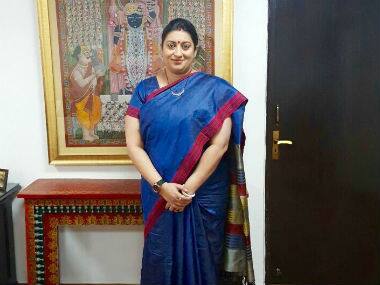
Smriti Irani donning a handloom silk saree for #IWearHandloom campaign. Twitter/@smritiirani[/caption]A section of mainstream and social media went after her with gusto. A ferocious attack of a very personal nature followed. It also smacked of barely disguised misogyny, elitist intellectual superiority and bare-knuckle antagonism. The virulence was vicious and unwarranted but to her credit, Irani took it in her stride. She joked with assembled media persons that textile ministry had hardly seen such media presence before the day she assumed new office .Ill-informed, illogical rants in guise of commentary that painted textiles as the boondocks of political opportunity, failed to take into account the immense job creating opportunities it provides. In their proclivity to find fault with Irani, her entire portfolio was downgraded as some sort of a semi-retirement option which will give her ample space to cool the heels and take some deep breaths.No heed was paid to the fact that Irani is now in charge of a ministry that is responsible for implementing a Rs 6,000 crore special package for textiles and apparel approved by the Union cabinet on 22 June, aiming to create 10 million new jobs in three years and attracting $11 billion in investments.Shortly after taking charge, Irani had made her intention clear: “Textiles industry is the largest employer after agriculture. I hope to engage with the industry to promote exports, skill more people and provide as much assistance as possible to weavers.”As Jaya Jaitly, the former president of Samata Party, wrote in The Indian Express: "(textiles) should be a very creative challenge for a woman who has displayed dynamism and pro-activeness, not always to people’s liking…The pathway for the Indian garment industry, which is highly labour intensive, and particularly attractive to women workers, can be carefully guided to achieve great heights. With a number of trained Indian fashion designers already in the field, the synergy can be geared for success."As a minister, Irani must focus on sustainable employment in this sector where weaving is seen as the weakest link due to an earlier policy of reserving the segment for small scale industries, which discouraged large investments. Indian factories, unlike their Bangladesh, Sri Lankan or Chinese counterparts, had labour laws limiting them to just 100 workers. As the scenario changes with the new textile policy, Indian workers now stand to benefit.A clutch of states including Maharashtra, Gujarat, Tamil Nadu, Madhya Pradesh, UP and Rajasthan have a strong weaving community who need a strong domestic markets to flourish. The focus, therefore, needs to be inward than aiming for the mass-produced export market.To make handlooms popular in the domestic market, it needs to catch the imagination of the youth. That's exactly the reason behind Irani's #IWearHandloom campaign that took the social media by storm as soon it was launched on 1 August, building up for the National Handloom Day on 7 August.Wearing a beautiful blue handloom silk saree, she uploaded a Facebook post:

'From make in India to launch from India': Skyroot COO on why Vikram-1 could change India’s space sector
Choke terror funding, keep international shipping lanes safe: Jaishankar at Asean Regional Forum
PM Modi announces fast-track courts for paper leak cases; CJP responds ‘Dharmendra Pradhan must go’
Sikkim tunnel collapse rescue resumes, death toll rises to 22
Delhi Police asks personnel to wear uniform: What the law says on cops in plainclothes during protests