


ISRO to launch its earth observation GISAT-1 satellite on 28 March
GISAT-1 launch will be followed by the maiden flight of Small Satellite Launch Vehicle, ISRO’s compact launcher, likely in April.

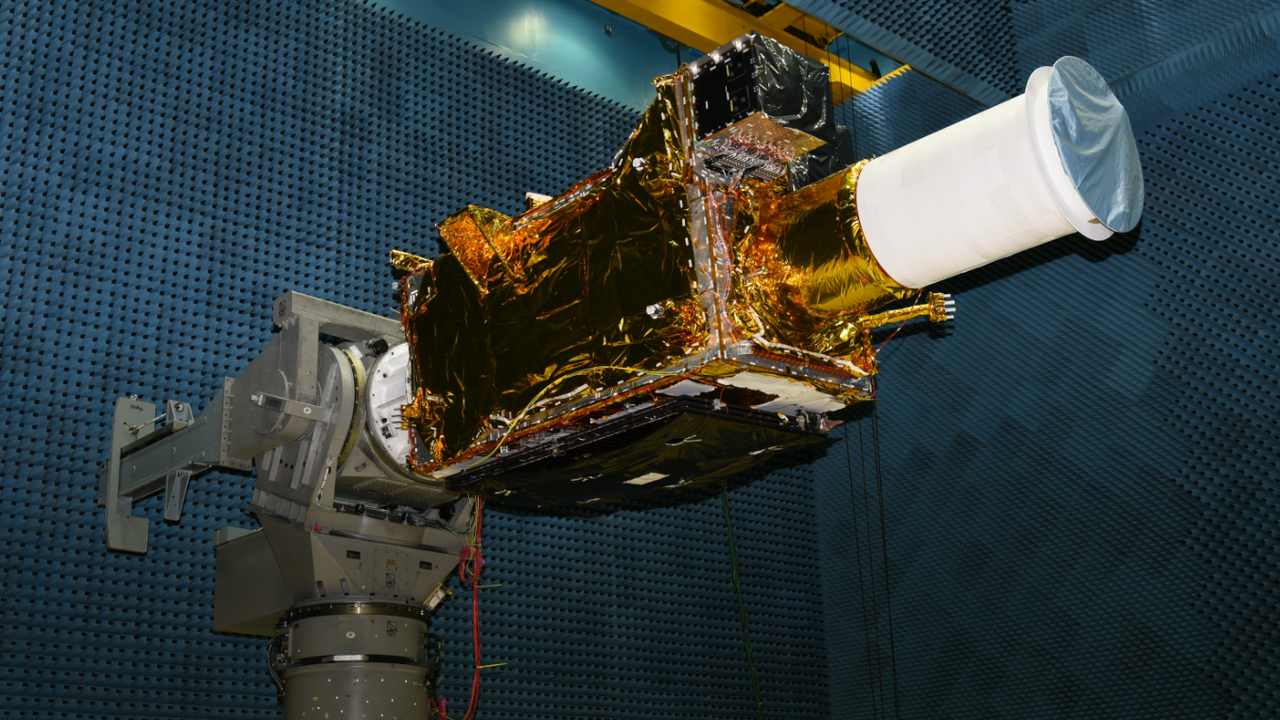
The first Geo Imaging Satellite that was supposed to launch on 5 March 2020 but was postponed due to technical reasons. Image credit: ISRO[/caption]Listing the objectives of the mission, ISRO has earlier said the satellite would provide near real-time imaging of the large area region of interest at frequent intervals. It would help in quick monitoring of natural disasters, episodic and any short-term events.The third objective is to obtain spectral signatures of agriculture, forestry, mineralogy, disaster warning, cloud properties, snow and glacier and oceanography.GISAT-1 will facilitate near real-time observation of the Indian sub-continent, under cloud-free condition, at frequent intervals, ISRO said.The planned launch of GISAT-1, weighing about 2,268 kg, comes close on the heels of the successful February 28 PSLV- C51 mission that orbited Brazil’s earth observation satellite Amazonia-1 and 18 co-passengers, including five built by students.Secretary of the Department of Space and ISRO Chairman K Sivan told PTI last week that the technical issues that led to the postponement of the GISAT-1 mission have been resolved and the further delay in the launch was due to COVID-19-induced lockdown which affected normal work.According to sources, GISAT-1 will be followed by the maiden flight of Small Satellite Launch Vehicle, ISRO’s compact launcher, likely in April.SSLV has been designed to meet “launch on-demand” requirements in a cost-effective manner for small satellites in a dedicated and ride-share mode.It is a three-stage all solid vehicle with a capability to launch up to 500 kg satellite mass into 500 km low earth orbit (LEO) and 300 kg into Sun Synchronous Orbit (SSO).By comparison, PSLV — the workhorse launch vehicle of ISRO — can take up to 1,750 kg payload into SSO of 600 km altitude.With a lower per kg launch cost, the mini launcher will have multiple satellite mounting options for nano, micro and small satellites.Sivan had earlier termed the SSLV an innovative vehicle that can be assembled in just 72 hours.“Instead of 60 days (for building a PSLV), it (SSLV) will be assembled in three days; instead of 600 people (needed to build a PSLV), it (SSLV) will be done by six people”, he had said.

Delhi Police asks personnel to wear uniform: What the law says on cops in plainclothes during protests
No premium queues, 30-minute target: What changes for Indian passport applicants in UAE
CJP Protest in Delhi Live Updates: Delhi metro shuts 16 stations as protests continue in Jantar Mantar
Bharat Forge, Flying Whales sign pact to develop 60-tonne airships for India’s defence logistics
Air India to cut Delhi-Toronto flight time by 3 hours, resume non-stop services from August 1