
Advertisement


Sections
Isro successfully launches PSLV's longest flight SCATSAT-1 and seven others into orbit; PM Modi lauds scientists
India on Monday morning successfully put into orbit its own weather satellite SCATSAT-1 and seven others - five foreign and two domestic - in a copy book style.

Sriharikota (Andhra Pradesh): India on Monday morning successfully put into orbit its own weather satellite SCATSAT-1 and seven others - five foreign and two domestic - in a copy book style.With this, India successfully completed yet another multiple satellite launch in a single rocket mission and is marching forward towards the milestone of 100 foreign satellite launches.With this success, India has successfully launched 79 satellites for international customers.Interestingly, this was also PSLV's longest launch spread over two hours and 15 minutes.The Indian space agency Isro also put into commercial use its multiple burn technology in its rocket Polar Satellite Launch Vehicle (PSLV). Simply put multiple burn technology is the switching off and switching on of a rocket's engine in space mainly to deliver satellites in two different orbits."Today is a land mark day. Using the PSLV rocket we achieved he launch of eight satellites," AS Kiran Kumar, Chairman, Indian Space Research Organisation (Isro) said soon after the launch."After a long gap of two hours, the entire mission was completed successfully," the chairman added.Vikram Sarabhai Space Centre (VSSC) director K Sivan said, "The mission was exciting and the longest one. The other landmark mission to be done this year will be the GSLV-Mk 3 rocket."Exactly at 9.12 a.m. the PSLV rocket standing 44.4 metres tall and weighing 320 tonnes tore into the morning skies with fierce orange flames at its tail.Gathering speed every second the rocket raced towards the heavens amidst the cheers of the Isro officials and the media team assembled at the rocket port here.At the rocket mission control room, Indian space scientists at Isro were glued to their computer screens watching the rocket escaping the earth's gravitational pull.[caption id="attachment_3020160" align="alignleft" width="380"]![PSLV-C35 at the Launchpad. Image courtesy: Isro]() PSLV-C35 at the Launchpad. Image courtesy: Isro[/caption]Seventeen minutes into the flight the rocket's main cargo, the 371 kg SCATSAT-1 - for ocean and weather-related studies - was injected into a 730 km polar sun synchronous orbit.The remaining seven satellites were also placed in a 689 km polar orbit after a long time lag.These seven satellites include five foreign satellites: three from Algeria (Alsat-1B 103kg, Alsat-2B 117kg, Alsat-1N 7kg), and one each from Canada (NLS-19, 8kg) and US (Pathfinder-44kg).The two other Indian satellites are – Pratham (10kg) built by Indian Institute of Technology-Bombay (IIT-B) and Pisat (5.25 kg) from PES University, Bengaluru and its consortium.Although SCATSAT-1 is a follow-on mission for Oceansat-2 improvements have been made in the satellite's hardware configuration based on lessons learnt from Oceansat-2 instruments.Also SCATSAT-1's payload has been characterised with the objective of achieving data quality for Climate Data Records, apart from facilitating routine meteorological applications, the Isro said.The Isro said, SCATSAT-1's scatterometer will provide wind vector data products for weather forecasting, cyclone detection and tracking services to the users.The satellite carries Ku-band scatterometer similar to the one flown onboard Oceansat-2.The mission life of the satellite is five years.According to Isro, the two Algerian satellites Alsat-1B and Alsat-2B are remote sensing satellites while Alsat-1N is a technology demonstration nano satellite for Algerian students.On the other hand, the US satellite Pathfinder-1 is a commercial high resolution imaging micro satellite while the Canadian NLS-19 satellite is la technology demonstration nano satellite for experimentation in helping to reduce space debris and for tracking commercial aircraft.The IIT-B's satellite Pratham's mission objective is to estimate the total electron count with a resolution of 1km x 1km location grid while Pisat from PES University and its consortium is a nano satellite for remote sensing applications.[caption id="attachment_3020538" align="alignright" width="380"]
PSLV-C35 at the Launchpad. Image courtesy: Isro[/caption]Seventeen minutes into the flight the rocket's main cargo, the 371 kg SCATSAT-1 - for ocean and weather-related studies - was injected into a 730 km polar sun synchronous orbit.The remaining seven satellites were also placed in a 689 km polar orbit after a long time lag.These seven satellites include five foreign satellites: three from Algeria (Alsat-1B 103kg, Alsat-2B 117kg, Alsat-1N 7kg), and one each from Canada (NLS-19, 8kg) and US (Pathfinder-44kg).The two other Indian satellites are – Pratham (10kg) built by Indian Institute of Technology-Bombay (IIT-B) and Pisat (5.25 kg) from PES University, Bengaluru and its consortium.Although SCATSAT-1 is a follow-on mission for Oceansat-2 improvements have been made in the satellite's hardware configuration based on lessons learnt from Oceansat-2 instruments.Also SCATSAT-1's payload has been characterised with the objective of achieving data quality for Climate Data Records, apart from facilitating routine meteorological applications, the Isro said.The Isro said, SCATSAT-1's scatterometer will provide wind vector data products for weather forecasting, cyclone detection and tracking services to the users.The satellite carries Ku-band scatterometer similar to the one flown onboard Oceansat-2.The mission life of the satellite is five years.According to Isro, the two Algerian satellites Alsat-1B and Alsat-2B are remote sensing satellites while Alsat-1N is a technology demonstration nano satellite for Algerian students.On the other hand, the US satellite Pathfinder-1 is a commercial high resolution imaging micro satellite while the Canadian NLS-19 satellite is la technology demonstration nano satellite for experimentation in helping to reduce space debris and for tracking commercial aircraft.The IIT-B's satellite Pratham's mission objective is to estimate the total electron count with a resolution of 1km x 1km location grid while Pisat from PES University and its consortium is a nano satellite for remote sensing applications.[caption id="attachment_3020538" align="alignright" width="380"]![SCATSAT-1 spacecraft integrated with PSLV-C35 with two halves of the heat shield seen. Image: Isro]() SCATSAT-1 spacecraft integrated with PSLV-C35 with two halves of the heat shield seen. Image: Isro[/caption]After slinging SCATSAT-1 into its orbit the rocket's fourth stage was restarted one hour 22 minutes into the flight and cut off around 20 seconds later.Two hours and 11 minutes into the flight the fourth stage was again be restarted to be cut off one minute later.Following that, in three minutes all the seven satellites were ejected putting an end to PSLV's longest mission till date.The PSLV rocket is a four stage/engine rocket powered by solid and liquid fuel alternatively.On Sunday, Sivan told IANS that the long time gap between the cutting off of the engine and its restart was not an issue.The director said the first time the multiple burn technology was first tested by Isro while flying its PSLV rocket on December 16, 2015 and in June 2016, the technology was again demonstrated.About the challenge, Sivan said: "After cutting off the engine, its condition should be brought to such a stage that it could be restarted again. The next challenge is to control the engine and bring it so as to eject the remaining satellites into a different orbit."He said the rocket has GPS-aided navigation system so that data generated by the rocket's inertial navigation system and the one provided by the former will be blended so as to erase and errors and to generate a precise data.PM congratulates IsroPrime Minister Narendra Modi congratulated Isro scientists on the successful launch of advanced weather satellite SCSAT-1 and 7 other satellites, saying their "innovative zeal" has made India proud worldwide."Moment of immense joy and pride for India. Congratulations to ISRO on successful launch ofPSLV-C35/SCATSAT-1 and 7 co-passenger satellites," the Prime Minister said in a statement."Our space scientists keep scripting history. Their innovative zeal has touched the lives of 125 crore Indians & made India proud worldwide", he said.
SCATSAT-1 spacecraft integrated with PSLV-C35 with two halves of the heat shield seen. Image: Isro[/caption]After slinging SCATSAT-1 into its orbit the rocket's fourth stage was restarted one hour 22 minutes into the flight and cut off around 20 seconds later.Two hours and 11 minutes into the flight the fourth stage was again be restarted to be cut off one minute later.Following that, in three minutes all the seven satellites were ejected putting an end to PSLV's longest mission till date.The PSLV rocket is a four stage/engine rocket powered by solid and liquid fuel alternatively.On Sunday, Sivan told IANS that the long time gap between the cutting off of the engine and its restart was not an issue.The director said the first time the multiple burn technology was first tested by Isro while flying its PSLV rocket on December 16, 2015 and in June 2016, the technology was again demonstrated.About the challenge, Sivan said: "After cutting off the engine, its condition should be brought to such a stage that it could be restarted again. The next challenge is to control the engine and bring it so as to eject the remaining satellites into a different orbit."He said the rocket has GPS-aided navigation system so that data generated by the rocket's inertial navigation system and the one provided by the former will be blended so as to erase and errors and to generate a precise data.PM congratulates IsroPrime Minister Narendra Modi congratulated Isro scientists on the successful launch of advanced weather satellite SCSAT-1 and 7 other satellites, saying their "innovative zeal" has made India proud worldwide."Moment of immense joy and pride for India. Congratulations to ISRO on successful launch ofPSLV-C35/SCATSAT-1 and 7 co-passenger satellites," the Prime Minister said in a statement."Our space scientists keep scripting history. Their innovative zeal has touched the lives of 125 crore Indians & made India proud worldwide", he said.
 PSLV-C35 at the Launchpad. Image courtesy: Isro[/caption]Seventeen minutes into the flight the rocket's main cargo, the 371 kg SCATSAT-1 - for ocean and weather-related studies - was injected into a 730 km polar sun synchronous orbit.The remaining seven satellites were also placed in a 689 km polar orbit after a long time lag.These seven satellites include five foreign satellites: three from Algeria (Alsat-1B 103kg, Alsat-2B 117kg, Alsat-1N 7kg), and one each from Canada (NLS-19, 8kg) and US (Pathfinder-44kg).The two other Indian satellites are – Pratham (10kg) built by Indian Institute of Technology-Bombay (IIT-B) and Pisat (5.25 kg) from PES University, Bengaluru and its consortium.Although SCATSAT-1 is a follow-on mission for Oceansat-2 improvements have been made in the satellite's hardware configuration based on lessons learnt from Oceansat-2 instruments.Also SCATSAT-1's payload has been characterised with the objective of achieving data quality for Climate Data Records, apart from facilitating routine meteorological applications, the Isro said.The Isro said, SCATSAT-1's scatterometer will provide wind vector data products for weather forecasting, cyclone detection and tracking services to the users.The satellite carries Ku-band scatterometer similar to the one flown onboard Oceansat-2.The mission life of the satellite is five years.According to Isro, the two Algerian satellites Alsat-1B and Alsat-2B are remote sensing satellites while Alsat-1N is a technology demonstration nano satellite for Algerian students.On the other hand, the US satellite Pathfinder-1 is a commercial high resolution imaging micro satellite while the Canadian NLS-19 satellite is la technology demonstration nano satellite for experimentation in helping to reduce space debris and for tracking commercial aircraft.The IIT-B's satellite Pratham's mission objective is to estimate the total electron count with a resolution of 1km x 1km location grid while Pisat from PES University and its consortium is a nano satellite for remote sensing applications.[caption id="attachment_3020538" align="alignright" width="380"]
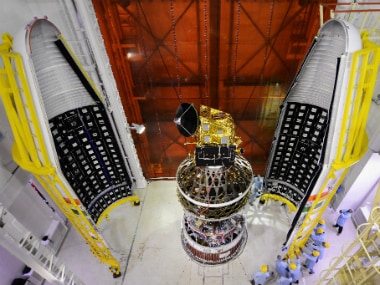 SCATSAT-1 spacecraft integrated with PSLV-C35 with two halves of the heat shield seen. Image: Isro[/caption]After slinging SCATSAT-1 into its orbit the rocket's fourth stage was restarted one hour 22 minutes into the flight and cut off around 20 seconds later.Two hours and 11 minutes into the flight the fourth stage was again be restarted to be cut off one minute later.Following that, in three minutes all the seven satellites were ejected putting an end to PSLV's longest mission till date.The PSLV rocket is a four stage/engine rocket powered by solid and liquid fuel alternatively.On Sunday, Sivan told IANS that the long time gap between the cutting off of the engine and its restart was not an issue.The director said the first time the multiple burn technology was first tested by Isro while flying its PSLV rocket on December 16, 2015 and in June 2016, the technology was again demonstrated.About the challenge, Sivan said: "After cutting off the engine, its condition should be brought to such a stage that it could be restarted again. The next challenge is to control the engine and bring it so as to eject the remaining satellites into a different orbit."He said the rocket has GPS-aided navigation system so that data generated by the rocket's inertial navigation system and the one provided by the former will be blended so as to erase and errors and to generate a precise data.PM congratulates IsroPrime Minister Narendra Modi congratulated Isro scientists on the successful launch of advanced weather satellite SCSAT-1 and 7 other satellites, saying their "innovative zeal" has made India proud worldwide."Moment of immense joy and pride for India. Congratulations to ISRO on successful launch ofPSLV-C35/SCATSAT-1 and 7 co-passenger satellites," the Prime Minister said in a statement."Our space scientists keep scripting history. Their innovative zeal has touched the lives of 125 crore Indians & made India proud worldwide", he said.
First Published:Sep 26, 2016, 13:02:12 IST
Advertisement
Advertisement

China has dominated Myanmar’s rare earth mines — now India eyes deal to harness country’s critical minerals
India is deepening rare earth cooperation with Myanmar as New Delhi seeks alternative sources of critical minerals dominated by China, including dysprosium and terbium used in EVs, defence systems and clean energy technologies
6 min read
CJP protest in Delhi: New videos of stone pelting, violence emerge as police, agitators trade charges
Fresh videos of violence that broke out during the Cockroach Janta Party's (CJP) protest in Delhi have surfaced, with the police releasing footage showing alleged stone pelting, vandalism and attacks on security personnel
3 min read
'From make in India to launch from India': Skyroot COO on why Vikram-1 could change India’s space sector
Skyroot Aerospace’s successful Vikram-1 mission marks a major milestone for India’s private space sector, as the country seeks to shift from “Make in India” to “Launch from India” and compete in the global commercial satellite launch market
8 min read
Choke terror funding, keep international shipping lanes safe: Jaishankar at Asean Regional Forum
Jaishankar's remarks came against the backdrop of recent terror attacks targeting India and growing threats to commercial shipping amid conflicts in West Asia and Europe
2 min read
PM Modi announces fast-track courts for paper leak cases; CJP responds ‘Dharmendra Pradhan must go’
Amid protests demanding accountability for the leak of medical entrance test Neet and other irregularities in the education system, Prime Minister Narendra Modi has announced that the government has decided to set up fast-track courts to ensure swift and stringent punishment for those involved in paper leaks.
3 min read
Advertisement
Advertisement