


India's population growth rate highly overestimated, inclusion of diversity can help with its accuracy: Austrian study
India's population growth rate is highly overestimated by existing models, say scientists who suggest that accounting for the diversity and differences in the levels of education among people can help arrive at more accurate projections.

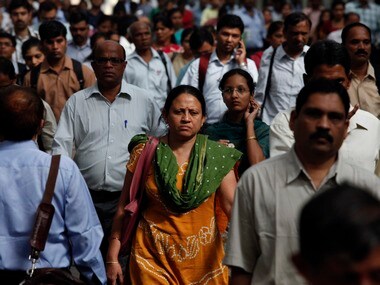
Representational image. Reuters[/caption]"India is an extremely heterogeneous sub-continent. Simply because it is one nation, unlike composite Europe, it should not be treated as a uniform entity," said Wolfgang Lutz, the World Population programme director at International Institute for Applied Systems Analysis in Austria. "The forecasts for India over the coming decades strongly depend on which sources of heterogeneity are explicitly included in the model," said Lutz.By 2025, India is expected to surpass China as the world's most populous country due to higher fertility rates and a younger population. However, India's population outlook depends heavily on the degree to which differences between regions within its population, or heterogeneity, are incorporated into population projection models.To account for the diversity between different areas of India, researchers designed a study that pioneered a five-dimensional model of India's population differences that include rural or urban place of residence, state, age, sex, and level of education. The model was then used to show the population projection changes within scenarios that combine different levels of these factors. For example, a much higher population projection results from a model that combines data from individual states as compared to the overall national projection, since states with higher fertility rates eventually add up to a higher national population projection.If the projection is carried out while only explicitly accounting for age and sex, influential factors like higher education, associated with decreased fertility, are left out. Thus, a projection based on today's much higher fertility rate of uneducated and rural women predicts a drastically larger population in the future. Since education level across all of India has increased over time, and is associated with a lower fertility rate, the same projection may predict a drastically smaller population when accounting for education and increasing urbanisation.Combining both effects, the influence of education appears to dominate, resulting in a lower population projection. Depending on the dimensions considered, when fertility, mortality, education and migration rates are frozen at the 2011 levels, stratification by education, states, or residence can result in population projections that span a huge range from 1.6 to 3.1 billion. Where these rates change according to plausible model predictions, the population peaks between 1.65 to around 1.8 billion. The difference between projections shows the critical importance of deciding which demographical measures to include in a projection model, and at what rates of change.

Bharat Forge, Flying Whales sign pact to develop 60-tonne airships for India’s defence logistics
Air India to cut Delhi-Toronto flight time by 3 hours, resume non-stop services from August 1
J&K cop on Amarnath Yatra duty shot dead in Anantnag terror attack; TRF claims responsibility
Jaishankar meets Canada's Anita Anand, discusses bilateral cooperation and shared interests
Delhi, Bengaluru, Hyderabad... Neet paper leak protest spreads nationwide even as govt reaches out to CJP, Opposition