


India lags in implementation, not laws on sexual harassment; #MeToo movement highlights need for better enforcement
From the #MeToo movement, we must grasp the magnitude and seriousness of sexual harassment cases, which prevail even though there are seemingly strict provisions under the law.

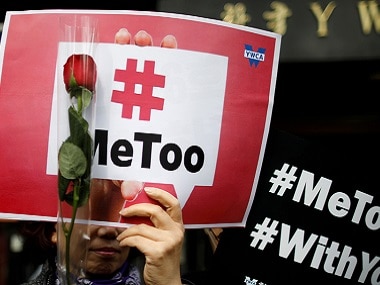
A woman holds up a banner on the #MeToo movement against sexual harassment. Reuters[/caption]In light of the countless disclosures, this piece will draw light on the law relating to workplace sexual harassment in India. The law on sexual harassment was developed after the landmark judgment in the case of Vishakha versus State of Rajasthan in 1997. This case laid down the guidelines on sexual harassment at the workplace. It defined sexual harassment as* An implied or explicit promise of preferential treatment in her employment* An implied or explicit promise of detrimental treatment in her employment* An implied or explicit threat about her present or future employment status* Interference with her work or creating an intimidating/offensive/hostile work environment* Humiliating treatment that is likely to affect health or safetyAfter the Vishakha case, in 1999, the case of Apparel Export Promotion Council versus AK Chopra took the media by storm by recognising that sexual harassment interferes with the performance of a female employee at work and creates an intimidating and hostile environment for her to work in. Then in 2008, in the case of DS Grewal versus Vimmi Joshi & Ors, Joshi, who was the principal of a school, complained of sexual harassment that resulted in the termination of her services. This case is vital as it indicates the apathy towards the issue of workplace sexual harassment.Finally, in 2013, the Sexual Harassment at the Workplace Act was enacted to protect victims of such misconduct. According to the Act, every organisation with more than 10 employees is required to have an Internal Complaints Committee — half the members should be women and it must contain a neutral third party. Once an employee files a complaint, the members of the committee can take disciplinary action if the conduct of the accused is found to violate a service rule of the organization, or criminal action if they are found to have violated a provision of the law. The victim can also seek compensation from the offender and a deduction in his salary. She can also request for a transfer in the offender’s office branch. In case an Internal Complaints Committee does not exist or take action, there has to be a Local Complaints Committee in every district.Some of the key remedies available under the law are as follows:* If a woman expresses her disinterest and the man continues to ask for sexual favours, he is punishable under Section 354(A) of the Indian Penal Code (IPC). The offender can be punished with a three-year jail term, or a fine, or both.* If someone tries to threaten to physically harm a woman, or damage her reputation, or property, the offender can be imprisoned for a maximum of two years under Section 503 of the IPC.* If a man captures, or shares, images of a woman engaging in a private act without her consent, it is considered voyeurism and is punishable under Section 354 (C) of the IPC. The offender can face a jail term for one to three years, in addition to a fine.* If a man morphs a woman’s photographs and shares them with an intent to defame and harass, it is a crime under Section 499 of the IPC. The punishment includes a jail term of up to two years.* If a man posts any obscene or defamatory material on a public, online platform, intending to harass a woman, it is considered a crime under Section 67 of Information Technology Act. The accused can face jail time of two years coupled with a fine.* If a man performs an obscene act in any public place, or sings, recites and utters any obscene songs or words, he shall be punished with imprisonment up to three months, or with a fine, or with both, according to Section 294 of the IPC.From the #MeToo movement, we must grasp the magnitude and seriousness of sexual harassment cases, which prevail even though there are seemingly strict provisions under the law. We must resolve to stand up for women who have been victimised.While it is not possible to wipe out sleaze entirely, hitting back definitely is. To protect a person’s rights, the judiciary must strengthen the enforcement of sexual harassment laws, and private and public organisations must be held accountable for the way they tackle incidents of sexual misconduct.Alas! Even animals don’t hurt you, unless you hurt them. They abide by the principle of live and let live. If they can understand that, what happened to the Darwinian, evolved man?The Ministry of Women and Child Development has launched SHe-Box — Sexual Harassment Electronic Box — that allows female employees to complain against their harasser and also helps raise the matter with the Internal Complaints Committee of a company or the Local Complaints Committee.

China has dominated Myanmar’s rare earth mines — now India eyes deal to harness country’s critical minerals
CJP protest in Delhi: New videos of stone pelting, violence emerge as police, agitators trade charges
'From make in India to launch from India': Skyroot COO on why Vikram-1 could change India’s space sector
Choke terror funding, keep international shipping lanes safe: Jaishankar at Asean Regional Forum
PM Modi announces fast-track courts for paper leak cases; CJP responds ‘Dharmendra Pradhan must go’