


Having called Pakistan's bluff, India must now make its own 'nuclear doctrine' more intimidating and relevant
India must also do everything to convince Pakistan that it also has a second-strike nuclear capability that would make the neighbour's first-strike far too risky to even contemplate.

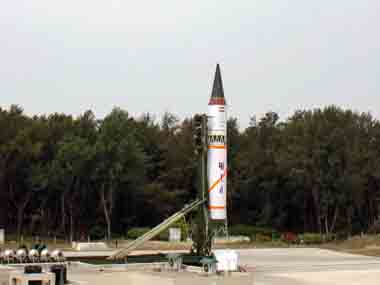
File photo of India's nuclear-capable Agni-III missile. Reuters[/caption]The ability of India and Pakistan to damage each other with their respective nuclear arsenal has never been doubted. But there has been much disagreement within each country on whether, or to what extent, the other will harm it. In India, though successive governments didn't respond with violence to the terror attacks from Pakistan, fearing escalation and a nuclear conflict, many consider the fears to be grossly exaggerated. And in Pakistan, few believed that India would indeed be prepared to launch retaliatory air raids, leave lone an all-out conventional war for fear of a nuclear conflict.India's attacks on the Balakot terror base on 26 February may have finally served the purpose of calling Pakistan's nuclear bluff to some extent, but the larger question of the nuclear imbalance between the two countries, in terms of both the size of arsenals and retaliatory policies, remains unresolved, to the disadvantage of India.Look at the nuclear doctrines of each country. To begin with, Pakistan refuses to accept the No-First-Use (NFU) rule, unlike India. This means, Pakistan retains the choice to be the first to deploy nuclear weapons. India will use nuclear weapons only when it's attacked with nuclear weapons.Pakistan's 'Full Spectrum Deterrence'Pakistan's nuclear "policy" is supposedly centred around the so-called doctrine of "Full Spectrum Deterrence", which means possessing "all" kinds of weapons to have "all" Indian targets within striking range. Pakistan claims this is in line with the policy of "Credible Minimum Deterrence and avoidance of arms race".In 2002, Lieutenant General Khalid Kidwai, who was then the head of Pakistan's Strategic Plans Division, had listed four circumstances in which his country, while retaining the option of striking first, could launch a nuclear attack on India:- When India attacks Pakistan and occupies a large part of its territory;- When India destroys a large part of Pakistan's armed forces;- When India strangulates Pakistan's economy;- When India causes political destabilisation, or creates internal subversion in Pakistan.India's 'massive' retaliationIn 2003, the Atal Behari Vajpayee government came up with a nuclear doctrine with eight points. The first three are important:- Building and maintaining a credible minimum deterrent;- A posture of 'No First Use' — nuclear weapons will only be used in retaliation against a nuclear attack on Indian territory or on Indian forces anywhere;- Nuclear retaliation to a first strike will be massive and designed to inflict unacceptable damage.India has never officially explained what it means by "massive retaliation". By Cold War definition, it's presumed to mean targeting Pakistan's cities and eliminating millions of people, an implication that Pakistan has dismissed as no more than a silly bluff.In other words, Pakistan doesn't take India's nuclear threat seriously enough. The word "credible" in the first point in India's nuclear doctrine is not credible enough to cause any deterrence in Pakistan.Since 2004, India has been talking about a Cold Start war doctrine, which means quick attacks on Pakistan without risk of escalation. But from 2015, Pakistan has been threatening to use Tactical Nuclear Weapons (TNWs), short-range nuclear powered missiles, on any advancing Indian troops. This is an idea copied from a strategy of the North Atlantic Treaty Organisation against the large army of the erstwhile Soviet Union.TNWs, though not as deadly as the bigger nuclear weapons, can eliminate large numbers of armed personnel more quickly and effectively than non-nuclear weaponry. Pakistan finds it unbelievable that India would stick to its current doctrine and respond to its deployment of TNWs with "massive" destruction by targeting its cities.'Second Strike' capabilitySince India has abjured the option of first strike, there can be valid questions about the country's ability to launch second strikes, as well. For a country to launch a second strike, it must be left with enough nuclear weapons after destruction in the first attack by the enemy. At the last count, India has 135 nuclear warheads and Pakistan has 145 and counting. It has been acknowledged that Pakistan has the world's fastest growing nuclear arsenal.It's not surprising that Pakistan has been continuing with hostilities towards India without any fear of reprisals. Cross-border firing is a default state of affairs along the Line of Control, and an occasional terror strike against India is an integral part of its foreign policy. India's 2016 surgical strikes proved too insufficient. Although the latest air raids by India constitute a welcome departure in India's counter-terrorism policy, the country will continue to mull over its position of nuclear disadvantage and the escalatory consequences of any future decision to hit back at Pakistan at a level bigger than what it did at Balakot.For India to come out of this difficult situation, Pakistan's nuclear threat must weaken or must be proved to be not as strong as it seems. A good thing is that, according to some experts, TNWs may not be enough to completely rout an advancing army from India. There are some who point out that if Pakistan, indeed, deploys these, it may suffer more from radiation hazards than any damage it may inflict on India since it has urban centres, including Lahore, not far from the border.At the same time, India can also make its nuclear doctrine more muscular — and credible. Knee-jerk reactions from some hardliners might favour India giving up its No-First-Use clause. The BJP's 2014 election manifesto promise to review India's nuclear doctrine was interpreted by many to mean that the party would do away with the clause if it came to power. But Narendra Modi ruled out any change after he took over as prime minister.Doing away with the No-First-Use policy might deny India its position on the high moral pedestal, which made possible the 2008 India-US nuclear deal. What could work better for India instead is to shift its nuclear retaliation from "massive" to "flexible". as former US president John F Kennedy did in 1961. A flexible line of action including causing retaliatory damage to Pakistan to an extent that is somewhat proportional to the initial havoc it inflicts may be more credible and may deter the generals of that country from needless adventurism.India must also do everything to convince Pakistan that it also has a second-strike capability that would make the neighbour's first-strike far too risky to even contemplate.The author tweets @sriniprasadindia

PM Modi announces fast-track courts for paper leak cases; CJP responds ‘Dharmendra Pradhan must go’
Sikkim tunnel collapse rescue resumes, death toll rises to 22
Delhi Police asks personnel to wear uniform: What the law says on cops in plainclothes during protests
No premium queues, 30-minute target: What changes for Indian passport applicants in UAE
CJP Protest in Delhi Live Updates: PM Modi announces fast-track courts for NEET paper leak cases