
Advertisement


Sections
Govt may approve ordinance to restore 200-point roster system: What is this appointment process for SC/ST faculty?
Under the 200-point roster system, 99 faculty posts are reserved for SC, ST and OBC communities, and the remaining 101 posts are kept for the unreserved.

Days after the Supreme Court dismissed a special leave petition filed by the Ministry of Human Resource Development (HRD) against the imposition of what is popularly known as the 13-point roster system — a new method of appointing teaching faculty — the government, on Tuesday, said it may come out with an ordinance on faculty quota in colleges. The decision comes after the top court quashed the review petition the government filed after its leave petition was rejected.The JD(U), on Monday, had asked the Central government to bring forth an ordinance to restore the earlier 200-point roster system.Union HRD minister Prakash Javadekar said the Centre was in "favour of the 200-point roster" and was likely to make a decision in the matter in two days at a Cabinet meeting.What is a 200-point roster?In the 200-point roster system, 99 posts were reserved for SC, ST and OBC communities. The remaining 101 posts were kept for the unreserved. In case of a deficit in reserved seats in one department, more people from reserved communities could be employed in other departments at the university under this system. Doing so ensured that the constitutionally mandated reservation is maintained.However, in the 13-point system, the first, second, third, fifth, and sixth posts will be unreserved in a department, while the fourth will be reserved for OBCs, the seventh for SCs, the 14th post for STs and the eighth and 12th for OBCs. The ninth, 10th and 11th will be unreserved.[caption id="attachment_2893754" align="alignleft" width="380"]![Representational image. Reuters]() Representational image. Reuters[/caption]The problem arises when the size of departments are small. In India, there are a few departments where there are more than 14 faculty positions, and in such cases, it becomes difficult to ensure reservation to all SC/ST/OBC posts. In departments with fewer than four available positions, no reserved seat will be created at all. Similarly, for departments with fewer than seven faculty positions, there will be no SC and ST position. In departments with fewer than 14 faculty positions, there will be no ST faculty.According to a report submitted by Banaras Hindu University to the HRD ministry in 2018, if the university were to use the 13-point roster, posts reserved for SCs would be reduced by half, those for STs by almost 80 percent and those for OBC teachers by 30 percent.Also, if the new 10 percent reservation for the economically backward is implemented, SC, ST and OBC teachers could be completed wiped out from all Central universities.Developments in courtThe latest development on a possible ordinance comes amid protests by university faculty members and student bodies after the Supreme Court, on 22 January, dismissed the special leave petition that had sought to restore the earlier mechanism of faculty reservation. The bench had upheld an order of the Allahabad High Court, which had ruled that reservation in faculty positions in universities should be calculated department-wise, not by taking the total number of seats at the institute as the basis.Soon after the Supreme Court's dismissal order was announced, teachers and students in Delhi had held a march from Mandi House to Jantar Mantar in the national capital against the order.The HRD ministry had filed the special leave petition in April 2018, following a political furore over the University Grants Commission's (UGC) 5 March, 2018, order that said the number of reserved faculty posts across universities and colleges would be calculated department-wise. A bench of Justice UU Lalit and Justice Indira Banerjee had rejected the Centre's plea challenging the 7 April, 2017, order of the Allahabad High Court.In February 2008, the UGC had advised the Banaras Hindu University to follow the roster system cadre wise instead of applying it department wise. The university had then issued an advertisement in July 2016 to fill the vacancies of various teaching and equivalent posts. But the move was challenged in the Allahabad High Court, which then directed universities to make fresh rosters, taking department/subject as a unit, not the university.
Representational image. Reuters[/caption]The problem arises when the size of departments are small. In India, there are a few departments where there are more than 14 faculty positions, and in such cases, it becomes difficult to ensure reservation to all SC/ST/OBC posts. In departments with fewer than four available positions, no reserved seat will be created at all. Similarly, for departments with fewer than seven faculty positions, there will be no SC and ST position. In departments with fewer than 14 faculty positions, there will be no ST faculty.According to a report submitted by Banaras Hindu University to the HRD ministry in 2018, if the university were to use the 13-point roster, posts reserved for SCs would be reduced by half, those for STs by almost 80 percent and those for OBC teachers by 30 percent.Also, if the new 10 percent reservation for the economically backward is implemented, SC, ST and OBC teachers could be completed wiped out from all Central universities.Developments in courtThe latest development on a possible ordinance comes amid protests by university faculty members and student bodies after the Supreme Court, on 22 January, dismissed the special leave petition that had sought to restore the earlier mechanism of faculty reservation. The bench had upheld an order of the Allahabad High Court, which had ruled that reservation in faculty positions in universities should be calculated department-wise, not by taking the total number of seats at the institute as the basis.Soon after the Supreme Court's dismissal order was announced, teachers and students in Delhi had held a march from Mandi House to Jantar Mantar in the national capital against the order.The HRD ministry had filed the special leave petition in April 2018, following a political furore over the University Grants Commission's (UGC) 5 March, 2018, order that said the number of reserved faculty posts across universities and colleges would be calculated department-wise. A bench of Justice UU Lalit and Justice Indira Banerjee had rejected the Centre's plea challenging the 7 April, 2017, order of the Allahabad High Court.In February 2008, the UGC had advised the Banaras Hindu University to follow the roster system cadre wise instead of applying it department wise. The university had then issued an advertisement in July 2016 to fill the vacancies of various teaching and equivalent posts. But the move was challenged in the Allahabad High Court, which then directed universities to make fresh rosters, taking department/subject as a unit, not the university.
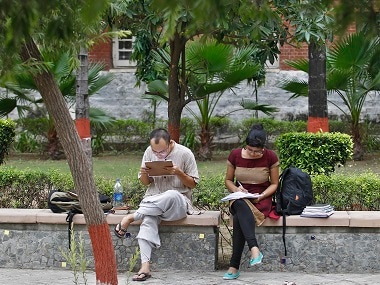 Representational image. Reuters[/caption]The problem arises when the size of departments are small. In India, there are a few departments where there are more than 14 faculty positions, and in such cases, it becomes difficult to ensure reservation to all SC/ST/OBC posts. In departments with fewer than four available positions, no reserved seat will be created at all. Similarly, for departments with fewer than seven faculty positions, there will be no SC and ST position. In departments with fewer than 14 faculty positions, there will be no ST faculty.According to a report submitted by Banaras Hindu University to the HRD ministry in 2018, if the university were to use the 13-point roster, posts reserved for SCs would be reduced by half, those for STs by almost 80 percent and those for OBC teachers by 30 percent.Also, if the new 10 percent reservation for the economically backward is implemented, SC, ST and OBC teachers could be completed wiped out from all Central universities.Developments in courtThe latest development on a possible ordinance comes amid protests by university faculty members and student bodies after the Supreme Court, on 22 January, dismissed the special leave petition that had sought to restore the earlier mechanism of faculty reservation. The bench had upheld an order of the Allahabad High Court, which had ruled that reservation in faculty positions in universities should be calculated department-wise, not by taking the total number of seats at the institute as the basis.Soon after the Supreme Court's dismissal order was announced, teachers and students in Delhi had held a march from Mandi House to Jantar Mantar in the national capital against the order.The HRD ministry had filed the special leave petition in April 2018, following a political furore over the University Grants Commission's (UGC) 5 March, 2018, order that said the number of reserved faculty posts across universities and colleges would be calculated department-wise. A bench of Justice UU Lalit and Justice Indira Banerjee had rejected the Centre's plea challenging the 7 April, 2017, order of the Allahabad High Court.In February 2008, the UGC had advised the Banaras Hindu University to follow the roster system cadre wise instead of applying it department wise. The university had then issued an advertisement in July 2016 to fill the vacancies of various teaching and equivalent posts. But the move was challenged in the Allahabad High Court, which then directed universities to make fresh rosters, taking department/subject as a unit, not the university.
First Published:Mar 05, 2019, 14:09:48 IST
Advertisement
Advertisement

China has dominated Myanmar’s rare earth mines — now India eyes deal to harness country’s critical minerals
India is deepening rare earth cooperation with Myanmar as New Delhi seeks alternative sources of critical minerals dominated by China, including dysprosium and terbium used in EVs, defence systems and clean energy technologies
6 min read
CJP protest in Delhi: New videos of stone pelting, violence emerge as police, agitators trade charges
Fresh videos of violence that broke out during the Cockroach Janta Party's (CJP) protest in Delhi have surfaced, with the police releasing footage showing alleged stone pelting, vandalism and attacks on security personnel
3 min read
'From make in India to launch from India': Skyroot COO on why Vikram-1 could change India’s space sector
Skyroot Aerospace’s successful Vikram-1 mission marks a major milestone for India’s private space sector, as the country seeks to shift from “Make in India” to “Launch from India” and compete in the global commercial satellite launch market
8 min read
Choke terror funding, keep international shipping lanes safe: Jaishankar at Asean Regional Forum
Jaishankar's remarks came against the backdrop of recent terror attacks targeting India and growing threats to commercial shipping amid conflicts in West Asia and Europe
2 min read
PM Modi announces fast-track courts for paper leak cases; CJP responds ‘Dharmendra Pradhan must go’
Amid protests demanding accountability for the leak of medical entrance test Neet and other irregularities in the education system, Prime Minister Narendra Modi has announced that the government has decided to set up fast-track courts to ensure swift and stringent punishment for those involved in paper leaks.
3 min read
Advertisement
Advertisement