


Following landmark Supreme Court judgment, India joins league of select nations which allow passive euthanasia
With the Supreme Court holding the right to die with dignity a fundamental right and recognising 'living will' made by terminally-ill patients as permissible, India has joined a league of select countries where passive euthanasia has been accorded legal sanctity

New Delhi: With the Supreme Court holding the right to die with dignity a fundamental right and recognising 'living will' made by terminally-ill patients as permissible, India has joined a league of select countries where passive euthanasia has been accorded legal sanctity.[caption id="attachment_4383107" align="alignleft" width="380"] Representational image. Reuters[/caption]The Oxford English Dictionary defines "euthanasia" as "the painless killing of a patient suffering from an incurable and painful disease or in an irreversible coma".The term is derived from the Greek "euthanatos", with 'eu' meaning well, and 'thanatos' meaning death. In ancient Greece and Rome, citizens were entitled to a good death to end the suffering of a terminal illness.There are different euthanasia laws in each country. It can be classified into five types — voluntary, non-voluntary, involuntary, passive and active.India joins countries like Netherlands, Canada, Belgium, Colombia and Luxembourg in legalising passive euthanasia.
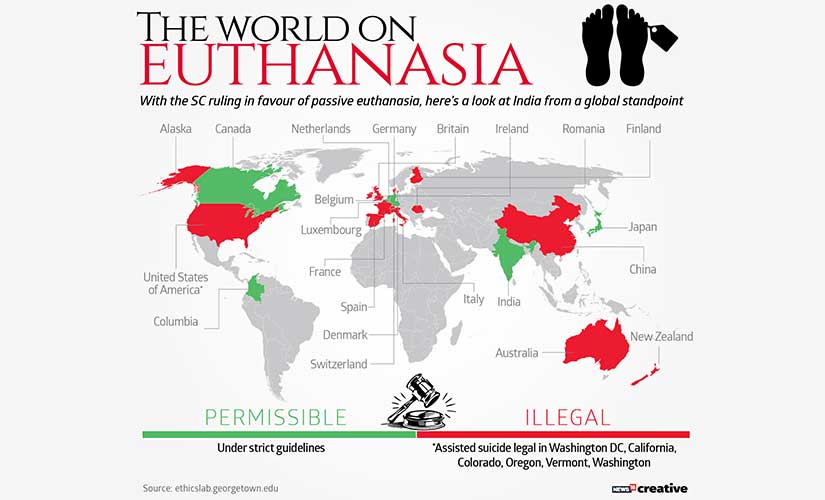 While dealing with the issue, the five judges arrived at a concurrent finding by analysing the practice of euthanasia in various countries.Chief Justice Dipak Misra and Justice AM Khanwilkar, who wrote a separate judgement, noted that in the US, active euthanasia was illegal but physician-assisted death is legal in the states of Oregon, Washington and Montana. A distinction has been drawn between euthanasia and physician-assisted suicide.In both Oregon and Washington, only self-assisted dying is permitted. Doctor-administered assisted dying and any form of assistance to help a person commit suicide outside the provisions of the legislation remains a criminal offence.In Canada, physician-assisted suicide is illegal according to Section 241(b) of the Criminal Code of Canada.In Germany, assisted suicide is illegal. However, this is not the case for passive assisted suicide. Thus, if doctors stop life-prolonging measures on the written wishes of a patient, it is not considered as a criminal offence.Besides, it is legal for doctors in Germany to administer painkillers to a dying patient to ease the pain. The painkillers, cause low breathing that may lead to respiratory arrest and, ultimately, death.

'From make in India to launch from India': Skyroot COO on why Vikram-1 could change India’s space sector
Choke terror funding, keep international shipping lanes safe: Jaishankar at Asean Regional Forum
PM Modi announces fast-track courts for paper leak cases; CJP responds ‘Dharmendra Pradhan must go’
Sikkim tunnel collapse rescue resumes, death toll rises to 22
Delhi Police asks personnel to wear uniform: What the law says on cops in plainclothes during protests