
Advertisement


Sections
Explained: What is the Flag Code of India? What changes has the Centre made?
The Flag Code of India, which took effect on 26 January 2002, governs the use, display and hoisting of the tricolour. The new rules allow a member of the public, a private organisation or an educational institution to hoist the flag on all days and occasions, ceremonial or otherwise

The Centre has tweaked the Flag Code of India to allow the Tricolour to be displayed the open and on houses and buildings through day and night.Now, a member of the public, a private organisation or an educational institution is allowed to hoist the flag on all days and occasions, ceremonial or otherwise, consistent with dignity and honour of the national flag.![Representational image. AFP]() Representational image. AFP[/caption]The Flag Code of India, 2002 has been further amended through an order on 20 July, 2022, and clause (xi) of paragraph 2.2 of Part-II of the Flag Code of India, 2002 shall now be read as under:- (xi) "where the Flag is displayed in open or displayed on the house of a member of public, it may be flown day and night".Similarly, paragraph 1.2 of Part-I of the Flag Code of India, 2002 shall now be read as under: 1.2. "The national flag shall be made of hand spun and hand woven or machine made, cotton/ polyester/ wool/ silk khadi bunting."The home secretary also enclosed with his letter the salient features of the Flag Code including the changes made on 30 December, 2021 and 2 July, 2022 and the frequently asked questions (FAQs) about the use and display of the national flag."You are requested to ensure that these are widely disseminated among various organisations, PSUs under your administrative control," the home secretary said in his letter.Prime Minister Narendra Modi and Union home minister Amit Shah have appealed to the citizens to hoist the tricolour at their homes from August 13 to 15. Shah said on Saturday that “during the 75th year of Independence, citizens should pledge to re-dedicate themselves to the tricolour for the development, bright future and security of the country, by hoisting the Tricolour in their homes from August 13 to 15.”President of Flag Foundation of India (FFI) Naveen Jindal on Sunday welcomed the latest Amendment to the Flag Code of India 2002 after which a common citizen can hoist and unfurl the national flag 24 hours a day (day and night) at their homes and office locations, said a statement issued by the FFI."This is a very progressive decision. This amendment to the Flag Code of India will definitely encourage more and more people to display the Tiranga with dignity and pride on all days of the year and will also give a boost to the Har Ghar Tiranga. Jai Hind.”
Representational image. AFP[/caption]The Flag Code of India, 2002 has been further amended through an order on 20 July, 2022, and clause (xi) of paragraph 2.2 of Part-II of the Flag Code of India, 2002 shall now be read as under:- (xi) "where the Flag is displayed in open or displayed on the house of a member of public, it may be flown day and night".Similarly, paragraph 1.2 of Part-I of the Flag Code of India, 2002 shall now be read as under: 1.2. "The national flag shall be made of hand spun and hand woven or machine made, cotton/ polyester/ wool/ silk khadi bunting."The home secretary also enclosed with his letter the salient features of the Flag Code including the changes made on 30 December, 2021 and 2 July, 2022 and the frequently asked questions (FAQs) about the use and display of the national flag."You are requested to ensure that these are widely disseminated among various organisations, PSUs under your administrative control," the home secretary said in his letter.Prime Minister Narendra Modi and Union home minister Amit Shah have appealed to the citizens to hoist the tricolour at their homes from August 13 to 15. Shah said on Saturday that “during the 75th year of Independence, citizens should pledge to re-dedicate themselves to the tricolour for the development, bright future and security of the country, by hoisting the Tricolour in their homes from August 13 to 15.”President of Flag Foundation of India (FFI) Naveen Jindal on Sunday welcomed the latest Amendment to the Flag Code of India 2002 after which a common citizen can hoist and unfurl the national flag 24 hours a day (day and night) at their homes and office locations, said a statement issued by the FFI."This is a very progressive decision. This amendment to the Flag Code of India will definitely encourage more and more people to display the Tiranga with dignity and pride on all days of the year and will also give a boost to the Har Ghar Tiranga. Jai Hind.”
The Tricolour can now also be made out of polyester and by a machine.Earlier, the Tricolour was only allowed to be displayed from sun rise to sun set irrespective of weather conditions. Machine-made and polyester flags were not allowed.The move came as the government is going to launch a 'Har Ghar Tiranga' (hoisting of flag in every home) from 13 to 15 August as part of its 'Azadi Ka Amrit Mahotsav' which will commemorate 75 years of a progressive, independent India.But what is the Flag Code of India? Let’s take a closer look:As per Indian Express, the ‘Flag Code of India 2002’ governs the use, display and hoisting of the national flag in the country.It brings together all laws, conventions, practices, and instructions for the display of the national flag by private, public, and government institutions.As per Clause 2.1 of the Flag Code of India, there shall be no restriction on the display of the national flag by members of the general public, private organisations, educational institutions etc. consistent with the dignity and honour of the national flag.
The code also states that those found insulting the national flag can face a prison term of up to three years and a fine for a first offence.As per NewsonAir, the Flag Code of India was earlier amended on 30 December, 2021, allowing the use of polyester, apart from cotton, wool, silk and khadi for making hand-spun, hand-woven and machine-made flags.Before the Flag Code of India took effect on 26 January, 2002, the rules for the display of the national flag were governed by the provisions of The Emblems and Names (Prevention of Improper Use) Act, 1950 and The Prevention of Insults to National Honour Act, 1971.Union home secretary writes letterIn a letter to secretaries of all central ministries and departments, Union home secretary Ajay Bhalla said the display, hoisting and use of the Indian national flag is governed by the Flag Code of India, 2002 and the Prevention of Insults to National Honour Act, 1971.[caption id="attachment_10954221" align="alignnone" width="640"]
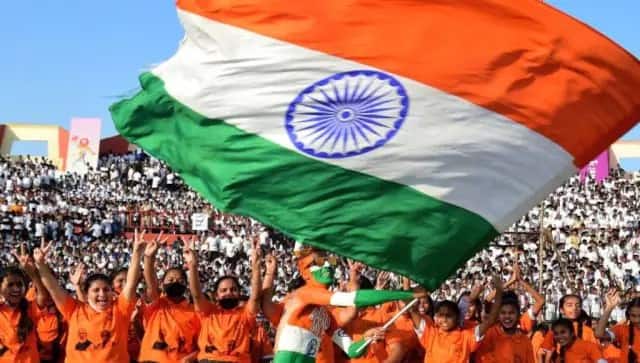 Representational image. AFP[/caption]The Flag Code of India, 2002 has been further amended through an order on 20 July, 2022, and clause (xi) of paragraph 2.2 of Part-II of the Flag Code of India, 2002 shall now be read as under:- (xi) "where the Flag is displayed in open or displayed on the house of a member of public, it may be flown day and night".Similarly, paragraph 1.2 of Part-I of the Flag Code of India, 2002 shall now be read as under: 1.2. "The national flag shall be made of hand spun and hand woven or machine made, cotton/ polyester/ wool/ silk khadi bunting."The home secretary also enclosed with his letter the salient features of the Flag Code including the changes made on 30 December, 2021 and 2 July, 2022 and the frequently asked questions (FAQs) about the use and display of the national flag."You are requested to ensure that these are widely disseminated among various organisations, PSUs under your administrative control," the home secretary said in his letter.Prime Minister Narendra Modi and Union home minister Amit Shah have appealed to the citizens to hoist the tricolour at their homes from August 13 to 15. Shah said on Saturday that “during the 75th year of Independence, citizens should pledge to re-dedicate themselves to the tricolour for the development, bright future and security of the country, by hoisting the Tricolour in their homes from August 13 to 15.”President of Flag Foundation of India (FFI) Naveen Jindal on Sunday welcomed the latest Amendment to the Flag Code of India 2002 after which a common citizen can hoist and unfurl the national flag 24 hours a day (day and night) at their homes and office locations, said a statement issued by the FFI."This is a very progressive decision. This amendment to the Flag Code of India will definitely encourage more and more people to display the Tiranga with dignity and pride on all days of the year and will also give a boost to the Har Ghar Tiranga. Jai Hind.”
But not all are celebrating.Weavers unhappy, Congress lashes outAs per Indian Express, a section of Khadi weavers and activists have launched an agitation to protest the change.A nationwide protest has been called by the Karnataka Khadi Gramudyog Samyukta Sangha (KKGSS) — a unit that spins the fabric used to make the national flag, which has now paused operations in the wake of the move.KKGSS, which claims to be the only BIS approved khadi unit for the material used to make the Tricolour, say they used to get orders worth Rs 3-4 crore every year in the run up to the Independence Day, but this year, in the wake of the amendment, the demand has been abysmal, as per the report.Meanwhile, the newspaper quoted senior Congress leader Jairam Ramesh as saying: “By allowing the import of Tricolour made of polyester, an arrangement has been made for ‘China-made Tricolour in every home’ — the very China that is encroaching on our land.”Party spokesperson Ajoy Kumar added, “They (BJP government) have been vending government properties, and now they are aiming at selling the national flag as the country’s treasury is waning.”With inputs from agencies
First Published:Jul 25, 2022, 15:26:44 IST
Advertisement
Advertisement

PM Modi announces fast-track courts for paper leak cases; CJP responds ‘Dharmendra Pradhan must go’
Amid protests demanding accountability for the leak of medical entrance test Neet and other irregularities in the education system, Prime Minister Narendra Modi has announced that the government has decided to set up fast-track courts to ensure swift and stringent punishment for those involved in paper leaks.
3 min read
Sikkim tunnel collapse rescue resumes, death toll rises to 22
The death toll at the collapsed tunnel at Sikkim's Namchi district rose to 22 after nine more bodies were recovered overnight. At least 27 workers were trapped in a tunnel at an NHPC project after a sudden burst of suspected methane gas trapped within rock formations triggered an explosion.
2 min read
Delhi Police asks personnel to wear uniform: What the law says on cops in plainclothes during protests
The Delhi Police has instructed all its personnel to wear uniforms when they report for duty at Jantar Mantar for crowd control. This comes after outrage grew over videos of men in civilian clothes or without name tags hitting protesters in the Capital. Is it legal for the police to ditch uniforms during protests?
4 min read
No premium queues, 30-minute target: What changes for Indian passport applicants in UAE
Indian passport applicants in the UAE can now access passport, visa and attestation services through Alhind’s 16 centres, with no premium queues, a Dh19 service fee and a target of completing applications within 30 minutes
4 min read
CJP Protest in Delhi Live Updates: PM Modi announces fast-track courts for NEET paper leak cases
CJP Protest in Delhi Live Updates: Heavy security has been deployed at the Jantar Mantar in Delhi, where the Cockroach Janta Party (CJP) is continuing its protest demanding the resignation of Union Education Minister Dharmendra Pradhan over the recent paper leaks controversy
1 min read
Advertisement
Advertisement