
Advertisement


Sections
Down To The District: The health of 5 states going to the polls
While healthcare has largely been a neglected issue in past Indian general elections, major parties started talking about health in their manifestos from 2004.

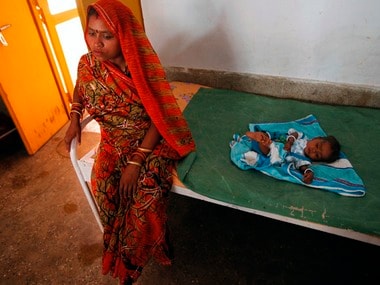 Seven-month-old Deepak, who weighs 4 kg and suffers from severe malnutrition with his mother at the Nutritional Rehabilitation Centre in Lalitpur district, Uttar Pradesh. Reuters[/caption]Healthcare is important to political and economic debate because inadequate public healthcare and healthcare expenses push an additional 55 million people back into poverty in India every year, according to this 2015 Lancet paper. However, health-related political discussions are, currently, limited to debates around major health scams, or state failure during severe epidemic outbreaks. In general, electoral battles have not been won or lost because of healthcare issues.India has a healthcare crisis, but solutions need to be state- and district-specificWhile India still has more wasted (low weight-for-height) and stunted (low height-for-age) children than any other country–about 40 million–the rate of obesity recorded an 8.6-fold increase in India’s rural areas over 14 years and a 1.7-fold increase in urban areas over 20 years, IndiaSpend reported in June 2016.More than half of India’s rural population uses private healthcare, which is four times as costly as public healthcare, and can cost the poorest 20% of Indians more than 15 times their average monthly expenditure; shortages of doctors at public health centres have risen 200% over a decade, and even cities such as Mumbai need to double staffing of public healthcare (details here, here and here).The five states going into polls represent the good, the bad and the ugly of nutrition and health in India, our analysis showed. The trends are so diverse that it is clear that no single set of solutions can be the answer. India needs state-specific, if not district-specific, solutions in health and nutrition.Problems with early marriage and sex ratio in relatively advanced Manipur and GoaThe percentage of women currently aged 20-24 who were married before reaching the age 18 has declined in all the states going to elections, with the exception of Manipur, where their percentage increased from 12.7% to 13.1%, according to the National Family Health Survey (NFHS) reports for 2015-16, released over 2016 and 2017.In 2015, Punjab had an even lower proportion of women (currently aged 20-24) married before age 18 than Goa, declining from 19.7% in 2005 to 7.6% in 2015. Goa still has 9.8% women (currently aged 20-24) who were married before age 18.Manipur also has 65.9% children fully immunised.The latest NFHS data release shows that between 2005 and 2015, Manipur’s sex ratio at birth declined from 1,014 to 962. For a state known to be a showcase of women’s empowerment, this must come as a wake-up call. A girl born in Manipur was more likely to be educated; more likely to be working as an adult; more likely to survive childbirth and more likely to not be the victim of crime than in most Indian states.
Source: Census 2011; Census 2011; National Sample Survey Office; Regional Institute of Medical Sciences, Manipur, 2010-11; Sample Registration System report, 2010-12; National Crime Records Bureau’s Crime in India 2015 report.Note: Rankings are among 29 states; they do not include union territories.Uttarakhand also showed a decline in sex ratio at birth. Goa and Punjab showed improvement. NFHS data for Uttar Pradesh are not yet out. The government’s Sample Registration System (SRS) reports show that between 2011 and 2014, there was a decline in UP’s sex ratio at birth, from 875 to 869.Infant, maternal mortality: Vast variations within states, districts reveal clearer pictureUttarakhand has shown the slowest improvement in infant mortality rate (IMR)–deaths per 1,000 live births–although NFHS data for UP are yet to be released. Still, as SRS data show, UP’s IMR has come down from 57 to 48 between 2011 and 2014, suggesting that NFHS data will show improvement between 2005 and 2015.
Source: National Family Health Survey (NFHS); *Data for Uttar Pradesh are yet to be releasedHowever, as our state-specific analysis to follow will show, states such as UP reveal wide variations within districts in terms of IMR. For example, according to the Annual Health Survey (2012-13), the latest district level data available for UP, the IMR in Shrawasti district at 96 (the worst IMR in India was 56 in Madhya Pradesh in 2012) was almost three times as much as in Kanpur Nagar, which had an IMR of 37 (comparable to Gujarat’s 38 in 2012).
Source: Annual Health Survey (2012-13); Click on the map to view district-level data.The government does not provide maternal mortality ratio (MMR)–deaths per 100,000 births–estimates for small states such as Goa and Manipur, The Wire reported in July 2016. Still, there are not many indicators that reveal inter-state health variations within India like MMR does.The MMR in UP and Uttarakhand is almost five times that in Kerala, the state with the lowest MMR among major states. Yet, in states with high maternal mortality, political parties do not discuss plans to reduce these preventable deaths.
Source: Sample Registration SystemUndernutrition is key determinant of ill-health in all five statesUndernutrition is a major underlying determinant of ill-health in all the election-bound states, and the difference between states is not as stark, as it is with, say, MMR.For example, across the electoral-battleground states, the proportion of stunted children under the age of five were similar: 29% in Manipur, 20% in Goa, 26% in Punjab and 34% in Uttarakhand for the year 2015-16. The latest data for UP are awaited.
Source: National Family Health Survey (NFHS); *Data for Uttar Pradesh are yet to be releasedDoing too much is as bad as doing too little: The nuances of healthcareUnder-provisioning of healthcare is a major Indian problem, but so, often, is over-provisioning.In 2015, for instance, in rural areas of Kapurthala district in Punjab, 61.5% of all deliveries in private hospitals and clinics were caesarean. In Manipur’s Imphal West district, almost two of every three deliveries in private hospitals were caesarean. Public facilities also have a high proportion of caesarean deliveries, although not to the extent reported from private facilities, as we analyse in the state-specific stories.Similarly, undernutrition is a major issue, as is over-nutrition.In Punjab’s Fatehgarh Sahib district, 36.5% of men surveyed by NFHS in 2015-16 proved to be obese or overweight, as were 41% of all the women surveyed. In Uttarakhand districts such as Dehradun, Nainital and Udham Singh Nagar, one in every four women surveyed was obese or overweight.With non-communicable diseases becoming the leading cause of death in the country, the twin burdens of malnutrition and ill-health, and the resulting policy choices, will require discussion.Will such health- and nutrition-related issues be debated in the battle states? Will people demand better health and nutrition? Will politicians see the merit in developing a constituency of long-term supporters linked to human development? The coming weeks could provide some answers. Meanwhile, district level data analysis will raise more questions.Indiaspend.org is a data-driven, public-interest journalism non-profit/FactChecker.in is fact-checking initiative, scrutinising for veracity and context statements made by individuals and organisations in public life

First Published:Jan 27, 2017, 10:02:18 IST
Advertisement
Advertisement

PM Modi announces fast-track courts for paper leak cases; CJP responds ‘Dharmendra Pradhan must go’
Amid protests demanding accountability for the leak of medical entrance test Neet and other irregularities in the education system, Prime Minister Narendra Modi has announced that the government has decided to set up fast-track courts to ensure swift and stringent punishment for those involved in paper leaks.
3 min read
Sikkim tunnel collapse rescue resumes, death toll rises to 22
The death toll at the collapsed tunnel at Sikkim's Namchi district rose to 22 after nine more bodies were recovered overnight. At least 27 workers were trapped in a tunnel at an NHPC project after a sudden burst of suspected methane gas trapped within rock formations triggered an explosion.
2 min read
Delhi Police asks personnel to wear uniform: What the law says on cops in plainclothes during protests
The Delhi Police has instructed all its personnel to wear uniforms when they report for duty at Jantar Mantar for crowd control. This comes after outrage grew over videos of men in civilian clothes or without name tags hitting protesters in the Capital. Is it legal for the police to ditch uniforms during protests?
4 min read
No premium queues, 30-minute target: What changes for Indian passport applicants in UAE
Indian passport applicants in the UAE can now access passport, visa and attestation services through Alhind’s 16 centres, with no premium queues, a Dh19 service fee and a target of completing applications within 30 minutes
4 min read
CJP Protest in Delhi Live Updates: PM Modi announces fast-track courts for NEET paper leak cases
CJP Protest in Delhi Live Updates: Heavy security has been deployed at the Jantar Mantar in Delhi, where the Cockroach Janta Party (CJP) is continuing its protest demanding the resignation of Union Education Minister Dharmendra Pradhan over the recent paper leaks controversy
1 min read
Advertisement
Advertisement