
Advertisement


Sections
Demonetisation is India's move to less-cash; banks must seize the moment
There is a sense of urgency in the system, there is a genuine need, desire and willingness to move to a less-cash future

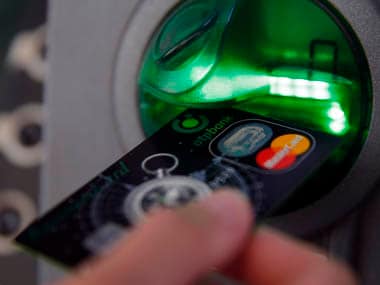
In the 21+ odd days post de-legalisation of old high denomination currency – Rs 500 and Rs 1000, there is one clear narrative that has emerged. India is now being catapulted into a less-cash (not cashless) economy. This tectonic shift should also promote the growth of financial inclusion in leaps and bounds. These are early days. The long war for less-cash has just begin. If India has to win this war, it is imperative that banks use the power of their franchise to own and define the narrative.[caption id="attachment_3119004" align="alignleft" width="380"]![A customer performs a transaction on an ATM at a branch of Hungary's largest lender OTP Bank in central Budapest July 24, 2013. REUTERS/Laszlo Balogh (HUNGARY - Tags: BUSINESS) - RTX11X2Y]() Reuters[/caption]There will be many pillars of the banks’ action strategy for India’s march to less-cash and to drive electronic payments. This note specifically addresses the role of cards (including direct electronic banking transfers by individuals in as much as they are facilitated by cards) across payment channels in this move to less-cash. Cards are an important cog in the wheel as they can replace cash in transactions from consumers to businesses and consumers to other consumers for transfer of funds for personal or business reasons. They are also the instruments that are used to load mobile wallets (hopefully cash will become less!).Basic factsLet us peruse some statistics and facts:• There were ~72.8 crore debit cards and ~2.68 crore credit cards in India as at the end of September 2016. ~80 percent of these debit cards are issued by PSU banks. The top 4 PSU banks – SBI, PNB, BOI and BOB account for ~45 percent of all debit cards.• As on 23 November 2016, there were 25.68 crore Jan Dhan accounts. 76 percent of these accounts had an associated RuPay debit card.• There were 2.18 lakh ATMs and ~15 lakh POS terminals as at the end of September 2016.• The cards (especially debit) are used primarily at ATMs.
Reuters[/caption]There will be many pillars of the banks’ action strategy for India’s march to less-cash and to drive electronic payments. This note specifically addresses the role of cards (including direct electronic banking transfers by individuals in as much as they are facilitated by cards) across payment channels in this move to less-cash. Cards are an important cog in the wheel as they can replace cash in transactions from consumers to businesses and consumers to other consumers for transfer of funds for personal or business reasons. They are also the instruments that are used to load mobile wallets (hopefully cash will become less!).Basic factsLet us peruse some statistics and facts:• There were ~72.8 crore debit cards and ~2.68 crore credit cards in India as at the end of September 2016. ~80 percent of these debit cards are issued by PSU banks. The top 4 PSU banks – SBI, PNB, BOI and BOB account for ~45 percent of all debit cards.• As on 23 November 2016, there were 25.68 crore Jan Dhan accounts. 76 percent of these accounts had an associated RuPay debit card.• There were 2.18 lakh ATMs and ~15 lakh POS terminals as at the end of September 2016.• The cards (especially debit) are used primarily at ATMs.![chart1]() Data courtesy: RBI, All cards may not active – these are cards issued.• At the end of 2015, compared to ~60 crore cards in India, China would have had a staggering ~4200 crore cards. Even if we account for population and demographic differential, the gap is staggering.• India has a fully functional indigenous cards network – RuPay – launched by NPCI in 2012. The National Unified USSD Platform (NUUP) is also live.• As per an eMarketer study, the number of mobile users who will be using a mobile messaging app at the end of 2016 will be ~13.3 crore.• India should touch the 50 crore internet users mark in 2017.Important note – Number of cards and number of users do not suggest unique individuals as there may be multiple holdings by one individual and should be discounted when perusing statistics.Have cards will not use!Some prima facie conclusions:• Low card penetration and inadequate POS machines are well acknowledged impediments to the low levels of card usage. However, inactivity of cardholders either due to lack of knowledge and/or due to propensity and the merchant (seller’s) willingness to accept are also critical factors.• If there are only 13.3 crore users who use a messaging app, it is unlikely that a significantly higher number will be more comfortable in using their mobile phones to transact. So mobile payments and mobile wallets while very important drivers, have limitations in terms of reach.• As of today, it is the banks and especially the top 4 PSU banks who have the sheer strength of numbers to drive this move to less-cash. The cards issued by them are already out there. They has to be put to work now.Simple equation, complex eco-system
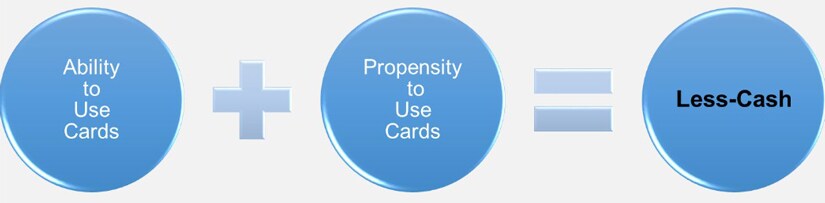
Data courtesy: RBI, All cards may not active – these are cards issued.• At the end of 2015, compared to ~60 crore cards in India, China would have had a staggering ~4200 crore cards. Even if we account for population and demographic differential, the gap is staggering.• India has a fully functional indigenous cards network – RuPay – launched by NPCI in 2012. The National Unified USSD Platform (NUUP) is also live.• As per an eMarketer study, the number of mobile users who will be using a mobile messaging app at the end of 2016 will be ~13.3 crore.• India should touch the 50 crore internet users mark in 2017.Important note – Number of cards and number of users do not suggest unique individuals as there may be multiple holdings by one individual and should be discounted when perusing statistics.Have cards will not use!Some prima facie conclusions:• Low card penetration and inadequate POS machines are well acknowledged impediments to the low levels of card usage. However, inactivity of cardholders either due to lack of knowledge and/or due to propensity and the merchant (seller’s) willingness to accept are also critical factors.• If there are only 13.3 crore users who use a messaging app, it is unlikely that a significantly higher number will be more comfortable in using their mobile phones to transact. So mobile payments and mobile wallets while very important drivers, have limitations in terms of reach.• As of today, it is the banks and especially the top 4 PSU banks who have the sheer strength of numbers to drive this move to less-cash. The cards issued by them are already out there. They has to be put to work now.Simple equation, complex eco-system![chart2]() The card payment ecosystem is complex. The primary participants are:• Merchants (sellers) and card holders (buyers).• Banks: Issuing banks - they put the card in the customer’s wallet and acquiring bank - they enable the merchant and/or settle the transaction.• Card associations - enable the network for settlements.• Third party logistics providers - provide POS terminals and payment gateways, maintain and service them.• Telecom companies - role may be indirect but is crucial as they provide the backbone.• The ubiquitous government and the RBI.Why was this complex system not running at break neck speed till now?Well, because it is complicated! For the banks and associations, there are transaction costs to the system and no one is willing to bear them. On a standalone basis, acquiring profit and loss statements are nothing to write home about and hence banks (even globally) have not been bullish on the business. In addition, the Indian economy was (hopefully will not be) a cash driven economy and despite many efforts, cards remained a fringe payment method.There are also multiple issues from certain merchants’ and card holders’ perspective. Some of those issues/ beliefs are summarised below:• Cash is easier to use and more reliable (transaction failure rate).• Transaction costs of cash are lower - merchants pay a portion of the sale to banks (Merchant discount rate – MDR) and may also incur one time setup costs and recurring maintenance costs; customers pay convenience fees/surcharges in some cases like fuel and IRCTC.• Lack of adequate knowledge on the whys and hows.• Infrastructure woes: Acceptance infrastructure and telecom backbone.• Merchants could be unwilling to accept card in some cases in order to keep their sales unaccounted.• Perceived and real security concerns.The advent of ecommerce and eticketing coupled with the mobile revolution were a booster to card payments. Increase in organised retail helped and banks and ecosystem participants upped the game. Card payments have been growing albeit from a low base.However, we seem to be at an inflection point now assuming that recent events will help in re-setting the base and will allow us to leapfrog many steps in between.What should banks and other ecosystem participants do to take this tide that has come their way? There is a three pronged strategy that is needed to enter the virtuous cycle of card payment adoption in India. Each of the three elements are sine qua non for success and will have to work in tandem.
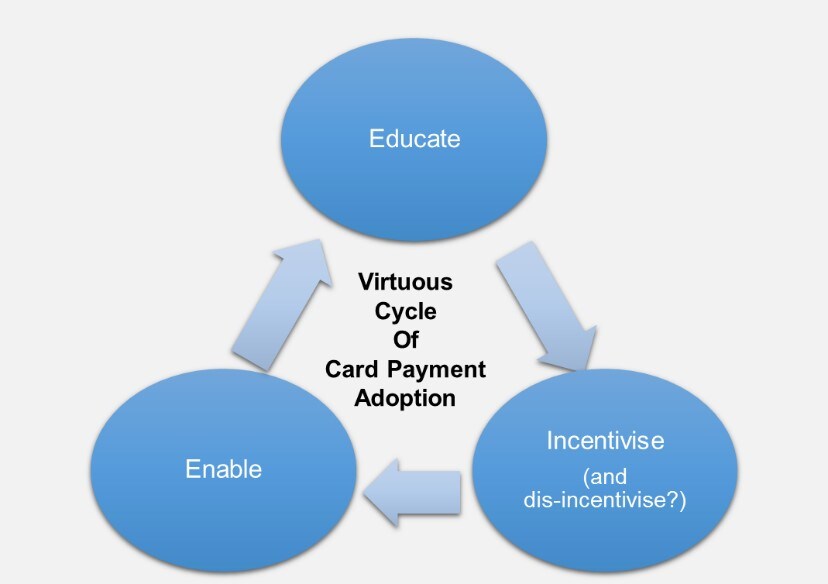
The card payment ecosystem is complex. The primary participants are:• Merchants (sellers) and card holders (buyers).• Banks: Issuing banks - they put the card in the customer’s wallet and acquiring bank - they enable the merchant and/or settle the transaction.• Card associations - enable the network for settlements.• Third party logistics providers - provide POS terminals and payment gateways, maintain and service them.• Telecom companies - role may be indirect but is crucial as they provide the backbone.• The ubiquitous government and the RBI.Why was this complex system not running at break neck speed till now?Well, because it is complicated! For the banks and associations, there are transaction costs to the system and no one is willing to bear them. On a standalone basis, acquiring profit and loss statements are nothing to write home about and hence banks (even globally) have not been bullish on the business. In addition, the Indian economy was (hopefully will not be) a cash driven economy and despite many efforts, cards remained a fringe payment method.There are also multiple issues from certain merchants’ and card holders’ perspective. Some of those issues/ beliefs are summarised below:• Cash is easier to use and more reliable (transaction failure rate).• Transaction costs of cash are lower - merchants pay a portion of the sale to banks (Merchant discount rate – MDR) and may also incur one time setup costs and recurring maintenance costs; customers pay convenience fees/surcharges in some cases like fuel and IRCTC.• Lack of adequate knowledge on the whys and hows.• Infrastructure woes: Acceptance infrastructure and telecom backbone.• Merchants could be unwilling to accept card in some cases in order to keep their sales unaccounted.• Perceived and real security concerns.The advent of ecommerce and eticketing coupled with the mobile revolution were a booster to card payments. Increase in organised retail helped and banks and ecosystem participants upped the game. Card payments have been growing albeit from a low base.However, we seem to be at an inflection point now assuming that recent events will help in re-setting the base and will allow us to leapfrog many steps in between.What should banks and other ecosystem participants do to take this tide that has come their way? There is a three pronged strategy that is needed to enter the virtuous cycle of card payment adoption in India. Each of the three elements are sine qua non for success and will have to work in tandem. ![chart3]() 1. EnableTo enable card transactions, banks will need to adopt a multi-layered approach.• Re-imagine the merchant. The merchant is not just a business owner but the merchant for the sole purpose of accepting payments is also the professional service provider – the doctor, lawyer, taxi-driver, etc. and the individual seller of products (the unorganised sector) – the vegetable vendor, the chaat waala, etc. These individual providers or sellers of products and services have to be enabled to accept micro-payments if we have to move to less-cash.• Robust and well penetrated, easy to use, omni-channel acceptance infrastructure.
1. EnableTo enable card transactions, banks will need to adopt a multi-layered approach.• Re-imagine the merchant. The merchant is not just a business owner but the merchant for the sole purpose of accepting payments is also the professional service provider – the doctor, lawyer, taxi-driver, etc. and the individual seller of products (the unorganised sector) – the vegetable vendor, the chaat waala, etc. These individual providers or sellers of products and services have to be enabled to accept micro-payments if we have to move to less-cash.• Robust and well penetrated, easy to use, omni-channel acceptance infrastructure.
 Reuters[/caption]There will be many pillars of the banks’ action strategy for India’s march to less-cash and to drive electronic payments. This note specifically addresses the role of cards (including direct electronic banking transfers by individuals in as much as they are facilitated by cards) across payment channels in this move to less-cash. Cards are an important cog in the wheel as they can replace cash in transactions from consumers to businesses and consumers to other consumers for transfer of funds for personal or business reasons. They are also the instruments that are used to load mobile wallets (hopefully cash will become less!).Basic factsLet us peruse some statistics and facts:• There were ~72.8 crore debit cards and ~2.68 crore credit cards in India as at the end of September 2016. ~80 percent of these debit cards are issued by PSU banks. The top 4 PSU banks – SBI, PNB, BOI and BOB account for ~45 percent of all debit cards.• As on 23 November 2016, there were 25.68 crore Jan Dhan accounts. 76 percent of these accounts had an associated RuPay debit card.• There were 2.18 lakh ATMs and ~15 lakh POS terminals as at the end of September 2016.• The cards (especially debit) are used primarily at ATMs.
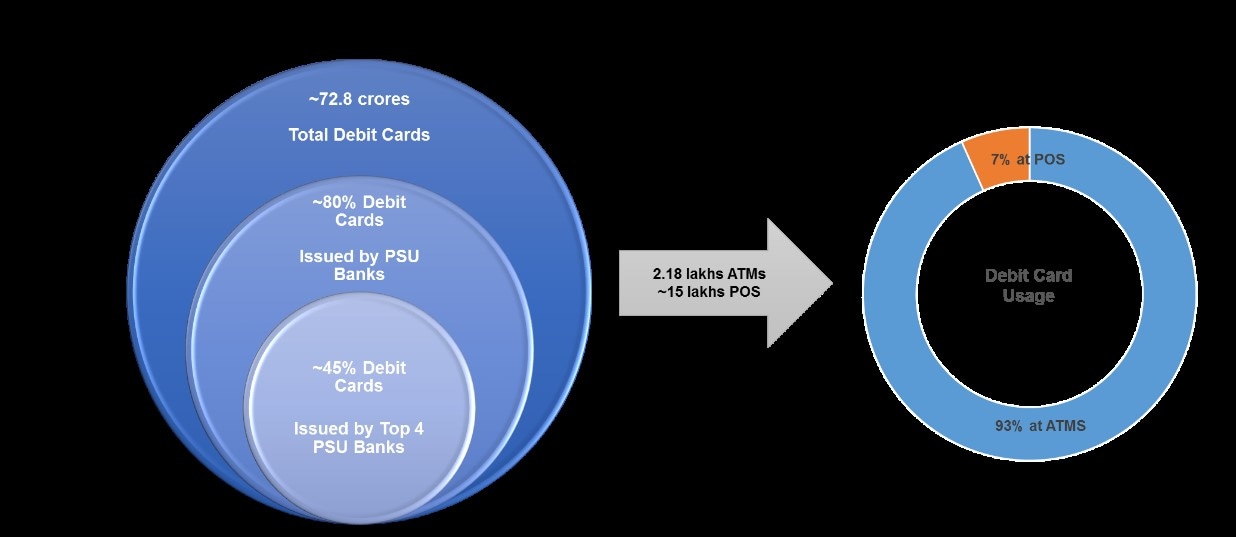 Data courtesy: RBI, All cards may not active – these are cards issued.• At the end of 2015, compared to ~60 crore cards in India, China would have had a staggering ~4200 crore cards. Even if we account for population and demographic differential, the gap is staggering.• India has a fully functional indigenous cards network – RuPay – launched by NPCI in 2012. The National Unified USSD Platform (NUUP) is also live.• As per an eMarketer study, the number of mobile users who will be using a mobile messaging app at the end of 2016 will be ~13.3 crore.• India should touch the 50 crore internet users mark in 2017.Important note – Number of cards and number of users do not suggest unique individuals as there may be multiple holdings by one individual and should be discounted when perusing statistics.Have cards will not use!Some prima facie conclusions:• Low card penetration and inadequate POS machines are well acknowledged impediments to the low levels of card usage. However, inactivity of cardholders either due to lack of knowledge and/or due to propensity and the merchant (seller’s) willingness to accept are also critical factors.• If there are only 13.3 crore users who use a messaging app, it is unlikely that a significantly higher number will be more comfortable in using their mobile phones to transact. So mobile payments and mobile wallets while very important drivers, have limitations in terms of reach.• As of today, it is the banks and especially the top 4 PSU banks who have the sheer strength of numbers to drive this move to less-cash. The cards issued by them are already out there. They has to be put to work now.Simple equation, complex eco-system
 The card payment ecosystem is complex. The primary participants are:• Merchants (sellers) and card holders (buyers).• Banks: Issuing banks - they put the card in the customer’s wallet and acquiring bank - they enable the merchant and/or settle the transaction.• Card associations - enable the network for settlements.• Third party logistics providers - provide POS terminals and payment gateways, maintain and service them.• Telecom companies - role may be indirect but is crucial as they provide the backbone.• The ubiquitous government and the RBI.Why was this complex system not running at break neck speed till now?Well, because it is complicated! For the banks and associations, there are transaction costs to the system and no one is willing to bear them. On a standalone basis, acquiring profit and loss statements are nothing to write home about and hence banks (even globally) have not been bullish on the business. In addition, the Indian economy was (hopefully will not be) a cash driven economy and despite many efforts, cards remained a fringe payment method.There are also multiple issues from certain merchants’ and card holders’ perspective. Some of those issues/ beliefs are summarised below:• Cash is easier to use and more reliable (transaction failure rate).• Transaction costs of cash are lower - merchants pay a portion of the sale to banks (Merchant discount rate – MDR) and may also incur one time setup costs and recurring maintenance costs; customers pay convenience fees/surcharges in some cases like fuel and IRCTC.• Lack of adequate knowledge on the whys and hows.• Infrastructure woes: Acceptance infrastructure and telecom backbone.• Merchants could be unwilling to accept card in some cases in order to keep their sales unaccounted.• Perceived and real security concerns.The advent of ecommerce and eticketing coupled with the mobile revolution were a booster to card payments. Increase in organised retail helped and banks and ecosystem participants upped the game. Card payments have been growing albeit from a low base.However, we seem to be at an inflection point now assuming that recent events will help in re-setting the base and will allow us to leapfrog many steps in between.What should banks and other ecosystem participants do to take this tide that has come their way? There is a three pronged strategy that is needed to enter the virtuous cycle of card payment adoption in India. Each of the three elements are sine qua non for success and will have to work in tandem.
  1. EnableTo enable card transactions, banks will need to adopt a multi-layered approach.• Re-imagine the merchant. The merchant is not just a business owner but the merchant for the sole purpose of accepting payments is also the professional service provider – the doctor, lawyer, taxi-driver, etc. and the individual seller of products (the unorganised sector) – the vegetable vendor, the chaat waala, etc. These individual providers or sellers of products and services have to be enabled to accept micro-payments if we have to move to less-cash.• Robust and well penetrated, easy to use, omni-channel acceptance infrastructure.
- Robustness implies reliable and secure. Reliability will come from a better telecom network, better maintenance and servicing and building acceptance systems that are scalable. Security is a subject by itself but suffice to say that banks have to not only to beef up security systems but also build trust with both merchants and card holders
- Penetration of acceptance infrastructure is key. It is both horizontal – across consumption categories and vertical – across urban and rural and across merchant sizes. As of today, penetration even beyond metros and Tier I cities is a challenge.
- Acceptance has to be both digital and physical - we need more POS machines and more payment gateways.
- It should be simple and efficient to accept non-cash payments.
Garima is an independent business and strategy consultant and mentors startups. In her corporate avatar, she spent 15+ years in various leadership roles at Capital18 (Network18), Topperlearning, Citi and TAS (Tata Administrative Services). An Indic Studies enthusiast, she can be reached at garima.c@hotmail.com. LinkedIn page: https://in.linkedin.com/in/garimac
First Published:Dec 02, 2016, 13:24:09 IST
Advertisement
Advertisement

China has dominated Myanmar’s rare earth mines — now India eyes deal to harness country’s critical minerals
India is deepening rare earth cooperation with Myanmar as New Delhi seeks alternative sources of critical minerals dominated by China, including dysprosium and terbium used in EVs, defence systems and clean energy technologies
6 min read
CJP protest in Delhi: New videos of stone pelting, violence emerge as police, agitators trade charges
Fresh videos of violence that broke out during the Cockroach Janta Party's (CJP) protest in Delhi have surfaced, with the police releasing footage showing alleged stone pelting, vandalism and attacks on security personnel
3 min read
'From make in India to launch from India': Skyroot COO on why Vikram-1 could change India’s space sector
Skyroot Aerospace’s successful Vikram-1 mission marks a major milestone for India’s private space sector, as the country seeks to shift from “Make in India” to “Launch from India” and compete in the global commercial satellite launch market
8 min read
Choke terror funding, keep international shipping lanes safe: Jaishankar at Asean Regional Forum
Jaishankar's remarks came against the backdrop of recent terror attacks targeting India and growing threats to commercial shipping amid conflicts in West Asia and Europe
2 min read
PM Modi announces fast-track courts for paper leak cases; CJP responds ‘Dharmendra Pradhan must go’
Amid protests demanding accountability for the leak of medical entrance test Neet and other irregularities in the education system, Prime Minister Narendra Modi has announced that the government has decided to set up fast-track courts to ensure swift and stringent punishment for those involved in paper leaks.
3 min read
Advertisement
Advertisement