
Advertisement


Sections
China's hand suspected in River Siang turning black: Beijing has always targeted Brahmaputra and its tributaries
Water from Siang river, a tributary of the Brahmaputra considered to be a lifeline to northern Arunachal Pradesh, is turning black,

Water from Siang river, a tributary of the Brahmaputra considered to be a lifeline to northern Arunachal Pradesh, is turning black, The Times of India reported on Wednesday. This has triggered panic among locals as well as authorities in the state, the report said, adding that the accumulation of heavy slag has turned the water unfit for consumption.East Siang district deputy commissioner Tamyo Tatak told The Times of India that the river water generally remains "crystal clear" between November and February. He said that it was first believed that the water was turning black due to mud being carried by the river in the monsoon. However, the problem has persisted even after rainfall ended, he added.Samples of the polluted water have been sent to the Central Water Commission, India's premier technical organisation for water resource research.However, Tatak as well as Arunachal MP Ninong Ering have suspected China's hand in the river water turning black, The New Indian Express reported.![Muddy Siang river. Twitter @marli_kamki]()
“A serious matter has arisen, which I am conveying to you in the interest of the state and the country. A few months back, a report, which was denied by Chinese government in regard to diverting a channel over Tsangpo in Tibet, has become an issue of concern. After the report, the Siang River has become muddy and slushy... It is an unusual phenomenon and the reason behind the river becoming dirty is unknown,” Ering wrote in his 25 November letter to Prime Minister Narendra Modi.Ering linked the present crisis to China's proposed plan to build a 1,000 kilometre-long tunnel to divert Brahmaputra water to its water-scarce areas, claiming that the water is turning black due to heavy land excavation on Chinese side.Last month, Hong Kong-based South China Morning Post reported that Chinese engineers were testing techniques that could be used to build a 1,000-kilometre long tunnel, the world's longest, to divert water from Brahmaputra river in Tibet close to Arunachal Pradesh to the parched Xinjiang region.[caption id="attachment_4234983" align="alignleft" width="380"]
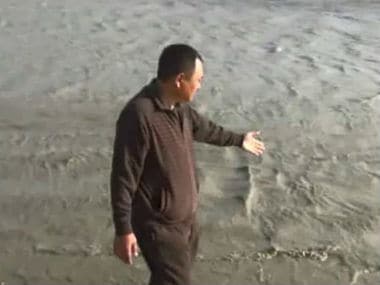
Muddy Siang river. Twitter @marli_kamki[/caption]The proposed tunnel, which would drop down from the world's highest plateau in multiple sections connected by waterfalls, would provide water in China's largest administrative division, comprising vast swathes of deserts and dry grasslands.
The move is expected to "turn Xinjiang into California", the report added. However, environmentalists have raised concerns about its likely impact on the Himalayan region.Brahmaputra waters have been a bone of contention between India and China for over a decade. The key issue between the two Asian giants has been Beijing's various dam projects on Yarlung Tsangpo: As it is called in Tibet.With China rising as a economic powerhouse, its energy requirements are increasing exponentially. China's dam building is seen as its attempt to harness the hydropower potential of the 2,800-long kilometre river.India is at a geographical disadvantage when it comes to the Brahmaputra. The river originates from the north—Tibetan Himalayas—and flows down southwards towards India and Bangladesh. Any dam building on the upstream can impact water flow to the these countries.
Since 2010, China has built five major dams over the Tsango in Tibet: Dagu, Jiacha, Jeixu and Zam, which is the largest hydropower plant built on Brahmaputra till date.In fact, in 2016, there were fears of China's dam building reducing water flows to India. According to a report in Hindustan Times, that year, China announced it was blocking one of the tributaries of the Brahmaputra to build the Lalho hydroelectric project in Xigase.The building of dams has also made monsoon flooding a real threat in the North East.A 2000 article in Rediff noted how floods wrecked havoc in North East India after additional water was released from a dam built on Tsangpo."More than 50,000 people in five districts of Arunachal Pradesh were left homeless by the floods in the past two weeks, while several parts of the state were still cut off from the rest of the country.The Arunachal Pradesh government had put the estimated loss at more than one billion rupees (22.9 million dollars)," Rediff reported.There is also a geo-political angle with China's Brahmaputra projects. According to a report in Economic Times, China believes that building a dam on the Brahmaputra helps it assert claim over Arunachal Pradesh. China claims that the disputed territory is "South Tibet".China also refused to share hydrological data with India during the two-month long military standoff at Doka La.
The data shared by upper riparian state, China, to lower riparian states, India and Bangladesh is essential every monsoon to allow anticipation of the flow of the water and take necessary measures to deal with flooding in India's northeastern states.However, China cited "upgradation" of research as the reason behind not revealing the hydrological data."For long time we have conducted cooperation on the river data with the Indian side. But to upgrade and renovate the relevant station in the Chinese side, we do not have the conditions now to collect the relevant statistics of the river," Chinese foreign ministry spokesman Geng Shuang told media in Beijing.With inputs from agencies
First Published:Nov 30, 2017, 14:19:18 IST
Advertisement
Advertisement

'From make in India to launch from India': Skyroot COO on why Vikram-1 could change India’s space sector
Skyroot Aerospace’s successful Vikram-1 mission marks a major milestone for India’s private space sector, as the country seeks to shift from “Make in India” to “Launch from India” and compete in the global commercial satellite launch market
8 min read
Choke terror funding, keep international shipping lanes safe: Jaishankar at Asean Regional Forum
Jaishankar's remarks came against the backdrop of recent terror attacks targeting India and growing threats to commercial shipping amid conflicts in West Asia and Europe
2 min read
PM Modi announces fast-track courts for paper leak cases; CJP responds ‘Dharmendra Pradhan must go’
Amid protests demanding accountability for the leak of medical entrance test Neet and other irregularities in the education system, Prime Minister Narendra Modi has announced that the government has decided to set up fast-track courts to ensure swift and stringent punishment for those involved in paper leaks.
3 min read
Sikkim tunnel collapse rescue resumes, death toll rises to 22
The death toll at the collapsed tunnel at Sikkim's Namchi district rose to 22 after nine more bodies were recovered overnight. At least 27 workers were trapped in a tunnel at an NHPC project after a sudden burst of suspected methane gas trapped within rock formations triggered an explosion.
2 min read
Delhi Police asks personnel to wear uniform: What the law says on cops in plainclothes during protests
The Delhi Police has instructed all its personnel to wear uniforms when they report for duty at Jantar Mantar for crowd control. This comes after outrage grew over videos of men in civilian clothes or without name tags hitting protesters in the Capital. Is it legal for the police to ditch uniforms during protests?
4 min read
Advertisement
Advertisement