


CAA protests: What the government must learn from India's mass movements against citizenship reforms
As India confronts the largest protest movements seen since Prime Minister Narendra Modi took office, it's important to understand the lessons of the past decades

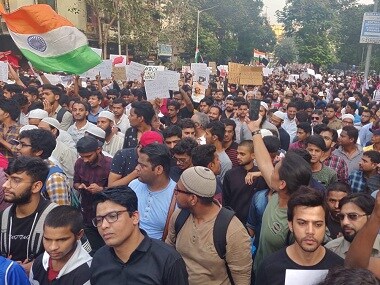
Protesters make their way to Mumbai's August Kranti Maidan on Thursday. Firstpost/Manasi Chandu[/caption]Left radical movements in the early 1970s, too, had little durable impact. The student Maoists of West Bengal were slaughtered — by the State, criminal vigilante organisations, and by the mainstream Left. Their successors have succeeded in carving out Red Corridor that runs, roughly, from Delhi's tony Nizamuddin on to Jawaharlal Nehru University — an empire of zero consequence, except in the imaginations of their Hindu-nationalist adversaries.Even the anti-Mandal Commission movement of the 1990s, despite the long procession of martyrs it generated, achieved little: The agonised yelps of élite families mattered little when pitted against the brutal logic of caste politics.But each of these movements were important signposts to new fissures in India’s civil society — fissures that would reshape the country, often among orgies of violence.Ever since the 1960s, when university education in India saw massive expansion, they have acted as petri dishes for the growth, and expansion, of the middle class. Long a preserve of élite, upper-caste families, universities began to see the entry of large numbers of the poor in the 1960s. These students came from social contexts that were provincial and inward-looking — but the university’s gates opened into a new world, governed by the values, mores and privileges of the élite.Liberal values — the rule of law, as opposed to communitarian entitlements and individual liberties — formed the core of this élite world. Irrespective of whether they are understood as such, liberal values have become more deeply embedded as India’s integration into the global capitalist order has deepened.Few Hindu-nationalist students, thus, share the aspirations of delusional reactionaries who claim air pollution is a Pakistani plot, or think traumatic brain injuries can be treated with mantras. Their chauvinism is a plea for status in world where their third-world homeland has little — not the rebellion of the khap panchayat against the nation-state.***Modi's rise has been built on two distinct pillars: One, a cohort seeking to roll back the great tide of change that has reshaped India this last century; the other seeking entry to the global order on equal terms. These two tendencies, it;s beginning to become apparent, cannot hold together.Except the ideological mind, there's no upside to the civic strife that's now been unleashed: The gains from the government's citizenship reforms are at best tenuous. Though the Government of India insists there are some 20 million foreigners, that number comes from arbitrary estimates made by state governments and the intelligence services. The Census of India, however, records that the population of Indians born outside the country fell from 6.2 million to 5.3 million between 2001 and 2011.Chinmay Tumbe, based on census statistics, has estimated that less than one percent s of Indian residents are immigrants — illegal or otherwise. The European Union, for example, has 38.2 million people born outside of a member State living there in 2017 — some 4.4 percent of the population. Forty million people living in the United States, about one in every fifth person, is an immigrant.Even the government admits it doesn’t intend to push identified illegal immigrants back to Bangladesh, for the excellent reason that there's no actual proof of their national origin. Foreigners Tribunals in Assam had identified 91,609 persons illegal immigrants until 31 March, 2018; a grand total of 128 were deported.The government's response to the protests it is facing isn't unique: Leaders of democratic nation-states, like the leaders of despotisms and like sheep, are quick to panic. The scholar Ram Guha's arrest in Bengaluru has depressingly wide global precedents. New Left icon Noam Chomsky, already author of the path-breaking Aspects of the Theory of Syntax and Cartesian Linguistics, was arrested in 1967 for marching on the Pentagon to protest the war in Vietnam — ending up sharing a cell with Norman Mailer.However, unwillingness to listen to criticism comes with costs. The failure to acknowledge the critique Chomsky, and others offered of Vietnam — this despite the government knowing full well that the war was unwinnable — sent 57,939 young Americans to their death.True believers might think we're laying the foundations for national integration: No Kashmiri, after all, will any longer feel lost in in cities were civic life is characterised by stone-throwing crowds, savage police violence and internet shutdowns.Everyone else is entitled to wonder where the sharp Right turn India's taken is leading them — especially young people, who have the longest distance to walk.

CJP protest in Delhi: New videos of stone pelting, violence emerge as police, agitators trade charges
'From make in India to launch from India': Skyroot COO on why Vikram-1 could change India’s space sector
Choke terror funding, keep international shipping lanes safe: Jaishankar at Asean Regional Forum
PM Modi announces fast-track courts for paper leak cases; CJP responds ‘Dharmendra Pradhan must go’
Sikkim tunnel collapse rescue resumes, death toll rises to 22