


By working through summer, Supreme Court is doing its bit to clear pendency: Govt must also chip in
In a break from tradition, most of India's Supreme Court will be working this summer with 19 of the 28 judges hearing cases over the summer.

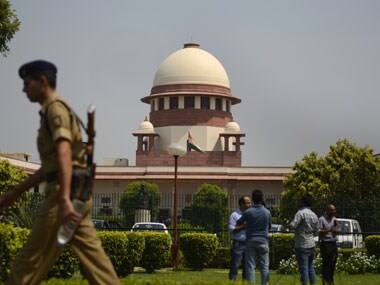
Representational image. AFP[/caption]This is welcome step by the Supreme Court in dealing with the backlog of cases. While there may be many advocates who would like to take advantage of court vacations to attend to other commitments (such as those in academia and research), there are many other advocates, especially those at the junior bar, who would like to carry on their work during their court holidays. But by allowing them the option of having their matters heard over the vacation, the Supreme Court has found a middle path between abolishing the vacation entirely and being accused of not doing enough to deal with the backlog.Further, this is also a way of dealing with the backlog of pending cases currently pending in the Supreme Court while the appointment of judges to the high court begins once more thanks to the the finalisation of the Memorandum of Procedure after an agreement was reached between the Collegium and the Central government earlier in March. As the vacancies in the high courts get filled, the pendency of cases in high court will begin to drop as their rates of disposal will increase. This may also mean much more work for the Supreme Court in the near future as it will have to deal with the appeals that arise from these final orders.So it is welcome that the Supreme Court is clearing its docket to ensure that there is room for the fresh appeals that will start coming in from the high courts. More importantly, the Supreme Court is suggesting increasing the number of judges on the Supreme Court and is instead focusing on efficient case management and listing in order to try and reduce the pendency of cases. As cases need to be managed more efficiently rather than the judges. The Supreme Court's rules in relation to the vacation benches have not been modified, so we do not know yet if the vacation benches hearing ordinary matters is going to be a one-off thing or an annual thing. But depending on the number of advocates who use the facility during the summer vacations and the number of matters disposed, we will only know how successful it is after July.Along with the judiciary working towards reducing the backlog, it is also incumbent on the government, which as this author pointed out in an earlier piece is the nation's largest litigant, to work towards reduction of the pendency.The government should examine if it can settle out of court a vast majority of the disputes it is currently litigating before the Supreme Court and the high court. If a majority of these matters can be disposed off vide consent terms or consent orders between the parties, the pendency can be resolved. Further, particularly in appeals that have been pending for a very long time, mediation and alternative dispute resolution can be encouraged to see if there can be a settlement between the parties in order to ensure that the court's time is restricted only to important matters to law. The Supreme Court presently is reduced to a court of appeal hearing ordinary appeals from high courts, instead of performing exclusively the important constitutional functions it was expected to.The government should also revisit legal provisions insofar as they relate to the levying of costs and the filing of frivolous litigation before the Supreme Court, so that parties cannot get away with filing frivolous appeals and matters and leaving them pending in the court's docket, nor can parties get away with taking adjournments without providing sufficient reasons. As of now, costs are rarely levied and when they are levied, costs are rarely based on actual costs incurred by the party, who suffers as a result of an adjournment or a frivolous appeal. Parties who fight cases before the apex court have to engage an advocate on record in Delhi and in most cases, have to brief a senior counsel for their matter. These parties suffer frivolous litigation because of India's liberal costs regime. This regime has the dual effect of also filling up court dockets with numerous cases that end up lying there for years.So while the Supreme Court is doing its bit to clear the judicial backlog in India, it's important that the government also does its bit. The judicial pendency cannot be cleared in a day and will require a coordinated effort of the bar, the bench and the litigants concerned.

'From make in India to launch from India': Skyroot COO on why Vikram-1 could change India’s space sector
Choke terror funding, keep international shipping lanes safe: Jaishankar at Asean Regional Forum
PM Modi announces fast-track courts for paper leak cases; CJP responds ‘Dharmendra Pradhan must go’
Sikkim tunnel collapse rescue resumes, death toll rises to 22
Delhi Police asks personnel to wear uniform: What the law says on cops in plainclothes during protests