


Ayodhya verdict today: Hindus indeed endangered, but only by their failure to fight for constitutional values
Ayodhya is back in the news because Uddhav Thackeray went there on 24 November.

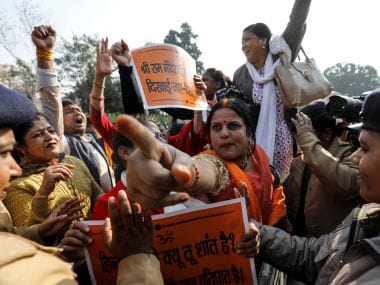
Representational image. Reuters[/caption]My memories of Ayodhya are inevitably centred around my own journey of faith. The steps going up to Hanuman Garhi, that I climbed often, the daily spectacle of ‘Anavarat Ramlila’ at the Tulsi Smarak Bhavan where I saw many groups perform, all represented moments of great joy. I walked among thousands in the chilly night-time November conditions, for the ‘parikrama’ or ‘paikarma’ as it is called by Ayodhya locals. This circumambulation of the holy sites of Ayodhya by pilgrims is an annual ritual that people complete in a 24-hour period, many walking all night long.Stumbling along village roads, resting on hay laid alongside the bank of a pond, I remember worrying about the absolute lack of facilities and transport. What if someone were to fall seriously ill during this walk? No doctors or ambulances were visible. The seva booths at various points looked unmanned and deserted. If this was a celebration of people’s faith, where were the practical amenities that would help sustain them during the ‘parikrama’? I had no answers then, as now, for many of the experiences I lived and observed in Ayodhya.It was my attachment to the place and its people that led me to write Portraits from Ayodhya: Living India’s Contradictions. I was trying to explore life beyond the headlines, and the months I spent listening to all 25 subjects featured in my book, as well as many other residents who offered comments and views gave me much to think about my faith, my people and my country.Today, Ayodhya is back in the news because Uddhav went there on 24 November and said he is attempting to wake the ‘Kumbhakarna’ or sleeping demon represented by the BJP governments at the Centre and Uttar Pradesh. It is making headlines because the Ram Mandir is being evoked in election campaigns in five different states, and a 221-metre statue of Lord Rama is being planned and promised on the banks of the Sarayu. It is awash, once more, across all TV channels as the site of competitive Hindutva.“Thackeray’s slogan of ‘pehle mandir phir sarkaar’ really clicked among the people and threw the RSS-BJP-VHP into a panic,” said Gaurav Tiwari, Ayodhya resident and Indian National Congress worker. “It was because of this panic that they hurriedly called a ‘dharma sabha’ at Ayodhya on 25 November. If they had allowed Thackeray to hog all the media attention, it would have been disastrous.”The panic in the prime minister and chief minister's camps could also have been because a local sadhu, Swami Paramhans Das, mahant of the Tapaswi Chhawni went on a fast-unto-death in October 2018 demanding that the Centre pass a law for construction of the Ram Mandir and that Prime Minister Narendra Modi visit Ayodhya and announce the date of its construction.After this, Pravin Togadia came to Ayodhya and announced that he would soon be launching a political party that would fight the Lok Sabha elections and build the Ram Mandir within three months of coming to power. Tiwari is sceptical about the 221-metre statue announced by Yogi Adityanath. “Where is the space for this on the banks of the Sarayu?” he asked. “It flows all the way to Ballia. Let them point to a place in Ayodhya where such a statue can be built, and then we can take it seriously,” he says.In the midst of all this grandstanding, life goes on in Ayodhya. “As far as development goes, nothing has changed since Nagar Nigam Ayodhya became the governing municipal corporation for both Faizabad and Ayodhya towns nearly a year ago. If anything, things are going downhill, and the monkey menace has become very severe,” said write and poet RD Anand.He was voicing such concerns to me because I spent a year trying to campaign for mini-sanctuaries for monkeys in Ayodhya and Faizabad towns. He also pointed out an important facet of life for many of us post-2014. “There is disquiet in many hearts about the renaming of Faizabad as Ayodhya. But people have been divided so much into ever-narrowing notions of identity that conversation on these matters has been frozen even among family members and friends. How can any popular resistance be organised against any of these measures without unity?”His words brought home what Ayodhya represents for me most of all. I see it as the failure to oppose what is manifestly ugly and harmful to us all. More than two decades after trained youth pulled down the Babri Masjid and threw our Republic into turmoil, we have failed, as Indian citizens and believing Hindus in protesting what takes place in the name of ‘faith’ around us today. If we are unable to say out loud that today’s protectors of the cow are destroyers of our faith, then indeed, Hindu khatre mein hain.

Choke terror funding, keep international shipping lanes safe: Jaishankar at Asean Regional Forum
PM Modi announces fast-track courts for paper leak cases; CJP responds ‘Dharmendra Pradhan must go’
Sikkim tunnel collapse rescue resumes, death toll rises to 22
Delhi Police asks personnel to wear uniform: What the law says on cops in plainclothes during protests
No premium queues, 30-minute target: What changes for Indian passport applicants in UAE