
Advertisement


Sections
Avalanches, Indian Army’s big enemy: What it does to protect our soliders
Bodies of seven Indian Army soldiers were found two days after they went missing in Arunachal Pradesh's Kameng sector. The area had been witnessing heavy snowfall for the last few days

On Tuesday, the Indian Army confirmed that seven of its troops, who went missing after their patrol was struck by an avalanche in Arunachal Pradesh’s Kameng sector, were found dead.According to news agency ANI, the army retrieved their bodies from the avalanche site.As the country mourns the loss of the seven personnel, it also brings back focus on avalanches are a big problem for the Indian Army in terms of not only causing casualties, but also damage to important tactical defences along the Line of Control.Yesterday’s incidentOn 6 February, seven army personnel went missing after a patrol team was hit by an avalanche in Kameng sector of Arunachal Pradesh.According to PTI, the area located at an altitude of 14,500 feet had been witnessing inclement weather with heavy snowfall for the last few days.Sang Thinley, officer-in-charge of Dirang police station, had earlier said the incident happened along the Line of Actual Control {LAC} on Sunday."Seven army personnel of 19 JAK Rifles have been reportedly stuck by an avalanche in the area near Mammy Hut. Following the incident, army officials had reported the incident at Jang police station. The area is very remote and all roads have been blocked due to snowfall," Thinley was quoted as saying by ANI.The Indian Army continued its search-and-rescue operations for the missing personnel continuously. But their efforts went in vain when the bodies of the seven were retrieved.Following the news of their demise, President Ram Nath Kovind, Vice President Venkaiah Naidu, Prime Minister Narendra Modi, Army chief General MM Naravane, Defence Minister Rajnath Singh and Union minister and Arunachal Pradesh MP Kiren Rijiju among others shared their grief over the loss of the lives.Avalanches, a concern for Indian ArmyAvalanches are a major concern for the troops posted at high-altitude areas in Arunachal Pradesh and Jammu and Kashmir.On 3 February, 2016, an avalanche hit a military base in northern Siachen Glacier region, trapping 10 soldiers under deep snow. Lance Naik Hanumanthappa was rescued after being trapped for six days beneath the snow. The nation prayed for Lance Naik Hanumanthappa's recovery. However, the valiant soldier's battle for life came to an end on 11 February. He succumbed to multiple organ failure.In 2019, four Indian Army soldiers and two porters died after an avalanche struck on the Siachen glacier. Rescue teams managed to pull all the men out. But, they died of hypothermia later in hospital.In November 2020, another soldier died after an avalanche hit an Army post in Kupwara district of Jammu and Kashmir. The avalanche had hit the Army post near the Line of Control (LoC) at Roshan Post in Tangdhar area of north Kashmir's Kupwara district.In fact, Defence Minister Rajnath Singh in 2019 had said in Parliament there were 18 Army casualties because of avalanches in 2016, while in 2017, the number of deaths were 30. There were six deaths in 2018. In 2019, the Indian Army had suffered 20 casualties owing to avalanches.During winters, avalanches occur when the fresh layer of snow does not merge with the bottom harder layer of ice and snow. The heavy winds and steep gradients in the mountains then trigger the avalanche, pushing the upper layer down.The Indian Army soldiers are trained to work in snow-bound areas with avalanches being one of the biggest challenges faced by the men along the LoC.Explaining how avalanches pose a problem other than the issue of claiming lives, an official in an Economic Times report said that these avalanches also cause damage to posts. "If the avalanches are big then several of our equipment and rations get buried under the snow. At that moment, there is no time to save them and even completely protect ourselves. After the avalanche is over, we have to quickly dig out any equipment that can be found. But this is difficult, because the temperature quickly freezes the snow and makes it hard. There is also the risk of an immediate second avalanche. That is why several of our equipment lost in avalanches are found during summers when the snow melts.”The avalanches also block important routes to the posts.[caption id="attachment_10360301" align="alignnone" width="640"]![File image of an Indian Army truck on the Srinagar-Leh highway in Zojila, Srinagar. AFP]() File image of an Indian Army truck on the Srinagar-Leh highway in Zojila, Srinagar. AFP[/caption]How Army is tackling this issueRealising the difficulties avalanches cause, the Indian Army has methods and uses new, innovative technology to mitigate the damage.The Indian Army has the Snow and Avalanche Study Establishment {SASE}, which monitors the weather conditions in the avalanche-prone areas of Jammu and Kashmir. A laboratory of the Defence Research & Development Organisation, its primary aim is to research and provide avalanche control measures and forecasting support to Indian Armed Forces.Also, troops in high-altitude areas are trained to carry out movement during the night, as avalanches are usually caused by accumulated fresh snow and are common during the day.Troops forced to venture out during the day are trained to react suitably in the advent of a disaster. A soldier is coached on ways to take off his equipment and swim in the direction of an avalanche.Another official, in The Print, said that the Indian Army had an avalanche lookout man who keeps a watch on tell-tale signs of a possible disaster.There's also the ‘avalanche mitigation walls’, avalanche detection devices and ‘winter route markers’. An avalanche mitigation wall is made of stone and is about five feet high. It is placed in layers around a post and takes the impact of an oncoming avalanche.Markers are poles planted along the route of a post for troops to attach themselves to it using ropes while climbing up, so that when an avalanche hits them they can be easily found by the rescue team.There are also snow fences and snow nets, which are designed to stabilise the layer of snow at the potential avalanche initiation zone.The Indian Army also provides its troops with modern gadgets such as victim detectors and ricoh reflectors. There are also plans to introduce the avalanche bag system {ABS} that inflates like a balloon and ensures a soldier wearing it can “float” over the avalanche.With inputs from agenciesRead all the Latest News, Trending News, Cricket News, Bollywood News,India News and Entertainment News here. Follow us on Facebook, Twitter and Instagram.
File image of an Indian Army truck on the Srinagar-Leh highway in Zojila, Srinagar. AFP[/caption]How Army is tackling this issueRealising the difficulties avalanches cause, the Indian Army has methods and uses new, innovative technology to mitigate the damage.The Indian Army has the Snow and Avalanche Study Establishment {SASE}, which monitors the weather conditions in the avalanche-prone areas of Jammu and Kashmir. A laboratory of the Defence Research & Development Organisation, its primary aim is to research and provide avalanche control measures and forecasting support to Indian Armed Forces.Also, troops in high-altitude areas are trained to carry out movement during the night, as avalanches are usually caused by accumulated fresh snow and are common during the day.Troops forced to venture out during the day are trained to react suitably in the advent of a disaster. A soldier is coached on ways to take off his equipment and swim in the direction of an avalanche.Another official, in The Print, said that the Indian Army had an avalanche lookout man who keeps a watch on tell-tale signs of a possible disaster.There's also the ‘avalanche mitigation walls’, avalanche detection devices and ‘winter route markers’. An avalanche mitigation wall is made of stone and is about five feet high. It is placed in layers around a post and takes the impact of an oncoming avalanche.Markers are poles planted along the route of a post for troops to attach themselves to it using ropes while climbing up, so that when an avalanche hits them they can be easily found by the rescue team.There are also snow fences and snow nets, which are designed to stabilise the layer of snow at the potential avalanche initiation zone.The Indian Army also provides its troops with modern gadgets such as victim detectors and ricoh reflectors. There are also plans to introduce the avalanche bag system {ABS} that inflates like a balloon and ensures a soldier wearing it can “float” over the avalanche.With inputs from agenciesRead all the Latest News, Trending News, Cricket News, Bollywood News,India News and Entertainment News here. Follow us on Facebook, Twitter and Instagram.
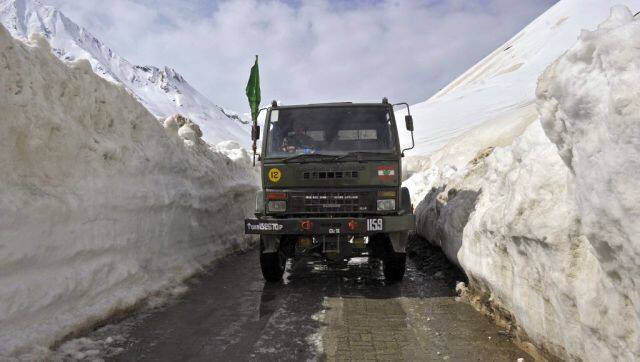 File image of an Indian Army truck on the Srinagar-Leh highway in Zojila, Srinagar. AFP[/caption]How Army is tackling this issueRealising the difficulties avalanches cause, the Indian Army has methods and uses new, innovative technology to mitigate the damage.The Indian Army has the Snow and Avalanche Study Establishment {SASE}, which monitors the weather conditions in the avalanche-prone areas of Jammu and Kashmir. A laboratory of the Defence Research & Development Organisation, its primary aim is to research and provide avalanche control measures and forecasting support to Indian Armed Forces.Also, troops in high-altitude areas are trained to carry out movement during the night, as avalanches are usually caused by accumulated fresh snow and are common during the day.Troops forced to venture out during the day are trained to react suitably in the advent of a disaster. A soldier is coached on ways to take off his equipment and swim in the direction of an avalanche.Another official, in The Print, said that the Indian Army had an avalanche lookout man who keeps a watch on tell-tale signs of a possible disaster.There's also the ‘avalanche mitigation walls’, avalanche detection devices and ‘winter route markers’. An avalanche mitigation wall is made of stone and is about five feet high. It is placed in layers around a post and takes the impact of an oncoming avalanche.Markers are poles planted along the route of a post for troops to attach themselves to it using ropes while climbing up, so that when an avalanche hits them they can be easily found by the rescue team.There are also snow fences and snow nets, which are designed to stabilise the layer of snow at the potential avalanche initiation zone.The Indian Army also provides its troops with modern gadgets such as victim detectors and ricoh reflectors. There are also plans to introduce the avalanche bag system {ABS} that inflates like a balloon and ensures a soldier wearing it can “float” over the avalanche.With inputs from agenciesRead all the Latest News, Trending News, Cricket News, Bollywood News,India News and Entertainment News here. Follow us on Facebook, Twitter and Instagram.
First Published:Feb 09, 2022, 12:10:54 IST
Advertisement
Advertisement

Govt to set up fast-track courts for swift punishment in paper leak cases, says PM Modi amid CJP protests
Amid protests demanding accountability for the leak of medical entrance test Neet and other irregularities in the education system, Prime Minister Narendra Modi has announced that the government has decided to set up fast-track courts to ensure swift and stringent punishment for those involved in paper leaks.
3 min read
Sikkim tunnel collapse rescue resumes, death toll rises to 22
The death toll at the collapsed tunnel at Sikkim's Namchi district rose to 22 after nine more bodies were recovered overnight. At least 27 workers were trapped in a tunnel at an NHPC project after a sudden burst of suspected methane gas trapped within rock formations triggered an explosion.
2 min read
Delhi Police asks personnel to wear uniform: What the law says on cops in plainclothes during protests
The Delhi Police has instructed all its personnel to wear uniforms when they report for duty at Jantar Mantar for crowd control. This comes after outrage grew over videos of men in civilian clothes or without name tags hitting protesters in the Capital. Is it legal for the police to ditch uniforms during protests?
4 min read
No premium queues, 30-minute target: What changes for Indian passport applicants in UAE
Indian passport applicants in the UAE can now access passport, visa and attestation services through Alhind’s 16 centres, with no premium queues, a Dh19 service fee and a target of completing applications within 30 minutes
4 min read
CJP Protest in Delhi Live Updates: PM Modi announces fast-track courts for NEET paper leak cases
CJP Protest in Delhi Live Updates: Heavy security has been deployed at the Jantar Mantar in Delhi, where the Cockroach Janta Party (CJP) is continuing its protest demanding the resignation of Union Education Minister Dharmendra Pradhan over the recent paper leaks controversy
1 min read
Advertisement
Advertisement