


Coronavirus Outbreak: Invisibility of circular migrants in host states is at the heart of their exodus from urban centres
Since the start of the coronavirus crisis, many issues have begun to emerge from their dormant existence and unfold dramatically to capture the public's mind

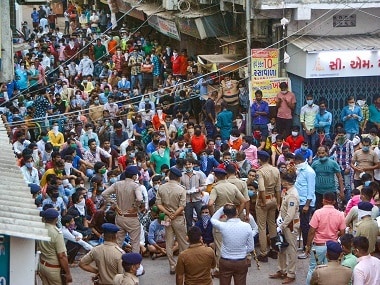
Cops in Surat stop migrant workers gathered in large numbers demanding to return to their villages. PTI[/caption]The city pays them back in kind for their ingratitude. Everything from housing to employment gets delivered through a rickety arrangement of informality without the state playing any role. Housing, for instance, is a densely packed makeshift arrangement that is either built on an encroached land or built without approvals and that incentivises the non-state actors with rent-seeking behaviour. Employment is a daily wage agreement that is sans checks and balances on the employer by the state. Access to utilities is either absent or sub-contracted via non-state actors. The battle to survive one day at a time compels them to view urban living from the prism of a 24-hour window.To put it differently, there is hardly any direct contact between the circular migrant and the state in the city. Whenever circular migrants do cross paths with the state, they do so for the wrong reasons: Anti-encroachment drives, anti-hawking drives, sealing drives etc. Consequently, circular migrants erect a shield of anonymity to the extent that they are almost invisible to the state. They don't expect anything from the state and the state is happy to oblige for its lack of capacity to do so in the first place over other priorities. They fall within the cracks of the urban-rural divide for all purposes of governance. They are the invisible citizens and the visible enjoy the fruit of their existence on convenience and affordability, provided the invisible remain invisible.The issue of circular migration has simmered for decades in India so much so that today over 100 million people in Urban India (a total population of 350 to 400 million urban Indians) live in informal housing, which is a close proxy to circular migrants in the city. Delhi-NCR alone accounts of nearly 40 percent of the people who live in informal housing. The state, to date, has responded with simplistic tools like regularisation of informal colonies without effecting structural changes, anti-encroachment drives and slum redevelopment programs that lack capacity, while informal living has grown unabated.The decision migrants took to walk back home rather than to stay within the confines of their homes needs to be understood in this backdrop. If they can barely recall an instance of a relationship with the state on trust and care, how can they now take the state at face value when it tells them to stay locked inside their homes and that everything will be taken care of? Similarly, the state is not obligated towards their invisible existence in the city and never misses a chance to reinforce their invisibility.Therefore, the state's failure to proactively account for them in the times of crisis management is more for its indifference towards them and less for any nefarious intentions. This mutually exclusive existence of migrants and the state then exposes its vulnerabilities to hearsay and snowballs into herd behaviour that was witnessed a few days ago.For the uninitiated, the instinct of the circular migrant to defy lockdown orders and march home will be seen as an act of defiance, but for the migrant it is a response borne out of her/his defence mechanism whenever s/he comes face-to-face with the state in the city.The dormancy of inaction over decades on matters that concern circular migrants was a simmering issue threatening to explode during this crisis, and did. COVID-19 will force governments the world over to change the order of things. When it comes to India, the task at hand will be to reassign the order of priorities. It will serve the government well to assign urgency to the issues of urban poor on housing, food and employment.Affordable housing approach to promote formal rental living and industrial hostels instead of house-as-asset, urban planning approach to design cities with an inclusive mindset, employment practices that increase the safety net of informal workforce, state capacity towards food and nutrition delivery are effective solutions. To do so, the urban development approach will need to change its view on affordable housing from an asset-based thinking to rental living housing models that can offer clean and safe living environment at a scale needed in Indian cities.Between living out the lockdown period in cramped and suffocating illegal ghettos without going insane and defying restriction orders to start the walk back home, for the migrant it was an easy choice to make. In the demand for formal rental housing solutions, look no further than the city of Mumbai. It was dotted with the chawl system for the working class during the city's industrialisation period. The demand is for such a chawl system to be modified to contemporary times in Indian cities for a better outcome, both in times of peace and of crisis.Structural limitation of slums and illegal ghettos to access food and essential supply also becomes a real challenge in the time of crisis. For the migrants, the delivery system for food and essentials is at the mercy of private and largely informal retailing models that are themselves vulnerable. Barely a handful of circular migrants make the cut to access the PDS system in their host cities. It is this inability to access food that played more on the minds of migrants than the cramped spaces in which they live when they decided to defy orders and start the walk back home.State-supervised or state-enabled systems to supply food essentials and cooked meals through canteens and establishments (that are clean and prolific to ensure last-mile connectivity with these migrants) should become an essential capability of the state for better functioning cities. This is not a subsided model but a self-sustaining functional solution that is needed at scale. Such a system can then be supervised for its efficacy to deliver nutrition and can be suitably modified in times of crisis such as this for a rapid response.It is the lack of such a capability that creates a wide chasm between the state's intent to supply food and its ability to do so. It will also not be a tall order to imagine plugging such a food delivery system with proposed system of contemporary chawls that are erected as formal housing communities for these migrants across the city. If for instance, Delhi had such a functional chawl system that was formal and well plugged with a working system of food and nutrition supply to such clusters, the call for confinement to homes would have worked just as well as it did in other parts of the city.When the next pandemic crisis strikes, whether or not our circular migrant friends will stay put inside their homes when asked to do so will depend upon the Indian State's approach to their access to housing and food in the city.The author is senior vice-president, Technopak Advisors

Stroke in young adults, silent symptoms and late diagnosis: India's growing brain health challenge
Brain tumours aren't always fatal, but delayed diagnosis can be: Experts explain the key warning signs
Spices, health and the Indian plate: Why chilli can be good for you—but moderation is still key
Organ donation: 5 myths you need to stop believing, according to a transplant specialist
Fish over meat: Why a pescatarian diet may help people with obesity live longer