


Avatar-style 3D mapping of patients for treatments planned
Doctors are taking the first steps towards a Google Earth style map of the human body.

London: Doctors in the UK are looking to build 3D computer 'avatars' of patients to 'test' treatments before prescribing, a step that can revolutionise medical science.Doctors are taking the first steps towards a Google Earth style map of the human body, scientists said today. A digital 3D replica of a patient would be created using their medical data to give an overall picture of their health.The 3D computer 'avatar' would then allow doctors to test how different treatments would work on that person's body. The detailed simulation would warn of unwanted side-effects before they happen.[caption id="attachment_239015" align="alignleft" width="380" caption="Representative image. Doctors are taking the first steps towards a Google Earth style map of the human body. Reuters"]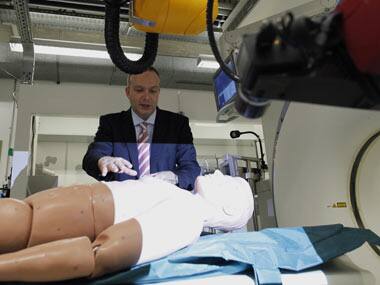 [/caption]Doctors are already piloting a model of a cerebral aneurysm which could assist clinicians in predicting how likely rupture would be and if treatment is necessary, the Daily Mail reported.Professor Alejandro Frangi of Sheffield University said, "There is a lot of data about us in the healthcare system, but it is fragmented. I think the modelling framework gives us a mechanism; I like to see it as Google Earth, putting all ofthese different layers of information together."The technological advance could also help predict the likelihood of bone fractures in patients with osteoporosis by producing a musculo-skeletal model from bone density data."By developing models of complete organ systems, such as the cardiovascular system, we can help clinicians predict whether treating a constriction in one coronary artery, for example, might improve or worsen blood supply in othercoronary arteries in patients with multiple lesions," Professor Frangi said."Because it's currently impossible to make these kinds of predictions, clinicians are often forced to deal with one issue at a time in diseases that are in fact multifactorial or systemic," he added.The system could be in place in the next 20 years, according to the Institute for Biomedical Imaging and Modelling (known as INSIGNEO), which has been set up by the University of Sheffield and the Sheffield Teaching HospitalsNHS Foundation Trust.PTI

BCCI earned more than Rs 2,400 crore in IPL 2022, reveal documents
Eight Russian judokas barred from world championships after Ukraine boycott
Old video of Donald Trump listening to Taylor Swift’s ‘Blank Space’ takes over internet; watch
SA20: Ex-New Zealand all-rounder Jacob Oram appointed MI Cape Town bowling coach
FIFA World Cup: Morgan Freeman, Jung Kook headline day one before Ecuador defeats hosts Qatar