


Why does PoK have its own Constitution, PM if Pakistan controls it?
Pakistan-occupied Kashmir (PoK) is once again in the spotlight. The region, which is witnessing protests, has its own president, prime minister, legislative Assembly, judicial system and police force, even though it is under Islamabad’s control. But why is this?

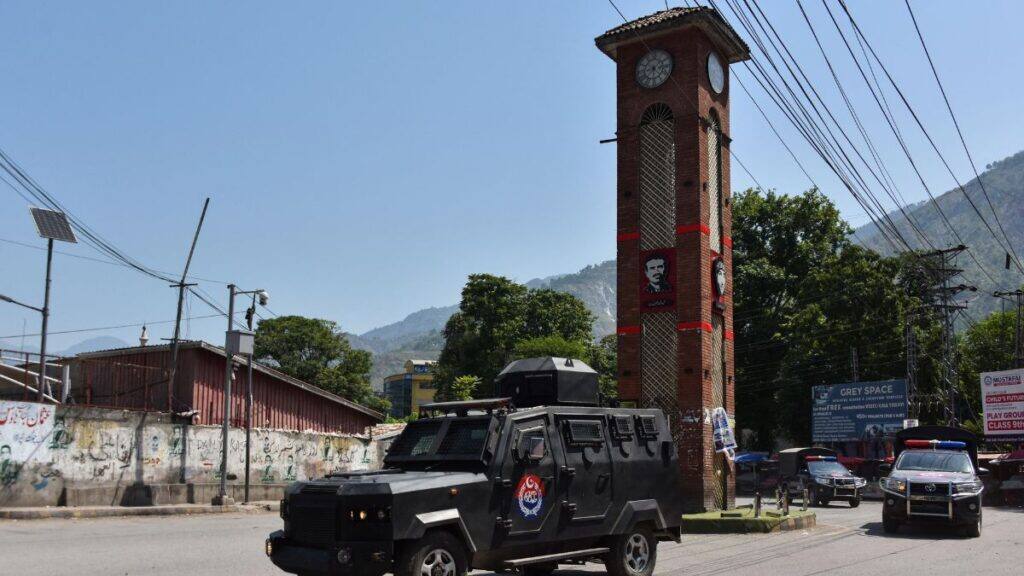
Pakistan’s brutal crackdown on protesters in Pakistan-occupied Kashmir (PoK) has left at least 11 people dead and hundreds of others injured. Authorities have slapped sedition charges and announced a Rs 1 crore bounty on four leaders of the now-banned Joint Awami Action Committee (JAAC), which had called for a march toward Muzaffarabad on June 9.
The unrest has put the spotlight on the territory illegally occupied by Pakistan. PoK has its own Prime Minister, President, Legislative Assembly, Constitution and flag, even though it is controlled by Islamabad and Rawalpindi.
But why? We take a look.
How PoK came to be
Pakistan-occupied Kashmir is a 13,297 sq km area ruled directly by Islamabad. In 1947, Pakistan illegally occupied certain parts of the erstwhile princely state of Jammu and Kashmir. These are referred to as PoK by India and "Azad Jammu and Kashmir" by Pakistan.
 More from Explainers
In October of 1947, Pakistan-backed Pashtun tribesmen invaded Kashmir. The 14-month hostility marked the first war between India and Pakistan. During the partition in August that year, Maharaja Hari Singh, the Hindu ruler of Muslim-majority Kashmir, had decided Kashmir would not accede to either India or Pakistan.
However, as the invaders made inroads in Kashmir, Singh signed the Instrument of Accession to India on October 26. A day later, Indian troops arrived in Srinagar. The Pakistani Army also formally entered the battlefield, leading to the conflict that lasted for over a year.
A ceasefire between India and Pakistan was declared on the night of December 31, 1948. As the ceasefire line was enforced from January 1, 1949, about 13,297 sq km area of Kashmir remained under the control of Pakistani forces, as per Indian Express.
This occupied region is divided into two parts: the so-called “Azad Jammu and Kashmir” or AJK and Gilgit Baltistan (GB), which comprises 86 per cent of the total area of PoK.
India maintains that PoK and GB are part of the state of Jammu and Kashmir on account of the Union Territory’s accession to India in 1947.
PoK has its own Constitution, PM & more
PoK is administered through the 1974 Interim Constitution Act.
The so-called Azad Jammu and Kashmir Interim Constitution Act of 1974 and Pakistan’s Constitution Act, 1974, define the power-sharing between Islamabad and PoK.
It allows PoK to have its own President, Prime Minister, Legislative Assembly, judicial system and police force.
Sub-section II of Section VII of the Interim Act states that “No person or political party in Azad Jammu and Kashmir shall be permitted to propagate against, or take part in activities prejudicial or detrimental to, the ideology of the State’s accession to Pakistan.”
The 1949 Karachi Agreement gives Pakistan control over PoK’s defence, foreign affairs and publicity and representation abroad.
For decades, Islamabad exerted considerable influence over governance in PoK through the Kashmir Council, headed by Pakistan’s prime minister. The powers of the council were significantly reduced in 2018.
Analysts often argued that this arrangement shows that ultimate authority over PoK lies with Pakistan and not Muzaffarabad.
Why Pakistan maintains farce of ‘autonomous’ PoK
Islamabad rules PoK and Gilgit Baltistan. However, it continues to maintain the farce that they are “autonomous territories”. This is because including them in Pakistan’s map would damage its global position that the entire Jammu and Kashmir is “disputed”.
Islamabad has used this "autonomous" or self-rule claim to keep its control and dominance over PoK's political and economic affairs under wraps, as per India Today.
Pakistan has four provinces — Punjab, Sindh, Khyber Pakhtunkhwa and Balochistan. However, it has not included PoK as a province to back its long-standing claim that Kashmir is a disputed territory.
"Pakistan perceives that if it had declared Gilgit Baltistan, PoK or both, which are only a part of the territories of J&K, as legitimate provinces of Pakistan, it would weaken its case for the entire J&K and lead to legal complications," Lt Gen Syed Ata Hasnain wrote in a piece in Rediff in 2020.
But public representatives like politicians and judges in PoK have to endorse it as Pakistan's territory. They have to take a mandatory oath expressing support for Kashmir's accession to Pakistan. With this, Pakistan effectively bans alternative political views from entering the mainstream in PoK.
In May 2016, several political parties in PoK had demanded to scrap the laws that require candidates contesting elections to sign an affidavit of allegiance to the “ideology of the state’s accession to Pakistan”.
The latest protests in PoK were called by JAAC to protest against the reservation of 12 seats for refugees in the July 27 elections to PoK’s Legislative Assembly. These seats are contested by candidates who do not live in PoK but in Pakistan.
With inputs from agencies
Tags

The Great Covid Fraud: How Indian-origin couple in UK funded lavish lifestyle through fake PPE orders
Fake jobs, tourist visas: Inside Russia’s vast network luring foreigners to fight Ukraine war
Why has Bangladesh’s choice of India spokespersons raised eyebrows?
Who is Sandeep Lamba, the Delhi cop removed from protest site duty after slapping female protester?
Explorers discover wreckage of plane 72 years later. Will this help in finding MH370?