


Explained: How the Maldives and other nations might vanish as oceans rise
If warming trends continue, the oceans could rise by nearly one additional metre around the Pacific and the Indian Ocean islands by the end of the century. Five nations – the Maldives, Tuvalu, the Marshall Islands, Nauru and Kiribati – may become uninhabitable

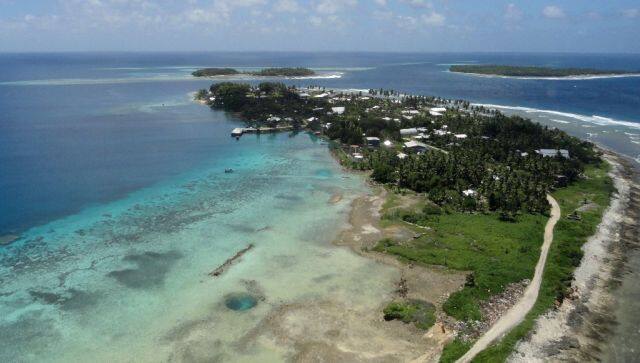
If the five nations become uninhabitable, they will create 600,000 stateless climate refugees. AFP[/caption]The ‘Rising Nations’ initiative That is the idea behind the “Rising Nations” initiative launched in September by several Pacific governments: “convince members of the UN to recognise our nation, even if we are submerged under water because that is our identity,” the prime minister of Tuvalu, Kausea Natano, explained to AFP.Some people are already thinking about how these Nation-States 2.0 might work.“You could have land somewhere, people somewhere else, and government in the third place,” Kamal Amakrane, managing director of the Global Centre for Climate Mobility at Columbia University, told AFP.This would first require a “political declaration” by the UN, then a “treaty” between the threatened state and a “host state,” ready to receive the government in exile in a kind of permanent embassy. The population, which might be in that state or even a different one, would then have dual nationality.Amakrane, a former UN official, also draws attention to an ambiguity in the Montevideo Convention: “When you speak about territory, is it dry or wet territory?”Floating cities of the future With 33 islands scattered over 3.5 million square kilometres (1.3 million square miles) in the Pacific, Kiribati, tiny in terms of land area, has one of the largest exclusive economic zones (EEZs) in the world.If this maritime sovereignty were preserved, then a state would not disappear, some experts say.While some islets are already being engulfed as shorelines recede, freezing the EEZs would preserve access to vital resources.In an August 2021 declaration, the members of the Pacific Islands Forum, including Australia and New Zealand, proclaimed that their maritime zones “shall continue to apply, without reduction, notwithstanding any physical changes connected to climate change-related sea level rise”.But even with rising ocean levels, some would simply not consider leaving their threatened country.“Human beings are so ingenious, they will find floating ways... to live exactly in this location,” says Nasheed, the Maldives’ former leader, suggesting people could resort to floating cities.Also read: Why are scientists sounding fresh alarms on ‘doomsday glacier’ Thwaites?How these states would find resources for such projects is unclear. The question of financing the “loss and damage” caused by the impacts of global warming will be a burning issue at COP27 in Egypt in November.Even as experts like Amakrane defend “the right to remain” for people who don’t want to leave their heritage, he adds, “You always need to have a plan B.”In this vein, he has called for launching “as soon as possible” a “political” process to preserve the future of uninhabitable states, “because it gives hope to people”.Otherwise, he warns, the current state of uncertainty “creates bitterness and disarray, and with that, you kill a nation, a people”.

The Great Covid Fraud: How Indian-origin couple in UK funded lavish lifestyle through fake PPE orders
Fake jobs, tourist visas: Inside Russia’s vast network luring foreigners to fight Ukraine war
Why has Bangladesh’s choice of India spokespersons raised eyebrows?
Who is Sandeep Lamba, the Delhi cop removed from protest site duty after slapping female protester?
Explorers discover wreckage of plane 72 years later. Will this help in finding MH370?