
Advertisement


Sections
Has Earth’s water come from asteroids? Here’s what Japan’s Hayabusa-2 probe found
After scrutinising material that was brought to earth from an asteroid named Ryugu by Japanese space probe Hayabusa-2, scientists are saying water may have come to our planet from the outer edges of the solar system

How did the Earth become this big, blue planet?Humans have been pondering that question for ages.Now, scientists are saying water – which is so essential to human life – may have been brought to Earth by asteroids from the outer edges of the solar system.This, after examining rare samples collected on a six-year Japanese space mission.Studies on the material are beginning to be published, and in June, one group of researchers said they had found organic material which showed that some of the building blocks of life on Earth, amino acids, may have been formed in space.Researchers are scrutinising material brought back to Earth in 2020 from the asteroid Ryugu by Japanese space probe Hayabusa-2.Let’s take a closer look at what the study suggests:The missionHayabusa-2 was launched in 2014 on its mission to Ryugu, around 300 million kilometres away.The Hayabusa-2, around the size of a refrigerator landed on the diamond-shaped asteroid Ryugu, which means "dragon palace" in Japanese, as per Phys.org.The probe collected the material – 5.4 grams (0.2 ounces) of rocks and dust – by firing an "impactor" into its surface.It returned to Earth's orbit two years ago to drop off a capsule containing the sample.CBS news reported that when the capsule descended to Earth in 2020, it put on a spectacular spectacle above the Australian outback, racing across the sky as a bright fireball.As per Indian Express, Hayabasu2’s predecessor, the Hayabusa mission, brought back samples from the asteroid Itokawa in 2010.What does the study say?In a new paper published in the journal Nature Astronomy, scientists said the Ryugu samples could give clues to the mystery of how oceans appeared on Earth billions of years ago."Volatile and organic-rich C-type asteroids may have been one of the main sources of Earth's water," said the study by scientists from Japan and other countries, published Monday."The delivery of volatiles (that is, organics and water) to the Earth is still a subject of notable debate," it said.![samples of surface dust and pristine material collected from the asteroid Ryugu by the Hayabusa-2 space probe. AFP]() samples of surface dust and pristine material collected from the asteroid Ryugu by the Hayabusa-2 space probe. AFP[/caption]“Proving amino acids exist in the subsurface of asteroids increases the likelihood that the compounds arrived on Earth from space. It also means amino acids can likely be found on other planets and natural satellites, hinting that life could have been born in more places in the universe than previously thought,” Kobayashi added.As per Kyodo News, while the composition of particles collected from Ryugu closely matches water on Earth, the study notes there were slight differences.That has led scientists to hypothesise that our planet’s water might have also originated from places other than asteroids, as reported by Kyodo News.“In a broad sense, it is possible that small celestial bodies brought things that led to water and life on Earth,” Motoo Ito, a senior researcher of geomaterials science at the Japan Agency for Marine-Earth Science and Technology was quoted as saying by the agency.In the Nature Astronomy study, the researchers again hailed the findings made possible by the mission."Ryugu particles are undoubtedly among the most uncontaminated Solar System materials available for laboratory study and ongoing investigations of these precious samples will certainly expand our understanding of early Solar System processes," the study said.As per CBS, the NASA OSIRIS-REx mission collected a sample from another near-Earth asteroid — Bennu, which is similar to Ryugu.The sample will return to Earth in 2023.With inputs from agenciesRead all the Latest News, Trending News, Cricket News, Bollywood News,India News and Entertainment News here. Follow us on Facebook, Twitter and Instagram.
samples of surface dust and pristine material collected from the asteroid Ryugu by the Hayabusa-2 space probe. AFP[/caption]“Proving amino acids exist in the subsurface of asteroids increases the likelihood that the compounds arrived on Earth from space. It also means amino acids can likely be found on other planets and natural satellites, hinting that life could have been born in more places in the universe than previously thought,” Kobayashi added.As per Kyodo News, while the composition of particles collected from Ryugu closely matches water on Earth, the study notes there were slight differences.That has led scientists to hypothesise that our planet’s water might have also originated from places other than asteroids, as reported by Kyodo News.“In a broad sense, it is possible that small celestial bodies brought things that led to water and life on Earth,” Motoo Ito, a senior researcher of geomaterials science at the Japan Agency for Marine-Earth Science and Technology was quoted as saying by the agency.In the Nature Astronomy study, the researchers again hailed the findings made possible by the mission."Ryugu particles are undoubtedly among the most uncontaminated Solar System materials available for laboratory study and ongoing investigations of these precious samples will certainly expand our understanding of early Solar System processes," the study said.As per CBS, the NASA OSIRIS-REx mission collected a sample from another near-Earth asteroid — Bennu, which is similar to Ryugu.The sample will return to Earth in 2023.With inputs from agenciesRead all the Latest News, Trending News, Cricket News, Bollywood News,India News and Entertainment News here. Follow us on Facebook, Twitter and Instagram.
But the organic materials found "in Ryugu particles, identified in this study, probably represent one important source of volatiles".The scientists hypothesised that such material probably has an "outer Solar System origin", but said it was "unlikely to be the only source of volatiles delivered to the early Earth".As per Indiatimes, the samples contained 20 distinct types of amino acids, a key component for all living things, which scientists don’t quite understand came to the Earth.Indiatimes quoted Kensei Kobayashi, professor emeritus of astrobiology at Yokohama National University as saying that the fact that amino acids were found on an extra-terrestrial body hints at life outside Earth.[caption id="attachment_11076701" align="alignnone" width="640"]
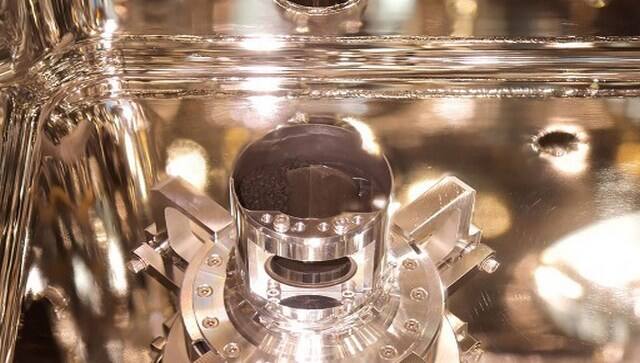 samples of surface dust and pristine material collected from the asteroid Ryugu by the Hayabusa-2 space probe. AFP[/caption]“Proving amino acids exist in the subsurface of asteroids increases the likelihood that the compounds arrived on Earth from space. It also means amino acids can likely be found on other planets and natural satellites, hinting that life could have been born in more places in the universe than previously thought,” Kobayashi added.As per Kyodo News, while the composition of particles collected from Ryugu closely matches water on Earth, the study notes there were slight differences.That has led scientists to hypothesise that our planet’s water might have also originated from places other than asteroids, as reported by Kyodo News.“In a broad sense, it is possible that small celestial bodies brought things that led to water and life on Earth,” Motoo Ito, a senior researcher of geomaterials science at the Japan Agency for Marine-Earth Science and Technology was quoted as saying by the agency.In the Nature Astronomy study, the researchers again hailed the findings made possible by the mission."Ryugu particles are undoubtedly among the most uncontaminated Solar System materials available for laboratory study and ongoing investigations of these precious samples will certainly expand our understanding of early Solar System processes," the study said.As per CBS, the NASA OSIRIS-REx mission collected a sample from another near-Earth asteroid — Bennu, which is similar to Ryugu.The sample will return to Earth in 2023.With inputs from agenciesRead all the Latest News, Trending News, Cricket News, Bollywood News,India News and Entertainment News here. Follow us on Facebook, Twitter and Instagram.
First Published:Aug 18, 2022, 17:53:57 IST
Advertisement
Advertisement

The Great Covid Fraud: How Indian-origin couple in UK funded lavish lifestyle through fake PPE orders
Indian-origin couple Jogesh Bhandari and his wife Meenakashi Bhandari have bee convicted of carrying out a personal protective equipment (PPE) scam alongside associate Craig Morris in the United Kingdom. The investigation found bank records showing Bhandari and his wife used the money to purchase Rolex watches, jewellery, holiday packages and luxury cars
3 min read
Fake jobs, tourist visas: Inside Russia’s vast network luring foreigners to fight Ukraine war
Russia is accused of using fake job offers, tourist visas and lucrative military contracts to recruit thousands of foreign nationals for the Ukraine war. Investigations reveal how poverty, deception and coercion have drawn people from Asia, Africa and Latin America into one of the world's deadliest conflicts
8 min read
Why has Bangladesh’s choice of India spokespersons raised eyebrows?
Bangladesh’s appointment of journalists Md Saidur Rahman and Umme Marufa to media roles in New Delhi and Kolkata has triggered controversy over their past anti-India social media posts, many of which were later deleted, prompting diplomatic scrutiny as India and Bangladesh seek to improve bilateral ties
6 min read
Who is Sandeep Lamba, the Delhi cop removed from protest site duty after slapping female protester?
Sandeep Lamba, an Additional Deputy Commissioner of Police (DCP) (North East District), was seen slapping a female CJP protester in a video on July 20. Lamba has now been removed from the protest site and sent back to his original station. In 2021, Lamba was awarded the Union Home Minister’s medal for excellent investigation
4 min read
Explorers discover wreckage of plane 72 years later. Will this help in finding MH370?
On April 11, 1952, a Pan Am Flight 526A, crashed into the Atlantic Ocean, killing 52 of the 69 people on board. After decades of effort, explorers have found the wreck of the plane at the bottom of the seabed near Puerto Rico. The discovery offers new hope to families who lost loved ones in the Malaysia Airlines Flight 370 crash in 2014
5 min read
Advertisement
Advertisement