


Will a drone attack on UAE’s Barakah nuclear plant cause Iran war to escalate?
A fire broke out on the perimeter of the Barakah nuclear energy plant in the United Arab Emirates after the site came under a drone attack. While there have been no injuries or damage, it marks an important escalation amid the Iran war. This power plant, the first of its kind in the Arab world, produces a quarter of the Emirates’ energy

Is the Iran-US war on the verge of a new regional escalation?
On Sunday (May 17), a drone attack sparked a fire on the perimeter of the Barakah Nuclear Energy Plant in the United Arab Emirates (UAE), amid a very fragile truce between the two warring nations.
UAE’s neighbours, Qatar and Saudi Arabia, along with India, have condemned the attack, calling it a “dangerous escalation”.
- Catch the latest updates on the US-Iran war here
What happened at the nuclear power plant? Why is this attack dangerous?
Drone strike at UAE’s Barakah nuclear plant
On Sunday (May 17), authorities in the UAE declared a blaze had broken out at an electrical generator outside the Barakah Nuclear Energy Plant after a drone strike.
In a statement, the UAE’s defence ministry said air defences had dealt “successfully” with two drones, while a third one hit a generator near the plant. It added that the drones were launched from the “western border”, without providing details, and said investigations were underway to determine the source of the attack.
 More from Explainers
As of now, the UAE has not publicly blamed any country. However, ever since the start of the US-Iran war on February 28, the UAE has come under repeated Iranian missile and drone attacks.
Anwar Gargash, an Emirati presidential adviser, made clear that he believed Iran or a regional proxy were the perpetrators. “The terrorist targeting of the Barakah clean nuclear power plant, whether carried out by the principal perpetrator or through one of its agents, represents a dangerous escalation,” Gargash wrote on X. He called the incident “a dark scene that violates all international laws and norms”, and accused those responsible of having a disregard for civilian lives.
The drone strike at the Barakah nuclear plant, fortunately, didn’t cause any fatalities or injuries. Moreover, officials said radiation levels remained normal. The Federal Authority for Nuclear Regulation (FANR) said the incident did not affect “the safety of the power plant or the readiness of its essential systems” and confirmed that all units at the Barakah facility were operating normally.
After the attack on Sunday, the UAE stated it “will not tolerate any threat to its security and sovereignty under any circumstances” and reserves its “full, sovereign, legitimate, diplomatic and military rights” to respond to any threats or hostile acts in accordance with international law.
Significance of the Barakah nuclear plant
This is the first time that the four-reactor Barakah plant has been targeted in the war since it began on February 28.
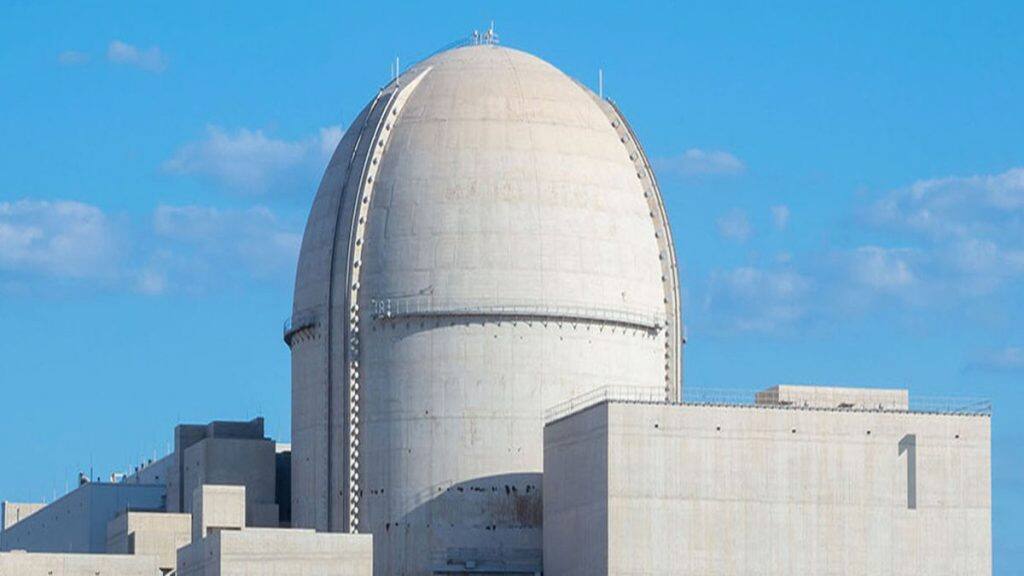
It is situated near the border with Saudi Arabia, some 225 kilometres west of the UAE’s capital city, Abu Dhabi.
The Barakah nuclear plant was built with South Korean assistance at a cost of around $20 billion and became fully operational in 2021. What makes Barakah especially important to the UAE is that it is the first nuclear power plant of the Arab world. Moreover, it supplies roughly 25 per cent of the UAE’s electricity needs, making it crucial for the country’s energy security.
For the UAE, the Barakah nuclear power plant is also vital for its climate strategy and its target of achieving net-zero emissions by 2050. It was built to reduce dependence on natural gas, diversify the economy beyond hydrocarbons, and provide stable long-term electricity as energy demand rises.
Global condemnation pours in after drone strike on Barakah
The drone attack at the nuclear power plant invited condemnation from across the world. The International Atomic Energy Agency (IAEA) chief Rafael Grossi expressed “grave concern” and warned that military activity threatening nuclear facilities was “unacceptable”.
Meanwhile, Qatar and Saudi Arabia have condemned Sunday’s attack, adding that it was a threat to the security and stability of the whole region.
India too condemned the attack on the nuclear plant in the UAE. In a statement, the Ministry of External Affairs said it was “deeply concerned” about the strike on the UAE’s nuclear facility. “India is deeply concerned about the attack targeting the Barakah nuclear facility in the UAE. Such actions are unacceptable and represent a dangerous escalation. We urgently call for restraint and a return to dialogue and diplomacy.”
India’s reaction to the drone strike on Barakah reflects the close ties between New Delhi and Abu Dhabi. As News18 reports, it is linked to an evolving India-UAE partnership in civilian nuclear energy and advanced infrastructure cooperation.
US-Iran war drags on with no peace in sight
The drone strike on the nuclear power plant comes amid a very fragile ceasefire between the US and Iran, which was first announced on April 8. However, sporadic exchanges of fire have continued.
On Saturday, US President Donald Trump met with top members of his national security team to discuss the way forward in the Iran war. And a day later, on Sunday, the American leader noted that Tehran “better get moving, fast, or there won’t be anything left of them.”
“For Iran, the Clock is ticking, and they better get moving fast, or there won’t be anything left of them. TIME IS OF THE ESSENCE! President DJT,” Trump posted on social media Sunday.
The US president has grown increasingly impatient with Tehran and the continued closure of the Strait of Hormuz and its impact on global oil prices. And in an attempt to get Iran to the negotiating table, Trump flooded his Truth Social platform with AI-generated images of missile strikes on Iranian boats, outer space warfare, and an American flag over Iran.
Among the 20-odd images that he posted, one showed a map of Iran with an American flag overlaid on it, while arrows pointed towards the Islamic republic from all sides.
Another image featured a US drone striking Iranian fast boats alongside the caption: “BYE BYE, Fast boats”.
We shall wait and watch to see if Trump resumes combat operations against Iran. For now, there remains an unease.
With inputs from agencies

The Great Covid Fraud: How Indian-origin couple in UK funded lavish lifestyle through fake PPE orders
Fake jobs, tourist visas: Inside Russia’s vast network luring foreigners to fight Ukraine war
Why has Bangladesh’s choice of India spokespersons raised eyebrows?
Who is Sandeep Lamba, the Delhi cop removed from protest site duty after slapping female protester?
Explorers discover wreckage of plane 72 years later. Will this help in finding MH370?