



Why Rahul Gandhi’s Rs 72,000 per annum minimum income promise is a blunder in the making
Minimum income guarantee promise will most likely shift attention from the more serious unemployment problem.

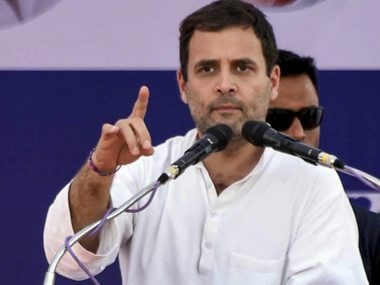
File image of Congress president Rahul Gandhi. PTI[/caption]Particularly for the Indian economy, this won’t be a constructive exercise as the fiscal burden is set to go up while there won’t be major contribution in terms of output that will come only through job creation and getting real economic activities back on track. Instead, such schemes will hand over begging bowls to the poor and make them wait for it every year, whereas little focus will be given on skill development.Worse, appeasement of the poor through freebies coming at a time when the country is in the grip of a serious unemployment problem. Minimum income guarantee promise will most likely shift attention from the more serious unemployment problem.Even in January, job creation fell by 6.91 percent to 11.23 lakh as compared to 12.06 lakh during the same period last year, according to payroll data of the Employees State Insurance Corporation (ESIC) released on Monday, PTI reported.During September 2017 to January 2019, about 2.08 crore new subscribers joined the ESIC scheme, the data showed. The unemployment level,according to an official report by the National Sample Survey Office (NSSO), which is yet to be accepted by the government, touched a 46-year high in 2018.A sharp surge in demand for Mahatma Gandhi National Rural Employment Guarantee Act (MNREGA) jobs is a big evidence that more people are getting out of organised factory jobs. Government data showed that in 2018-19, the demand for work under MNREGA increased by almost 10 percent compared with the previous year and also registered the highest number of person-days of work under the scheme since 2010-11, an Indian Express report said.Till now, there is no road map either from the ruling party or the Opposition on how to deal with the unemployment problem, except more and more announcements on state-sponsored farm loan waivers and minimum income promises. Millions of educated fresh job seekers are finding it difficult to get quality jobs, forcing many of them to compete even for the last grade jobs.Farm loan waivers already punched a big hole in the finances of government and banks thus weakening the economy. Minimum income guarantee schemes will be the next. A back of the envelop calculation shows that the total burden of Gandhi’s minimum income promise will be Rs 3.6 lakh crore. That’s 1.7 percent of the country’s Gross Domestic Product (GDP). We are talking about an economy that has breached the fiscal deficit target for three consecutive years and is struggling to mop up revenues to keep its balance sheet healthy.Any minimum guarantee programme such as the one announced by Gandhi will have enormous implications on the fiscal front. Gandhi’s comment re-emphasises that Indian politicians give far greater weightage to freebies and will go to any extent to win votes by totally undermining good economics. The idea seems to be throwing free money to all. The strategy Gandhi is now relying on is the United Progressive Alliance's (UPA) old trick of pushing social welfare schemes to win votes.When politicians vie to become socialist champions, there is no end to competition. By making the minimum income promise, Gandhi has attempted to outdo Modi’s scheme to win votes. Naturally, Modi will have to beat the Gandhi freebie scheme with a bigger one.In effect, multiple versions of vote-seeking socialist schemes are to be expected once politicians get a taste of success using this tool. On the implementation front, Gandhi’s scheme will face huge challenges as deciding the 20 percent bracket will be a tough job since there is no reliable and updated income data available. How will the 20 percent deserving poor be counted and the legitimacy of their claim decided is a big question at every level of the implementation.
MNREGA, a product of the UPA, has worked well to an extent to provide relief to the rural India.But, that will not be the case with the minimum income promise. Just like Modi government’s Rs 6,000 free income assurance to farmers, Gandhi’s minimum income promise is not going to help the poor in any significant manner.India already has nearly 950 centrally-sponsored schemes. These schemes target the economically weak in each area and assist them through state funding. It is nearly impossible and unwise to go back from this targeted approach and fix minimum income to all because then the purpose of addressing specific problems is lost.The first is about empowering needy with targeted assistance and the second about destroying the incentive to work and excel, not looking at specific segments of economically distressed. Most of this money, inevitably, will go to fulfil unproductive consumption needs, as is the case with Kisan Credit Card loans. On the other hand, chances of the benefit going to the undeserving is also high as fudging income documents aren’t difficult at the local level. This scheme will, thus, open up new avenues of corruption and can even boomerang on Gandhi’s party.(Data support by Kishor Kadam)

Google burns cash for first time as AI spending pushes 2026 capex to $205 billion
Tesla sells more cars but makes less money: Why Musk’s AI pivot is squeezing profits
No premium queues, 30-minute target: What changes for Indian passport applicants in UAE
Bharat Forge, Flying Whales sign pact to develop 60-tonne airships for India’s defence logistics
Air India to cut Delhi-Toronto flight time by 3 hours, resume non-stop services from August 1