
Advertisement
Co Presented By
Co Presented By


Sections
Subramanian Swamy says only people with solid grounding in macroeconomics can revive economy
Subramanian Swamy has come out with a book in which he takes a critical look at various aspects of the Indian economy, both past and present

New Delhi: BJP MP Subramanian Swamy, who has often criticised the government's economic policies, believes only people with solid grounding in macroeconomics can pull the economy out of its current tailspin.He is of the opinion that the “government today needs a crisis management team of experienced politicians and professional but politically-savvy economists who are rooted in Indian ethos and not compliant to institutions like the IMF and the World Bank”.[caption id="attachment_5130991" align="alignleft" width="380"]![File image of BJP leader Subramanian Swamy. PTI]() File image of BJP leader Subramanian Swamy. PTI[/caption]Swamy has come out with a book in which he takes a critical look at various aspects of the Indian economy, both past and present.“Today, the economy suffers from clueless economic stewardship, cloaked in spin, and media management, while the economy is debilitated by serious multiple structural flaws that make this current slowdown unlike any other we have experienced in India since 1947,” he writes in Reset: Regaining India's Economic Legacy.He also believes that many members of government subcommittees have no formal training in quantitative economic logic to be applied in a macroeconomic framework like recognising components of the crisis, identifying optimum measures and enthusing stakeholders.
File image of BJP leader Subramanian Swamy. PTI[/caption]Swamy has come out with a book in which he takes a critical look at various aspects of the Indian economy, both past and present.“Today, the economy suffers from clueless economic stewardship, cloaked in spin, and media management, while the economy is debilitated by serious multiple structural flaws that make this current slowdown unlike any other we have experienced in India since 1947,” he writes in Reset: Regaining India's Economic Legacy.He also believes that many members of government subcommittees have no formal training in quantitative economic logic to be applied in a macroeconomic framework like recognising components of the crisis, identifying optimum measures and enthusing stakeholders.
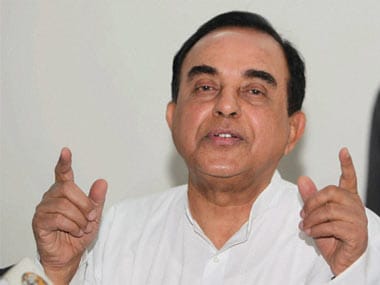 File image of BJP leader Subramanian Swamy. PTI[/caption]Swamy has come out with a book in which he takes a critical look at various aspects of the Indian economy, both past and present.“Today, the economy suffers from clueless economic stewardship, cloaked in spin, and media management, while the economy is debilitated by serious multiple structural flaws that make this current slowdown unlike any other we have experienced in India since 1947,” he writes in Reset: Regaining India's Economic Legacy.He also believes that many members of government subcommittees have no formal training in quantitative economic logic to be applied in a macroeconomic framework like recognising components of the crisis, identifying optimum measures and enthusing stakeholders.
Does the Modi government 2.0 have contingency prescriptions ready? Swamy says it “does not seem so as of now. The solid grounding in macroeconomics is essential…”He is also of the opinion that the slowing of inflation “cannot be celebrated as an achievement in the absence of robust demand signals and weak purchasing power among the masses. It is a form of deflation”.However, Swamy is hopeful India will come out successful, as it has in all crises in the past 72 years and suggests that the situation should be dealt with squarely by means of reforms that incentivise the people.In the book, the author uses a period of 150 years from 1870 to 2019 to “focus not so much on the historical narrative of India's economic development or the lack of it but on distilling out the consequences of the economic ideology adopted in three main phases” - British imperialism (1870-1947), period when the Soviet command economy model took root (1950-1990), and the period 1991-2019.He blames the government's “fascination for foreign investment since 2008” for the economy “worsening to a fluctuating but declining trend”.He is critical of the UPA governments (2004-2014) saying it “saw some of the most senior ministers committing gigantic corruption”.“Manmohan Singh, though an accomplished economist, remained a marginal figure of no consequence in his own government, and accidentally a prime minister,” he writes in the book, published by Rupa.
Comparing Modi with his predecessor Singh, Swamy says, “He is the exact opposite of Singh. He is not the person of letters, and one who has an unstudied familiarity with microeconomics but not macroeconomics and its intricacies of inter-sectoral economic dynamics,” he writes.But, Swamy says that Modi has immense appeal with the masses and hard-working middle class, and thus the mandate to carry out major reforms.He rues Modi has to depend on people who “never tell him the bitter truth about the economy or explain the macroeconomics or that he needs to figure the way out of a crisis”.
First Published:Sep 15, 2019, 16:30:11 IST
Advertisement
Advertisement

Bharat Forge, Flying Whales sign pact to develop 60-tonne airships for India’s defence logistics
Bharat Forge has signed an MoU with Flying Whales to jointly develop and manufacture 60-tonne heavy-lift airships in India for defence logistics, strategic mobility and disaster response
3 min read
Air India to cut Delhi-Toronto flight time by 3 hours, resume non-stop services from August 1
Air India will resume non-stop Delhi-Toronto flights from August 1, cutting travel time by nearly three hours and deploying its new Boeing 787-9 Dreamliner on the route
2 min read
South Korea economy grows faster than expected in Q2 as chip exports power recovery
South Korea’s economy grew 0.6% in the second quarter, beating expectations as strong semiconductor exports offset weakness in construction investment and domestic demand
2 min read
India remains among fastest-growing major economies despite global uncertainty, says RBI Bulletin
RBI says industrial and services activity stayed resilient through June, while strong trade, stable external sector and improving foreign investment continue to support economic growth.
1 min read
Iran war could cut global growth by more than half: World Bank’s chief economist Indermit Gill
Prolonged US-Iran conflict could fuel inflation, push up borrowing costs and deepen debt distress across developing economies, says Indermit Gill
2 min read
Advertisement
Advertisement