
Advertisement
Co Presented By
Co Presented By


Sections
Subhash Chandra Garg’s exit and Bimal Jalan report: Did dissent on surplus transfer trigger top official’s ouster from FinMin?
The ECF is one issue, but Garg has spearheaded too many controversial battles for the Finance Ministry with the RBI.

What will Subhash Chandra Garg’s abrupt exit from government mean for Bimal Jalan report on Reserve Bank of India’s capital surplus transfer to the government? Garg seeking voluntary retirement from service has left many surprised. Especially because the decision to resign from the government service came after he was transferred to the Power Ministry. For Garg, Power Ministry is a demotion from the economic affairs. Also, note that Garg’s exit happens shortly after his reported dissent note on the Bimal Jalal Committee report on Reserve Bank of India's (RBI) economic capital framework (ECF).The Jalan panel, which was formed in December 2018 on ECF, is yet to table its report. The committee was formed as a consensus solution after a long, public fight between the RBI and the government on the issue of RBI’s capital surplus transfer to the government. Jalan panel's recommendations will be crucial to settle the debate on RBI's surplus transfer to the government.Garg was instrumental in mooting the idea of tapping excess funds from the banking regulator. With Garg’s exit, the question arises whether the Jalan panel will have to rework its report seeking fresh inputs from the Finance Ministry.The ECF is one issue, but Garg has spearheaded too many controversial battles for the Finance Ministry with the RBI. This includes the Finance Ministry’s endless battle with Urjit Patel’s RBI on a range of issues including public sector bank (PSB) dual regulation, RBI’s governance and so on.[caption id="attachment_7057111" align="alignleft" width="380"]![File image of Subhash Chandra Garg. Pic courtesy: PIB]() File image of Subhash Chandra Garg. Pic courtesy: PIB[/caption]The RBI-government tussle intensified post-former deputy governor Viral Acharya’s public outburst and after reports speculated that the government threatened to invoke Section 7 of the RBI Act to overrule the central bank on controversial decisions. Garg had played a crucial role in defending the government’s interests.Garg is a 1983 batch IAS officer of the Rajasthan cadre and has been working as the secretary in Department of Economic Affairs since June 2017. Garg came to the Centre in 2014 and was appointed as the executive director in the World Bank where he stayed till 2017, when he was appointed the DEA secretary in June 2017.In March 2019, he was elevated as the finance secretary following the retirement of A N Jha. It is understood that Garg has played a key role in preparing the latest Union Budget presented by the country's first full-time Finance Minister, Nirmala Sitharaman.There is no clarity on what exactly is the crux of the Jalan panel report on the RBI’s surplus transfer. But according to a report, the panel might recommend RBI’s capital surplus transfer to the government over a period of 3-5 years. However, there are also reports that suggested Garg—a member of the panel—apparently dissented with this decision and insisted on a lumpsum transfer.There was another proposal in the Budget that said market regulator Securities and Exchange Board of India (SEBI) should constitute a reserve fund, and 25 percent of the annual surplus of the general fund should be credited to this reserve fund. After meeting all expenditures, the SEBI should transfer 75 percent of the surplus amount to the Consolidated Fund of India, according to the Budget proposal, it said.It is no secret in Delhi’s power corridors that Garg played a major role in stepping up the demand for the share in capital reserves from the regulators to the government and his proposals weren’t often welcomed by the RBI and SEBI. Garg’s exit once again puts limelight on the surplus transfer debate.
File image of Subhash Chandra Garg. Pic courtesy: PIB[/caption]The RBI-government tussle intensified post-former deputy governor Viral Acharya’s public outburst and after reports speculated that the government threatened to invoke Section 7 of the RBI Act to overrule the central bank on controversial decisions. Garg had played a crucial role in defending the government’s interests.Garg is a 1983 batch IAS officer of the Rajasthan cadre and has been working as the secretary in Department of Economic Affairs since June 2017. Garg came to the Centre in 2014 and was appointed as the executive director in the World Bank where he stayed till 2017, when he was appointed the DEA secretary in June 2017.In March 2019, he was elevated as the finance secretary following the retirement of A N Jha. It is understood that Garg has played a key role in preparing the latest Union Budget presented by the country's first full-time Finance Minister, Nirmala Sitharaman.There is no clarity on what exactly is the crux of the Jalan panel report on the RBI’s surplus transfer. But according to a report, the panel might recommend RBI’s capital surplus transfer to the government over a period of 3-5 years. However, there are also reports that suggested Garg—a member of the panel—apparently dissented with this decision and insisted on a lumpsum transfer.There was another proposal in the Budget that said market regulator Securities and Exchange Board of India (SEBI) should constitute a reserve fund, and 25 percent of the annual surplus of the general fund should be credited to this reserve fund. After meeting all expenditures, the SEBI should transfer 75 percent of the surplus amount to the Consolidated Fund of India, according to the Budget proposal, it said.It is no secret in Delhi’s power corridors that Garg played a major role in stepping up the demand for the share in capital reserves from the regulators to the government and his proposals weren’t often welcomed by the RBI and SEBI. Garg’s exit once again puts limelight on the surplus transfer debate.
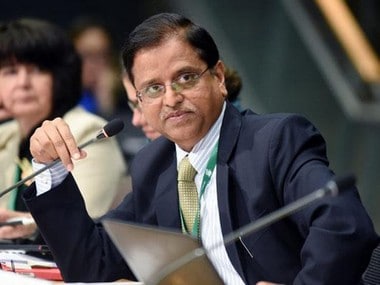 File image of Subhash Chandra Garg. Pic courtesy: PIB[/caption]The RBI-government tussle intensified post-former deputy governor Viral Acharya’s public outburst and after reports speculated that the government threatened to invoke Section 7 of the RBI Act to overrule the central bank on controversial decisions. Garg had played a crucial role in defending the government’s interests.Garg is a 1983 batch IAS officer of the Rajasthan cadre and has been working as the secretary in Department of Economic Affairs since June 2017. Garg came to the Centre in 2014 and was appointed as the executive director in the World Bank where he stayed till 2017, when he was appointed the DEA secretary in June 2017.In March 2019, he was elevated as the finance secretary following the retirement of A N Jha. It is understood that Garg has played a key role in preparing the latest Union Budget presented by the country's first full-time Finance Minister, Nirmala Sitharaman.There is no clarity on what exactly is the crux of the Jalan panel report on the RBI’s surplus transfer. But according to a report, the panel might recommend RBI’s capital surplus transfer to the government over a period of 3-5 years. However, there are also reports that suggested Garg—a member of the panel—apparently dissented with this decision and insisted on a lumpsum transfer.There was another proposal in the Budget that said market regulator Securities and Exchange Board of India (SEBI) should constitute a reserve fund, and 25 percent of the annual surplus of the general fund should be credited to this reserve fund. After meeting all expenditures, the SEBI should transfer 75 percent of the surplus amount to the Consolidated Fund of India, according to the Budget proposal, it said.It is no secret in Delhi’s power corridors that Garg played a major role in stepping up the demand for the share in capital reserves from the regulators to the government and his proposals weren’t often welcomed by the RBI and SEBI. Garg’s exit once again puts limelight on the surplus transfer debate.
First Published:Jul 25, 2019, 18:47:12 IST
Advertisement
Advertisement

Google burns cash for first time as AI spending pushes 2026 capex to $205 billion
Google parent Alphabet reported negative free cash flow of $5.9 billion in the second quarter for the first time since going public, as surging AI infrastructure spending pushed its 2026 capital expenditure forecast to as much as $205 billion
6 min read
Tesla sells more cars but makes less money: Why Musk’s AI pivot is squeezing profits
Tesla’s record Q2 deliveries failed to translate into higher profits as price cuts, falling regulatory-credit revenue and Elon Musk’s aggressive AI spending squeezed margins and pushed the EV maker into negative free cash flow
5 min read
No premium queues, 30-minute target: What changes for Indian passport applicants in UAE
Indian passport applicants in the UAE can now access passport, visa and attestation services through Alhind’s 16 centres, with no premium queues, a Dh19 service fee and a target of completing applications within 30 minutes
4 min read
Bharat Forge, Flying Whales sign pact to develop 60-tonne airships for India’s defence logistics
Bharat Forge has signed an MoU with Flying Whales to jointly develop and manufacture 60-tonne heavy-lift airships in India for defence logistics, strategic mobility and disaster response
3 min read
Air India to cut Delhi-Toronto flight time by 3 hours, resume non-stop services from August 1
Air India will resume non-stop Delhi-Toronto flights from August 1, cutting travel time by nearly three hours and deploying its new Boeing 787-9 Dreamliner on the route
2 min read
Advertisement
Advertisement